
引言
Kraft paper box packaging is widely used for takeaway meals, bakery products, sushi, salads, snacks, and other prepared foods. It gives food businesses a natural paper appearance, good printability, and a range of practical box formats.
However, the word “kraft” does not tell you everything about a package. Many food boxes use paperboard rather than thin kraft paper. They may also include a grease-resistant coating, a plastic liner, a clear window, an adhesive, or a separate plastic lid. These components affect heat resistance, leak performance, food-contact compliance, and recycling.
This guide explains how kraft paper food boxes work, where they fit, what their limits are, and what buyers should check before placing a wholesale order. For a broader comparison with PP, PET, bagasse, aluminum, and other 食品包装材料之一, start with the material guide.
What Is Kraft Paper Box Packaging?
Kraft paper is made from wood pulp using the kraft process. The material is known for its strength and its familiar brown appearance, although it can also be bleached, printed, laminated, or converted into thicker paperboard.
In food packaging, “kraft paper box” is a broad commercial term. It can describe:
- Folding takeaway cartons
- Paperboard meal boxes with lids
- Kraft paper bowls and tubs
- Bakery and cake boxes
- Sushi trays with clear PET lids
- Windowed boxes for sandwiches, salads, and baked goods
The paper provides the main structure. A coating or liner may provide resistance to oil, moisture, or sauces. A separate lid can improve visibility and closure. Because the finished package may contain more than one material, buyers should review the complete construction rather than judging it by the brown exterior alone.
Common Types of Kraft Paper Food Containers
Kraft food packaging comes in many shapes. The best format depends on the food, portion, temperature, display requirement, and delivery method.
Takeaway and meal boxes
Folding takeaway boxes are used for rice dishes, pasta, fried foods, sandwiches, and prepared meals. Some have integrated flaps. Others use a separate lid. A good takeaway box should close consistently, resist grease, and remain stable when stacked or carried.
For foods with several components, buyers may also compare kraft formats with compartmented 便当盒. The choice depends on whether the meal needs separation, clear presentation, reheating, or stronger leak control.

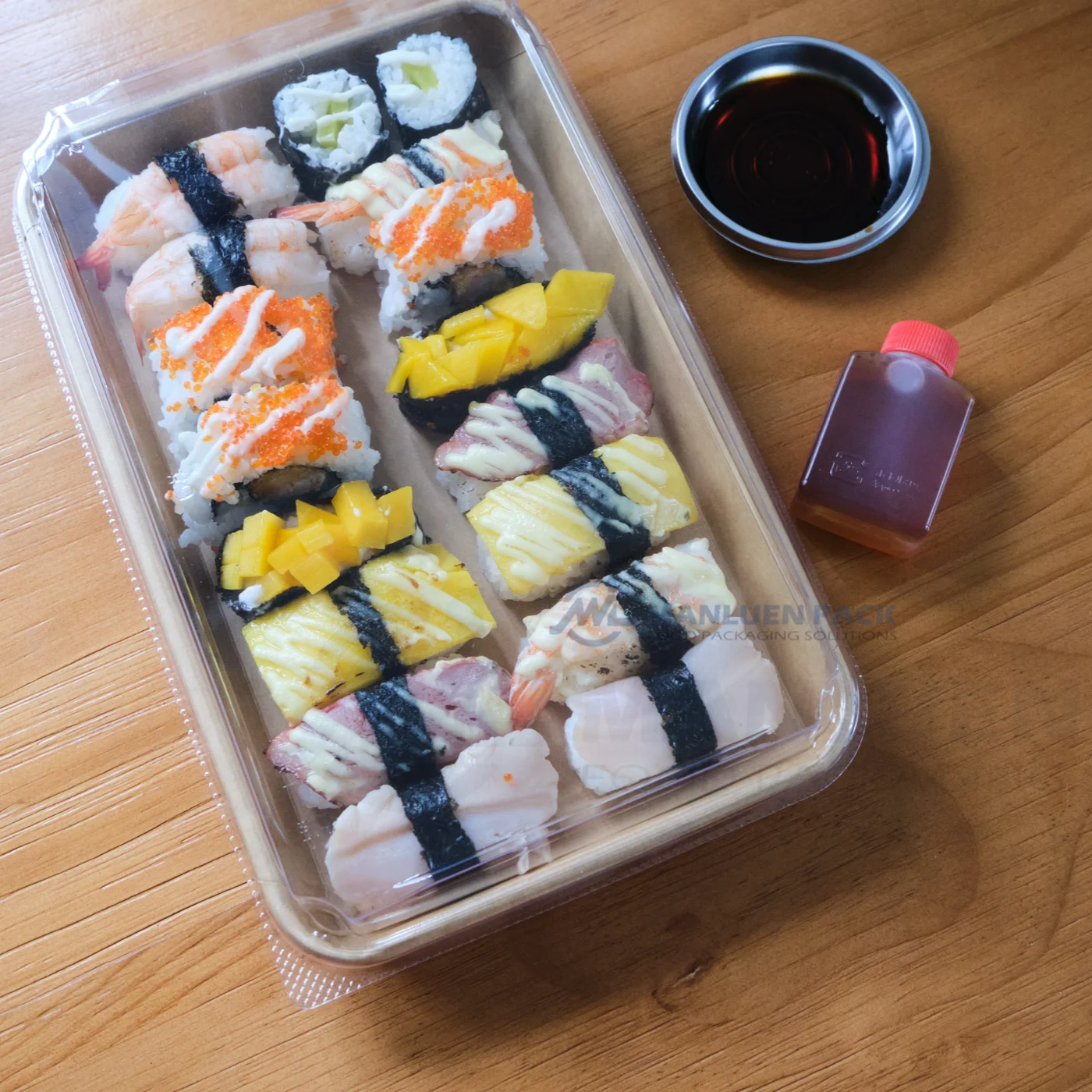
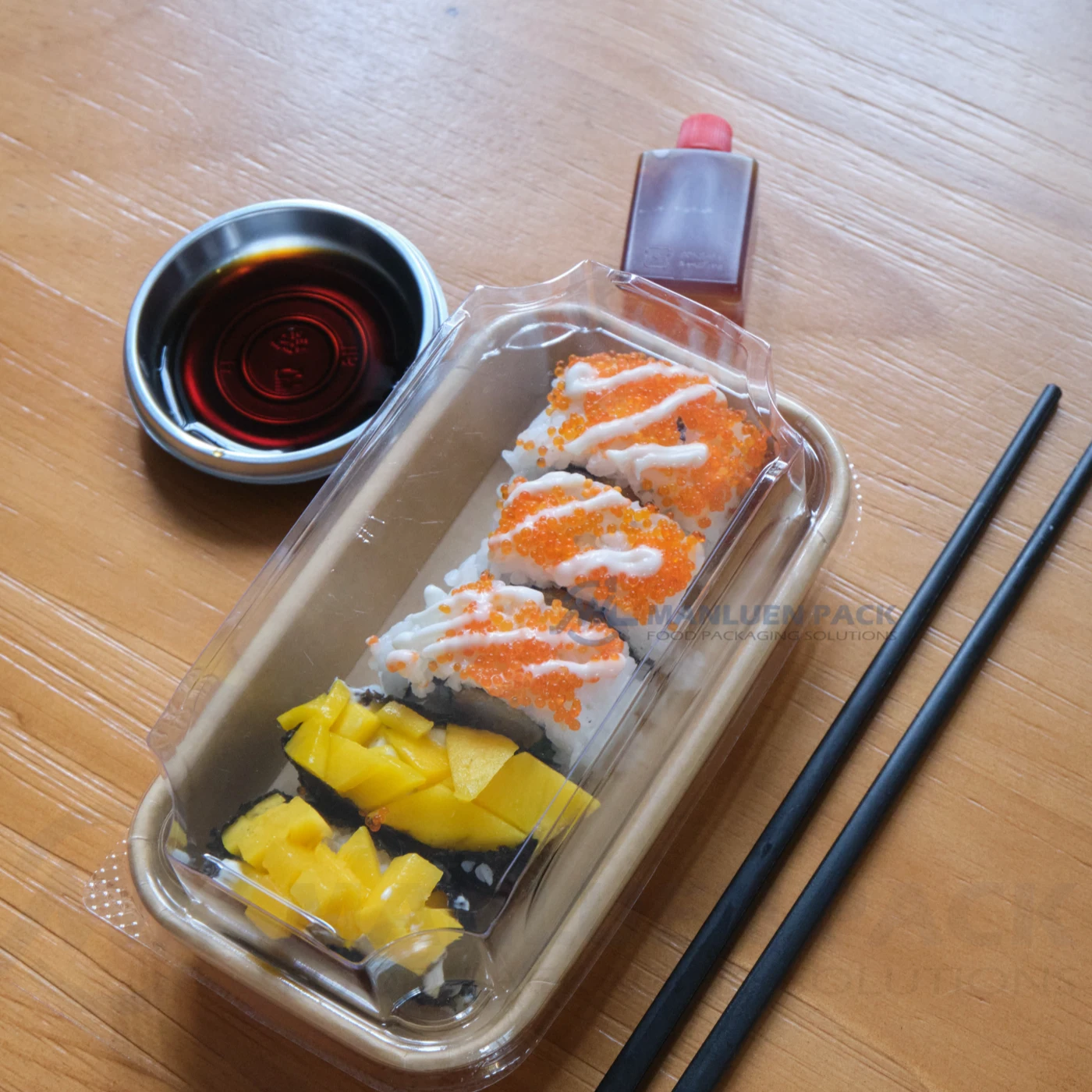
Kraft sushi boxes
Kraft sushi boxes usually combine a paper base with a clear plastic lid. The base gives the package a natural appearance while the lid shows the food and helps protect its arrangement.
Manluen的 0# mini kraft paper sushi container suits small takeaway portions. The larger 3# kraft 纸寿司盒 offers more space for rolls, nigiri, and mixed sets. Buyers can compare these with the broader 寿司托盘系列 when selecting sizes and presentation styles.
Bakery and cake boxes
Kraft bakery boxes are used for pastries, cupcakes, cookies, bread, and cakes. Their rigidity helps protect delicate products during handling. Window panels can improve visibility, but they also add another material that may affect recycling.
The box must fit the product closely enough to limit movement without touching decorations. Buyers comparing paper formats with rigid plastic options can review Manluen’s 蛋糕容器系列 for different display and transport requirements.

Kraft bowls and tubs
Kraft paper bowls are used for salads, noodles, rice dishes, snacks, and some soups. Their performance depends heavily on the board thickness, seam construction, barrier coating, and lid fit.
Do not assume that every paper bowl can hold hot liquid or oily food. Test the filled package at the actual serving temperature and expected holding time. For soup and meal service, compare the paper option with other food-service bowls before deciding.

Benefits of Kraft Paper Box Packaging
Strong structure for many dry and prepared foods
Kraft paper and kraft paperboard have good tensile strength. When the box is correctly designed, it can protect sandwiches, pastries, sushi, salads, snacks, and prepared meals during storage and short-distance transport.
Strength still depends on board grade, thickness, folds, seams, moisture exposure, and the weight of the food. A dry bakery box and a box for oily pasta do not need the same construction.
Natural appearance and easy branding
The brown surface creates a simple, natural look. It also provides space for logos, ingredient labels, handling instructions, and other printed information. Businesses can customize the shape, print, window, closure, and internal insert to match the product.
Keep printing practical. Heavy ink coverage, metallic layers, laminated windows, and decorative components can complicate recycling or add unnecessary cost.
Efficient storage and wholesale supply
Many paper boxes ship flat or nest efficiently. This can reduce storage space at restaurants, cafés, bakeries, and distribution centers. Bulk purchasing may also reduce the unit price, but buyers should compare carton dimensions, minimum order quantities, lead times, and inventory needs before ordering.
A useful alternative to all-plastic packaging
Paper-based packaging can reduce the amount of plastic used in some applications. It can also work well where the food is dry, chilled, or consumed soon after packing.
This does not mean every kraft box is automatically the most sustainable choice. Coatings, windows, food residue, collection systems, and food waste all affect the outcome. Manluen’s guide to 可持续食品包装 explains how buyers can compare these trade-offs.
Important Limitations to Check
Kraft paper boxes are useful, but they do not suit every product.
Moisture, oil, and sauces
Untreated paper absorbs moisture and grease. Food boxes intended for oily, wet, or sauced products usually need a barrier coating or liner. Ask the supplier to identify that barrier material and explain the intended food types, temperature range, and contact time.
Test for staining, softening, leakage, seam failure, and loss of rigidity. A box that performs well for sandwiches may fail with curry, soup, or oily fried food.
Heat and microwave use
Do not assume a kraft paper box is microwave-safe because it is made mainly from paper. The coating, adhesive, ink, window, handle, and lid must also suit the intended heating conditions.
Use a paper container in a microwave only when the finished package is documented for that use. Follow the supplier’s time, temperature, venting, and lid instructions. Never transfer microwave guidance from a PP container to a kraft paper box.
Recycling and composting claims
Clean, uncoated paperboard may be accepted by many recycling programs. A food-soiled or heavily coated box may not be. A clear plastic window or lid may also need to be separated.
“Recyclable,” “compostable,” and “biodegradable” are different claims. Ask what part of the package the claim covers, which standard supports it, and whether suitable local collection and processing exist. The U.S. Environmental Protection Agency notes that accepted materials vary by local recycling program.
How to Choose the Right Kraft Paper Box
Start with the food and the complete use cycle. The general food packaging selection guide provides a broader decision process. For kraft boxes, focus on these points:
- Food type: Is the food dry, oily, moist, acidic, or liquid?
- Temperature: Will it be packed cold, warm, or hot? Will the customer reheat it?
- Holding time: How long will the food remain in the box?
- 规格: Does the product need a folding carton, bowl, window, separate lid, or compartments?
- Transport: Will the package be stacked, tilted, refrigerated, or carried in a delivery bag?
- Presentation: Does the customer need to see the product before buying?
- Disposal: Can the destination market recycle or process the complete package?
Match the box to the food
Use a simple application table before requesting samples.
| Food or Use | Useful Box Feature | Main Check |
|---|---|---|
| 寿司和冷藏预制食品 | Kraft base with a fitted clear lid | Closure, condensation, lid material, and product movement |
| Cakes and pastries | Rigid board, window, and suitable internal clearance | Compression, decoration contact, and window attachment |
| Sandwiches and dry snacks | Simple folding box or windowed carton | Freshness, ventilation, and label space |
| Rice, pasta, and oily meals | Grease-resistant barrier and secure closure | Leakage, staining, heat, and seam strength |
| Soup or liquid-rich food | Purpose-designed bowl or tub with fitted lid | Barrier integrity, rim strength, and hot-fill suitability |
Test the complete package
Do not approve an empty sample alone. Fill the box with the actual food and test it under realistic conditions. Check:
- Leakage and grease staining
- Softening during the expected holding time
- Lid fit and closure after filling
- Stacking and compression
- Refrigeration and condensation
- Delivery vibration and tilting
- Label adhesion and print durability
This testing helps buyers compare primary, secondary, and tertiary packaging as one system rather than evaluating the food box in isolation.
Food-Contact Compliance for Kraft Paper Boxes
A natural brown appearance does not prove that a box is food safe. The paper, coating, adhesive, ink, window, and lid all need an appropriate regulatory basis for their intended use.
In the United States, the FDA regulates food-contact substances according to their identity and intended conditions of use. Buyers should ask the supplier to identify the materials used and provide product-specific documentation. Manluen’s guide to food-grade packaging explains why the finished package and its use conditions matter more than a general “FDA approved” claim.
A useful supplier file may include:
- A declaration or compliance statement identifying the exact product
- Material specifications for paper, coating, adhesive, ink, window, and lid
- The applicable regulatory basis for the destination market
- Migration or extractables test reports where relevant
- PFAS and heavy-metal statements when applicable
- Lot traceability and change-control records
- Evidence supporting recycled-content, recyclable, or compostable claims
For US and EU sourcing, use the broader food packaging compliance guide to understand how liners, lids, coatings, and plastic windows may introduce separate requirements.
The EU Packaging and Packaging Waste Regulation, Regulation (EU) 2025/40, has applied generally since August 12, 2026. Exporters serving the EU should confirm the requirements that apply to the finished package, including material composition, labeling, recyclability, and supplier documentation.
How to Choose a Kraft Paper Box Supplier
Compare suppliers using the same written specification. A low unit price is not useful if the delivered box leaks, changes material without notice, or lacks documents for the target market.
Ask each supplier about:
- Available paper grades, coatings, and lid materials
- Standard sizes and custom tooling
- Printing methods and food-contact ink controls
- Minimum order quantity and sample availability
- Case packing, pallet quantity, and lead time
- In-process inspection and finished-product checks
- Traceability and material change notification
- Test reports for the exact product and intended use
The related guide to kraft brown paper food packaging provides additional format and sourcing considerations. Buyers focused on material documentation can also review the article on safe materials for wholesale kraft paper boxes.

常见问题
Are kraft paper food boxes microwave-safe?
Some are, but not all. Microwave suitability depends on the complete package, including the coating, ink, adhesive, window, and lid. Use the box in a microwave only when the supplier documents the finished product for the intended heating conditions.
牛皮纸盒可以回收吗?
Clean, uncoated paperboard may be recyclable where local programs accept it. Food residue, grease-resistant coatings, plastic linings, windows, and lids can change acceptance. Check the complete package against local collection rules.
Are kraft paper boxes biodegradable or compostable?
The paper fiber may biodegrade under suitable conditions, but the complete box may contain coatings, adhesives, inks, or plastic parts. Do not make a compostable claim without a relevant certification covering the finished package and a suitable collection system.
Can kraft paper boxes hold hot or oily food?
Purpose-designed boxes can hold many hot or oily foods, but they usually require an appropriate barrier and strong seams. Test the real food at the actual packing temperature and holding time before ordering in volume.
What information should I send when requesting a quote?
Provide the food type, dimensions, capacity, temperature, holding time, lid or window requirement, printing needs, order quantity, destination market, and required compliance documents. You can use Manluen’s request-a-quote form to submit these details.
结论
Kraft paper box packaging can be a practical choice for takeaway meals, bakery products, sushi, salads, snacks, and other prepared foods. It offers useful strength, printability, and a natural appearance.
The correct choice depends on more than the paper color. Buyers must check the board grade, barrier coating, lid, window, food type, temperature, holding time, transport conditions, and local disposal system. Test the filled package and verify product-specific documents before placing a wholesale order.
References
U.S. Food and Drug Administration (FDA). Packaging & Food Contact Substances.
Used for the US framework covering substances that contact food and their intended conditions of use.
U.S. Food and Drug Administration
U.S. Environmental Protection Agency (EPA). Recycling Basics and Benefits.
Used for the role of local collection and processing systems in determining whether packaging is recycled.
U.S. Environmental Protection Agency
European Union. Regulation (EU) 2025/40 on Packaging and Packaging Waste.
Used for the PPWR application date and the EU packaging framework.
EUR-Lex

万联塑料包装公司专业生产塑料食品包装已有 20 多年的历史。我们的产品由 100% 原生和不含双酚 A 的 PP、PS 和 OPS 制成,符合 FDA 和欧洲标准。
 ZH
 EN
 FR
 PT
 ES
 KO
 JA