
For buyers comparing packaging across several chilled-food lines, the same material, closure, and handling checks also apply to disposable sushi trays used by supermarkets, restaurants, and takeaway counters.
Introduction
Cake slice boxes protect individual portions while keeping the layers, frosting, and decoration visible. A triangular box follows the natural shape of a cake slice, so it uses less empty space than a square container and helps limit movement during takeaway and display.
The right box still depends on the cake. A tall layered slice needs more lid height than a flat cheesecake portion. Soft frosting needs clearance around the sides. Chilled desserts also need a lid that stays clear and closes securely after refrigeration. Buyers can start with ManLuen’s cake container range, then compare each model against the actual slice, storage method, and delivery route.
This guide explains the benefits of triangular cake slice boxes, who uses them, what features to check, and what wholesale buyers should confirm before ordering.

Why Triangular Cake Slice Boxes Work
A triangular cake slice box is made for one portion cut from a round cake. The wide rear section supports the outer edge, while the narrow front holds the tip. This shape can reduce sliding and helps staff place the slice without squeezing it into a generic rectangular pack.
They Protect the Shape of the Slice
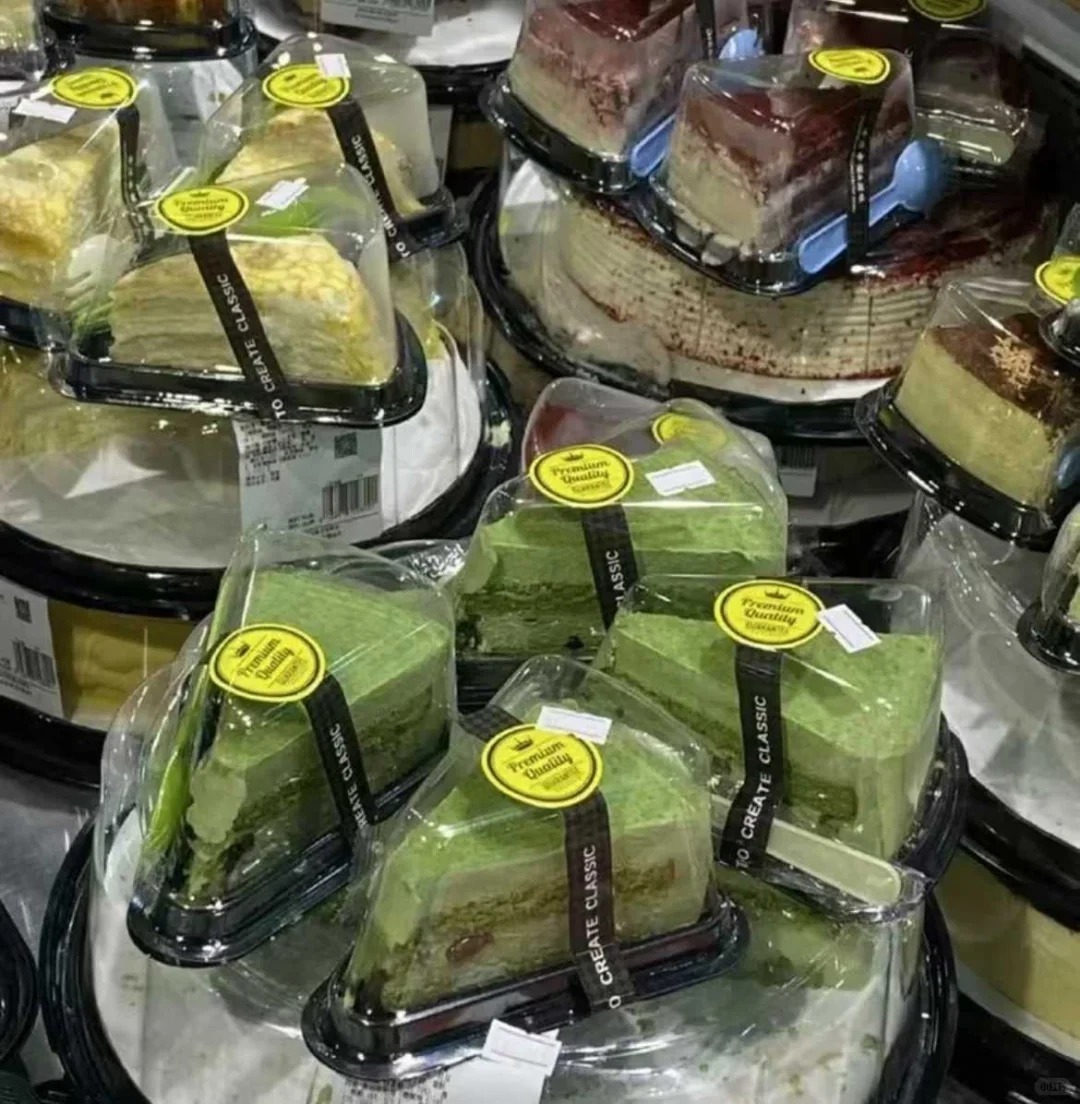
A fitted base supports the cake during handling. The lid should leave enough space above the frosting and around the sides. When the fit is right, the slice is less likely to tip, scrape the wall, or lose decorative toppings. The package does not make rough delivery harmless, but it gives the portion a more stable position.
They Keep the Product Visible
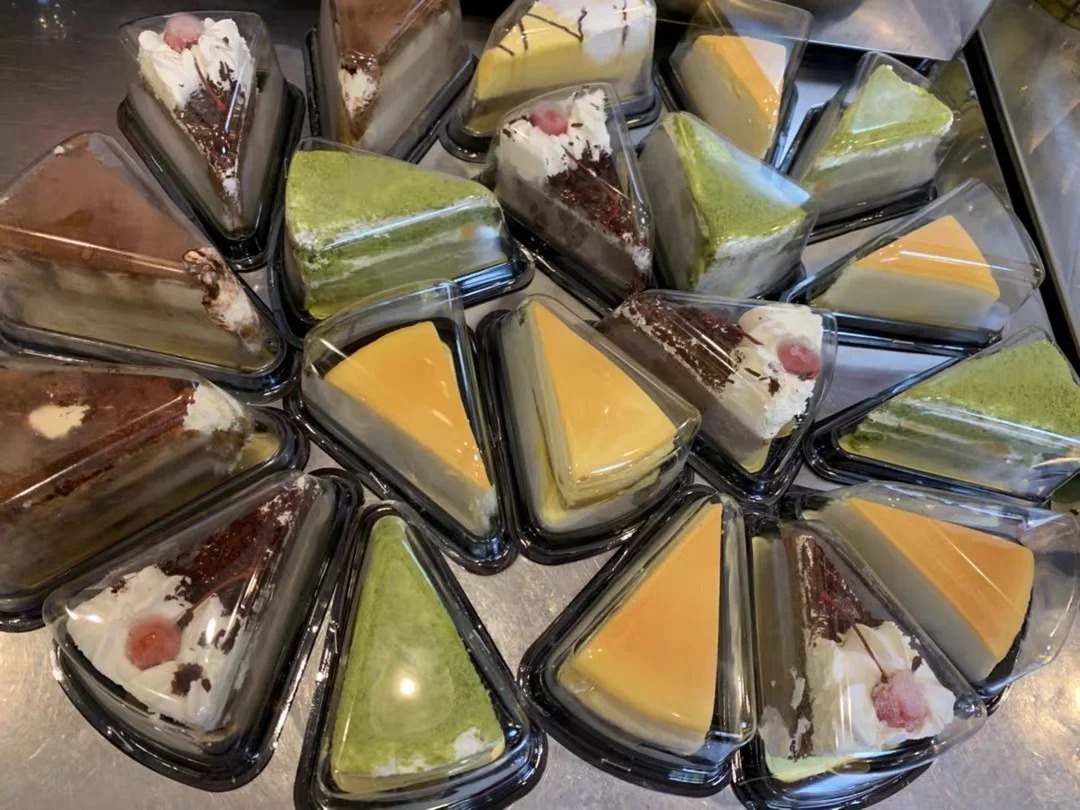
A clear lid lets customers see the cake before buying it. This matters in bakery display cases, supermarket chillers, and grab-and-go counters. Color, filling, layers, and decoration remain part of the presentation after the product has been packed.
They Make Single-Portion Service Faster
Staff can pre-pack popular slices before a busy period. A stackable container also simplifies counter service and reduces the need to fold a paper carton for every order. For a closer look at this packaging format, see the guide to triangular boxes for individual cake slices.
Who Uses Individual Cake Slice Boxes?
Single-slice packaging is useful wherever cake is sold by the portion rather than as a whole product.
- Bakeries and patisseries: Use the boxes for counter display, advance packing, takeaway, and delivery.
- Cafes and coffee shops: Pack cake quickly during peak service without transferring it to a larger container.
- Supermarkets and convenience stores: Present labelled portions in refrigerated grab-and-go cabinets.
- Caterers and event planners: Serve individual desserts or pack leftover slices for guests.
- Food distributors: Supply standard sizes to independent bakeries, cafes, and retail chains.
Features to Check Before Choosing a Cake Slice Box
Internal Size and Lid Height
Measure the finished slice, not only the whole cake. Record the maximum length, rear width, and height, including frosting, fruit, toppers, or other decoration. Leave enough clearance for staff to insert and remove the portion without touching the sides.
Ask the supplier for both external and usable internal dimensions. Two containers with similar outside dimensions may provide different food space because of the rim, wall angle, base pattern, or lid shape.
Lid Fit
The lid should close with normal hand pressure and stay closed during stacking and short-distance delivery. Test several samples. Look for loose corners, lids that spring open, brittle hinges, sharp edges, or excessive force when closing. If the container uses a hinged clamshell design, the clamshell packaging guide explains the basic format and its closure considerations.
Clarity and Condensation
Clear packaging supports display, but clarity should be checked after refrigeration. Fill a sample with the actual dessert, chill it for the normal holding time, and inspect fogging, water droplets, odor, and lid distortion. Cold, moist cake can perform differently from an empty room-temperature sample.
Rigidity and Stackability
The base should resist bending when staff lift a filled box. The lid should protect the decoration without bearing directly on the cake. Stack the packed samples in the same arrangement used in the display cabinet, delivery bag, and master carton. Check whether the lower packs deform under weight.
Label Area
Confirm where the ingredient label, date code, price label, barcode, and tamper-evident seal will sit. The label should adhere under chilled conditions without hiding too much of the product. It should not prevent the lid from closing correctly.
Choosing the Packaging Material
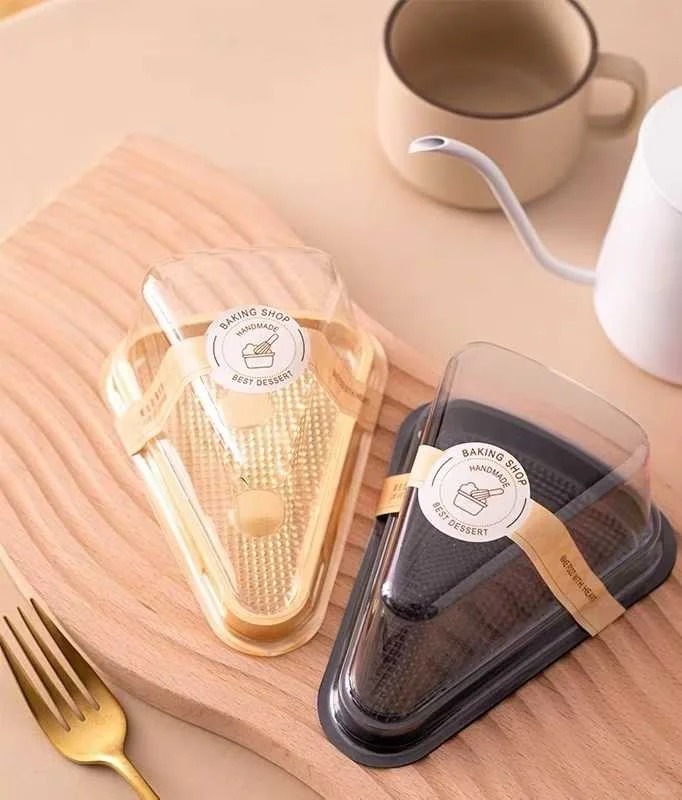
Clear cake slice boxes are commonly made from thermoformed plastic, but the material must be identified on the product specification. Do not rely on appearance alone. PET, OPS, PS, and PP can have different clarity, rigidity, temperature limits, recycling routes, and intended uses. ManLuen’s food packaging materials guide compares the main material families.
| Material or format | Why buyers consider it | What to verify |
|---|---|---|
| PET | Clear presentation and good rigidity for chilled bakery display | Exact resin grade, recycled content if claimed, food-contact documentation, temperature range, and local recycling guidance |
| OPS or PS | Clear lids or formed containers for cold display | Brittleness, crack resistance, intended temperature, and local restrictions or acceptance |
| PP | Greater flexibility and heat tolerance in some container designs | Clarity, exact intended use, finished-product instructions, and whether heating is actually supported |
| Paperboard box | Printable surface and a traditional bakery appearance | Grease resistance, window material, moisture performance, coatings, and food-contact documentation |
The resin code does not prove that a box is microwave-safe, freezer-safe, recyclable in every community, or suitable for every cake. The supplier should state the conditions of use for the finished container. For a detailed discussion of clear triangular PET packaging, read Cake Slice Containers: PET Triangular Solutions for Your Bakery.
Food-Contact Safety and Supplier Documents
Food-contact compliance is based on the material, additives, colorants, manufacturing process, and intended conditions of use. In the United States, the FDA explains that a food-contact substance that is also a food additive must be authorized for its intended use before marketing. This is more precise than calling a finished cake box “FDA approved.” The guide to which agency regulates food packaging explains the U.S. framework in buyer-friendly terms.
The FDA also evaluates migration according to intended use. A report should therefore identify the tested material or product and the relevant food type, contact time, and temperature. For the European Union, plastic food-contact materials are covered by Regulation (EC) No 1935/2004 and the specific requirements of Regulation (EU) No 10/2011.
Ask the supplier for:
- A specification naming the exact base and lid materials
- Dimensions, unit weight, color, and intended conditions of use
- Applicable food-contact declaration or regulatory basis for the destination market
- Migration or laboratory reports that can be linked to the supplied SKU
- Batch traceability and production records
- Evidence supporting recycled-content, recyclability, compostability, or other environmental claims
A general certificate for a different product does not establish compliance for the box being purchased. Buyers can review ManLuen’s certification information, then request the current product-specific documents for the chosen model. The article on food-contact plastics used in cake boxes provides further background.
How to Test a Sample with Real Cake
Test the box before placing a bulk order. Use the actual cake, topping, refrigerator, label, and delivery method.
- Measure the box. Compare internal and external dimensions with the supplier drawing.
- Load the slice. Check whether staff can insert it without touching the frosting.
- Close the lid. Confirm that every corner locks and the decoration has enough clearance.
- Refrigerate it. Inspect fogging, odor, brittleness, leakage, and label adhesion after the normal holding period.
- Stack it. Reproduce the display and delivery arrangement. Check pressure on lower containers.
- Transport it. Carry the packed sample over a realistic route and inspect movement, smudging, and lid security.
- Keep an approved sample. Sign and date it, or attach photographs and measurements to the approved specification.
Buying Cake Slice Boxes Wholesale
Wholesale buyers should compare quotations against one specification. Ask each supplier to state the material, dimensions, unit weight, pieces per carton, carton dimensions, minimum order quantity, sample cost, lead time, payment terms, and named Incoterm location.
MOQ and price depend on whether the container is a standard model or a custom design. Color, embossing, labels, printed sleeves, inserts, and new tooling can change the minimum order and lead time. Request separate prices for a standard clear box and each customization. Do not treat a general MOQ from an article as a firm offer.
For custom production, confirm tooling ownership, maintenance, storage, and replacement in writing. Approve a pre-production sample before the main run. Define visible defects, lid-fit requirements, dimensions, tolerances, packing, and inspection method in the purchase order.
The broader guide to choosing the right food packaging can help buyers connect product protection, presentation, storage, and distribution requirements.
Cake Slice Box or Whole-Cake Carrier?
Use a triangular box when the customer is buying one slice. Use a whole-cake carrier when the bakery sells a complete round cake. Oversized packaging wastes space and gives a single slice room to slide, while a slice box cannot protect a full cake.
ManLuen’s 9-inch round cake carrier and 11-inch round cake carrier illustrate the larger format. The bakery should select the pack according to the finished product rather than trying to use one container for every order.
Common Buying Mistakes
- Choosing by outside dimensions only: The usable internal space may be smaller than expected.
- Ignoring decoration height: A lid can fit the cake but still touch frosting or fruit.
- Approving an empty sample: Chilled, filled, stacked, and transported tests reveal different problems.
- Accepting vague material claims: “Food-grade plastic” should be replaced by an exact material and regulatory basis.
- Assuming clear plastic is recyclable everywhere: Collection and acceptance vary by material and local system.
- Calling every box microwave-safe: Suitability must come from the finished product’s instructions and supported conditions of use.
- Comparing only unit price: Weak cartons, low packing efficiency, breakage, and poor lid fit can erase a small price saving.
Frequently Asked Questions
What is a cake slice box?
A cake slice box is a single-portion container shaped and sized to protect one piece of cake. A triangular version follows the outline of a slice cut from a round cake and usually includes a clear or partly clear lid for display.
What material is best for a clear cake slice box?
PET is often considered for clear chilled-food packaging, but the best material depends on the required clarity, rigidity, temperature, local rules, and recovery system. Buyers should verify the exact material and conditions of use for the chosen SKU.
Are triangular cake slice boxes microwave-safe?
Do not microwave the box unless the manufacturer gives instructions for that exact container and lid. Many clear cake boxes are intended for cold display and takeaway, not heating.
Can cake slice boxes be recycled?
That depends on the resin, labels and other components, contamination, and the local collection system. Ask the supplier to identify the material. Then check the rules in the market where customers will discard the box.
How do I choose the correct size?
Measure the finished slice at its widest, longest, and tallest points. Include frosting and decorations. Then check the container’s usable internal dimensions and test a sample with the real product.
Can I order custom cake slice boxes?
Customization may include color, label, sleeve, embossing, carton packing, or a new mold. Ask the supplier which changes use an existing model and which require tooling. Confirm the MOQ, lead time, artwork approval, and tooling ownership before ordering.
Conclusion
A good cake slice box fits the portion, protects the decoration, closes securely, and stays presentable through refrigeration and delivery. Measure the cake first. Check the internal space and lid height. Then test the exact sample under real service conditions.
Wholesale buyers should also verify the material, food-contact documentation, carton data, quality requirements, and commercial terms for the selected model. To compare sizes or request a sample, send ManLuen the slice dimensions, cake type, order quantity, destination market, and preferred packaging format through the quotation page.
References
U.S. Food and Drug Administration. Food Packaging & Other Substances that Come in Contact with Food. Used for the definition and authorization of food-contact substances and the importance of intended use.
U.S. Food and Drug Administration
U.S. Food and Drug Administration. Preparation of Premarket Submissions for Food Contact Substances: Chemistry Recommendations. Used for the discussion of migration testing under intended contact conditions, including PET and refrigerated applications.
U.S. Food and Drug Administration
European Commission. Food Contact Materials Legislation. Used for the EU framework and the role of Regulation (EU) No 10/2011 for plastic food-contact materials.
European Commission
European Union. Commission Regulation (EU) No 10/2011 on plastic materials and articles intended to come into contact with food.
EUR-Lex

ManLuen Plastic Packaging Company, which is specialized in the production of Plastic Food Packaging for more than 20 years. Our products are made from 100% virgin and BPA-Free PP, PS, and OPS comply with FDA and European Standards.
 EN
 ZH
 FR
 PT
 ES
 KO
 JA