
Para compradores que comparam embalagens em várias linhas de alimentos refrigerados, os mesmos materiais, fechos e verificações de manuseio também se aplicam a bandejas descartáveis de sushi usados por supermercados, restaurantes e balcões de takeaway.
Introdução
A embalagem de bolo transparente tem uma tarefa simples. Mantém o bolo visível e o protege durante a exibição, recolha e transporte. Também deve ser adequada às condições de contacto com alimentos pretendidas.
Poliestireno (PS) e tereftalato de polietileno (PET) são dois plásticos utilizados para embalagens rígidas e transparentes de bolos. Os fabricantes podem moldá-los em bandejas, tampas, caixas de concha, caixas para cupcakes e suportes para bolos de tamanho completo. Pode encontrar uma comparação mais ampla no nosso guia de materiais comuns de embalagem de alimentos.
Ambos os materiais podem funcionar bem, mas não atuam exatamente da mesma forma. A escolha certa depende do bolo, do design do recipiente, das condições de armazenamento e da forma como a embalagem será manuseada.
Os compradores devem considerar as dimensões do bolo, a folga da tampa, a resistência ao fecho, o empilhamento, as condições de transporte e os documentos de contacto com alimentos disponíveis para o produto específico. A Manluen oferece vários formatos na sua gama de recipientes para bolos.
O que é PS na Embalagem de Bolo Transparente?
PS significa poliestireno. Pode ser moldado por termoformagem em bandejas leves, rígidas, tampas e recipientes de alimentos transparentes.
Na embalagem de bolos, o PS é comumente utilizado quando o recipiente necessita de boa rigidez e uma visão clara do produto. Pode adequar-se à exibição no retalho, take-away, armazenamento e condições normais de transporte.
Por que o PS é utilizado para caixas de bolo
O PS rígido mantém bem a sua forma em muitas aplicações de exibição. A sua rigidez ajuda as paredes e a tampa a permanecerem eretas sem tornar o recipiente desnecessariamente pesado.
No entanto, o nome do material não indica como o pacote acabado irá atuar. A espessura da folha, as nervuras, os cantos, as dobradiças, os fechos e a qualidade do molde afetam todos o resultado final.
Um recipiente fino com cantos fracos pode comportar-se de forma muito diferente de um recipiente reforçado feito do mesmo polímero.
O que os compradores devem verificar num recipiente de PS
O PS oferece uma rigidez útil, mas alguns designs rígidos de PS podem rachar sob impacto. Portanto, os compradores devem testar o pacote completo, em vez de confiar apenas na descrição geral do material.
Verifique os seguintes pontos:
- Rigidez da base sob o peso do bolo e da placa do bolo.
- Folga da tampa acima do glacê, fruta e decorações.
- Resistência a rachaduras ao redor dos cantos e dobradiças.
- Resistência à força de fechamento durante levantamento e manuseio.
- Estabilidade da pilha dentro da caixa de transporte.
- Desempenho da embalagem à temperatura de armazenamento pretendida.
Requisitos de contacto com alimentos para PS
Na Portugal, 21 CFR 177.1640 cobre poliestireno e poliestireno modificado com borracha usados como componentes de artigos destinados ao contacto com alimentos, sujeitos às disposições dessa secção.
Isto não significa que todos os recipientes de PS sejam adequados para todos os alimentos ou usos. A resina, aditivos, artigo acabado, tipo de alimento, temperatura e tempo de contacto continuam a importar. O nosso guia para embalagens de grau alimentar explica por que os compradores devem avaliar a embalagem completa, e não apenas o nome do polímero.
A FDA separa as avaliações de contacto com alimentos por tipo de alimento e condição de uso. As suas categorias distinguem armazenamento à temperatura ambiente, refrigeração, congelação, enchimento quente, reaquecimento e cozedura. Os produtos de padaria também são divididos de acordo com se a superfície contém gordura ou óleo livre.
Os compradores podem consultar estas categorias na página da Tipos de Alimentos e Condições de Uso para Substâncias de Contacto com Alimentos da FDA as regulações relevantes do polímero aparecem em 21 CFR Part 177.
O que é PET em Embalagens Transparentes para Bolos?
PET significa polietileno tereftalato. É amplamente utilizado para embalagens rígidas transparentes de alimentos porque combina claridade com resistência útil.
O PET funciona bem em embalagens de bolo que devem permanecer transparentes enquanto toleram manuseio durante embalagem, exibição, recolha e entrega.
Por que o PET é usado para caixas de bolo
PET é comum em conchas transparentes, suportes para cupcakes, tampas de cúpula e recipientes de bolos de tamanho completo. Comparado com PS rígido, é frequentemente escolhido quando a resistência a rachaduras e impacto é um requisito importante de design. Para mais informações sobre esta estrutura de embalagem, consulte o nosso guia de recipientes de concha.
Isto não significa que todo recipiente de PET seja mais resistente do que todo recipiente de PS. Espessura da parede, grau de resina, nervuras, dobradiças, geometria e condições de formação afetam o desempenho.
Os compradores devem testar o recipiente acabado com o produto real. Uma comparação de materiais por si só não pode mostrar se a tampa permanecerá fechada ou se a base se dobrará sob o peso de um bolo.
Exemplos de PET para Diferentes Formatos de Bolo
Uma padaria pode precisar de embalagens separadas para porções individuais, pedidos maiores de cupcakes e bolos completos. Cada recipiente deve corresponder ao seu produto pretendido.
Para um cupcake, muffin ou sobremesa pequena, o recipiente de PET para cupcake único CK-01 mede 109 × 97 × 89 mm e utiliza um design transparente com dobradiças.
Para pedidos maiores, o suporte de cupcake de PET CK-12 mede 320 × 266 × 96 mm e oferece 12 posições separadas.
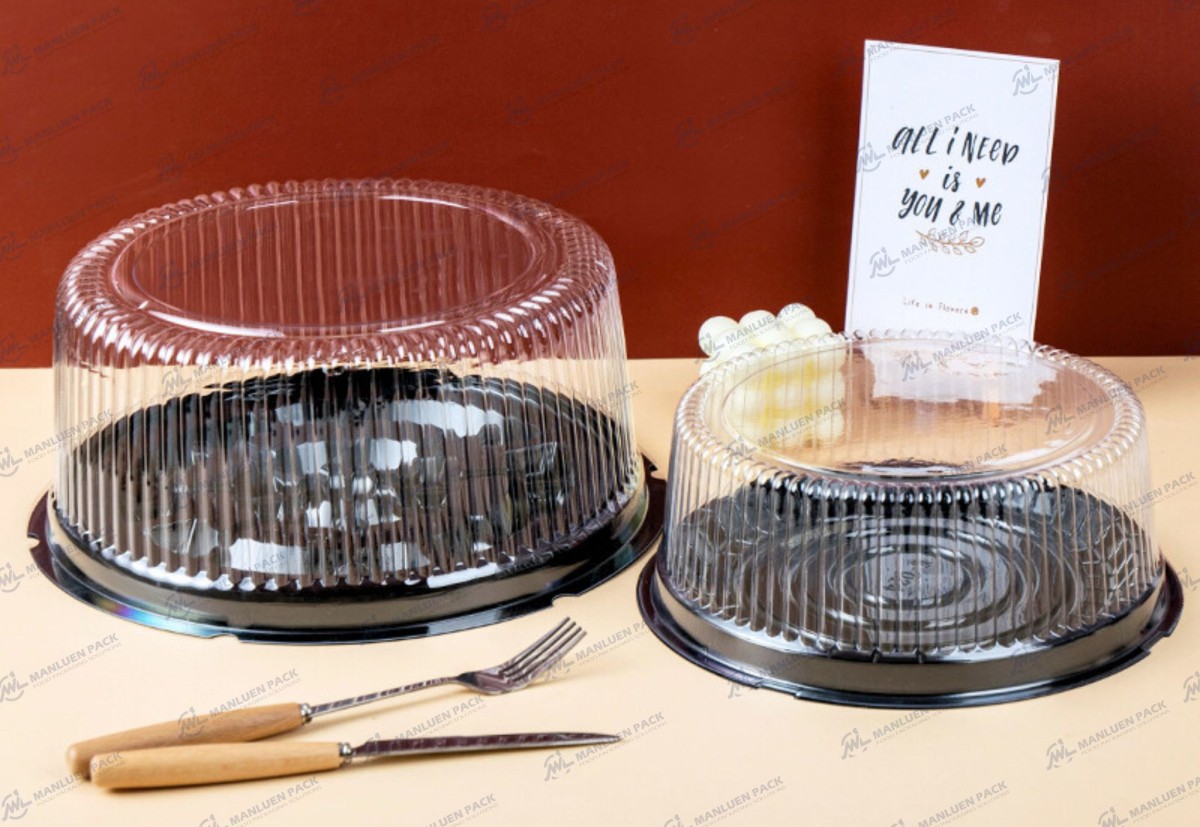
For a full cake, the WL-K09 round PET cake carrier measures Ø277 × 120 mm. It uses a clear dome lid and is designed around a nominal 9-inch cake format.
Food-Contact Requirements for PET
Na Portugal, 21 CFR 177.1630 covers polyethylene phthalate polymers used in plastics intended for food contact under prescribed conditions.
The section includes requirements relating to polymer composition, optional substances, specifications, and conditions of use. It should not be reduced to a general claim that all PET packaging is “FDA approved.”
A buyer should confirm that the exact PET material and finished container meet the requirements that apply to the intended food, temperature, and contact conditions.
PS vs. PET for Clear Cake Boxes
PS and PET can both work in clear bakery packaging. One is not automatically better than the other. Buyers should compare the properties that matter for the actual cake and distribution process.
| Factor | PS | PET |
|---|---|---|
| Product visibility | Provides clear, rigid packaging for bakery display | Commonly used for clear clamshells, lids, and cake carriers |
| Rigidity | Offers good stiffness in suitable thermoformed designs | Offers good rigidity when formed into reinforced structures |
| Impact resistance | Some rigid PS designs can crack under impact | Often selected when resistance to cracking is important |
| Typical formats | Clear trays, lids, and rigid display containers | Cupcake clamshells, compartment carriers, dome lids, and full cake carriers |
| Transport | Requires suitable geometry and protection from impact | Useful when the package will face frequent handling |
| Food-contact assessment | Check the specific product and intended conditions of use | Check the specific product and intended conditions of use |
| Microwave or oven use | Do not assume suitability unless the specific product states it | Do not assume suitability unless the specific product states it |
| Recycling | Depends on local collection, sorting, and container condition | Depends on local collection, sorting, and container condition |
Neither Material Is Always the Better Choice
PS can make sense when a package needs a light and stiff structure. PET can be useful when the package needs additional toughness during handling and transport.
The finished design matters as much as the polymer. Two containers made from the same material can perform differently because of their thickness, ribs, corners, hinges, and closures.
Buyers should compare finished samples under the same packing, stacking, storage, and transport conditions used in their own business.
How Clear Cake Boxes Support Bakery Operations
Product Visibility
Clear packaging lets customers and bakery staff see the icing, toppings, decoration, portion size, and general condition of the cake without opening the box.
This is useful for decorated cupcakes, mini cakes, cookies, and full cakes that rely on appearance at the point of sale.
Visibility also helps staff confirm that they packed the correct product before it reaches a pickup counter or delivery area.
Protection During Handling and Transport
A cake can still be damaged inside packaging made from a suitable food-contact material. Poor dimensions and weak closures often cause more immediate problems than the choice between PS and PET.
A lid that is too low can touch icing, fruit, chocolate work, or other decorations. A weak base can bend under the cake board. A loose closure can open when staff lift or stack the package.
Buyers should also check whether the package moves inside its transport carton. Excess space can allow the cake to slide, while tight packing can place pressure on the lid.
Faster Product Identification
Bakery staff often handle several products and orders at once. Transparent containers make visual checks easier.
Staff can identify different cupcakes, desserts, and decorated cakes without repeatedly opening each package. This can simplify counter service, pickup organization, and final order checks.
What Buyers Should Check Before Ordering
The material is only one part of the buying decision. Container dimensions, lid fit, closure strength, storage temperature, transport conditions, and documentation also matter. For a wider purchasing framework, read How to Choose the Right Food Packaging for Your Product.
1. Confirm Every Material in the Package
Ask the supplier to identify the material used for each food-contact part. Do not rely only on the description “clear plastic.”
Some containers use different materials for the lid and base. The WL-026 cake container, for example, should be evaluated as a complete package rather than by looking at the clear lid alone.
2. Check the Actual Dimensions
Measure the cake, cake board, decorations, and required headspace. For a round cake, check both diameter and height.
Do not assume that a nominal cake size gives the full internal dimensions of the container. Request a sample when the product has tall icing or delicate decoration.
3. Test the Lid and Closure
Place the real product inside the container. Confirm that the lid closes without touching the cake.
Lift, stack, and move the package. Check whether the closure remains engaged. For a hinged container, inspect the hinge after normal opening and closing.
4. Test Stacking and Transport
Test filled containers inside the actual transport carton. Look for:
- Lid deformation.
- Sidewall buckling.
- Base flexing.
- Cracked corners.
- Open closures.
- Movement of the cake.
- Pressure from packages stacked above it.
The material name cannot answer these questions. The finished package must work as a complete system.
5. Confirm the Intended Temperature
Clear PS and PET cake boxes are commonly used for display, storage, takeaway, and transport.
Do not treat them as microwave or oven containers unless the exact product is explicitly designed, labeled, and documented for that use.
A package used for refrigerated cake storage does not automatically meet the requirements for reheating or cooking.
6. Request Product-Specific Documents
A general statement about PS or PET is not a substitute for documentation covering the product being purchased.
Ask the supplier for information relevant to the exact material, finished package, intended food type, temperature, and conditions of use.
For U.S. applications, buyers should identify the applicable food-contact provisions. These may include 21 CFR 177.1640 for polystyrene and 21 CFR 177.1630 for polyethylene phthalate polymers.
7. Check Local Recycling Rules
A technically recyclable polymer is not necessarily accepted by every local recycling program.
Actual recovery depends on collection rules, sorting equipment, recycling capacity, end-market demand, package design, and food contamination.
Buyers should check the waste system in the market where the package will be used before making a recyclability claim.
U.S. and EU Food-Contact Rules
Portugal
U.S. food-contact requirements apply to specific substances and intended uses. A polymer name alone does not establish that every finished container is suitable for every food or temperature. Our article on which agency regulates food packaging explains the roles of the FDA, USDA, and other U.S. authorities.
21 CFR 177.1640 addresses polystyrene and rubber-modified polystyrene. 21 CFR 177.1630 addresses polyethylene phthalate polymers. Buyers who need a broader document checklist can also read our Plastic Food Packaging Compliance 2026 guide.
Both provisions contain conditions and specifications. Buyers should therefore confirm the regulatory basis and intended use of the exact container instead of accepting a general “FDA approved” claim.
União Europeia
EU food-contact rules use several layers of legislation.
Regulation (EC) No 1935/2004 provides the general framework for materials and articles intended to come into contact with food.
Commission Regulation (EU) No 10/2011 sets specific requirements for plastic materials and articles intended to contact food.
Commission Regulation (EC) No 2023/2006 covers Good Manufacturing Practice for food-contact materials.
The European Commission’s Food Contact Materials page explains this framework. Buyers should ask suppliers which rules and documents apply to the exact product rather than relying on a stand-alone “EU compliant” statement.
Why Choose Manluen for Clear Cake Packaging?
Manluen supplies food packaging for bakery, takeaway, catering, and other food-service applications. Buyers can review the company on the Sobre Nós page and check available company documents on the Certificações page.
O cake container category includes packages for individual desserts, cupcakes, and full cakes.
Before placing an order, buyers can ask about the material, dimensions, carton packing, intended use, available food-contact documents, and customization options.
Visit Manluen Pack to view the wider packaging range. You can also request a quote by providing the cake dimensions, packaging format, material preference, quantity, destination market, and intended use.
Fontes e Leitura Adicional
- Electronic Code of Federal Regulations: 21 CFR Part 177 — includes provisions covering polyethylene phthalate polymers and polystyrene.
- U.S. FDA: Food Types and Conditions of Use for Food Contact Substances — explains food categories and intended conditions of use.
- European Commission: Food Contact Materials — provides an overview of the EU food-contact framework and GMP requirements.
- EUR-Lex: Commission Regulation (EU) No 10/2011 reference — existing reference retained from the original article. Buyers should check the current consolidated text when reviewing requirements.
- U.S. FDA: Summary of Color Additives for Use in Cosmetics — existing reference retained from the original article. This cosmetics page is not a primary source for PS or PET food-packaging compliance.
Perguntas Frequentes
Can PS or PET cake boxes go in the microwave?
Do not assume that they can. Clear PS and PET cake containers are usually intended for display, storage, takeaway, and transport.
Only microwave a package when the specific product is designed, labeled, and documented for that use. For a detailed explanation of microwave labels and conditions of use, read Can You Microwave Food in a Plastic Container?. The same caution applies to oven use.
How do I choose between PS and PET for a cake box?
Start with the finished package requirements. Check the cake dimensions, lid height, base stiffness, closure, impact exposure, stacking, transport method, and storage temperature.
PS can provide good stiffness in rigid thermoformed packaging. PET is often selected when the package needs a tougher clear structure. Test finished samples under the conditions used in your business.
How can I verify food-contact compliance?
Request documents for the specific product rather than a general statement about PS or PET.
Confirm the material, food type, temperature, contact time, and intended conditions of use. For U.S. applications, identify the relevant provisions in 21 CFR. For EU applications, check the general framework, the plastic-specific requirements, and GMP requirements.
If a supplier offers several products made from the same polymer, do not assume that one report automatically covers every size, design, or material combination.
Conclusão
PS and PET can both be used in clear cake packaging. PS provides useful stiffness for many rigid designs. PET is often selected when the container also needs greater resistance to cracking during handling.
The polymer is only one part of the package. Wall thickness, lid clearance, closure design, stacking, storage, and transport all affect performance.
Buyers should test the finished container with the actual cake and verify the food-contact documents for the specific product. This gives a more reliable answer than a general claim that one plastic is always better or safer than another.

ManLuen Plastic Packaging Company, especializada na produção de Embalagens de Alimentos de Plástico há mais de 20 anos. Os nossos produtos são feitos de PP virgem e livre de BPA, em conformidade com os padrões da FDA e Europeus.
 PT
 EN
 ZH
 FR
 ES
 KO
 JA