
Introduction
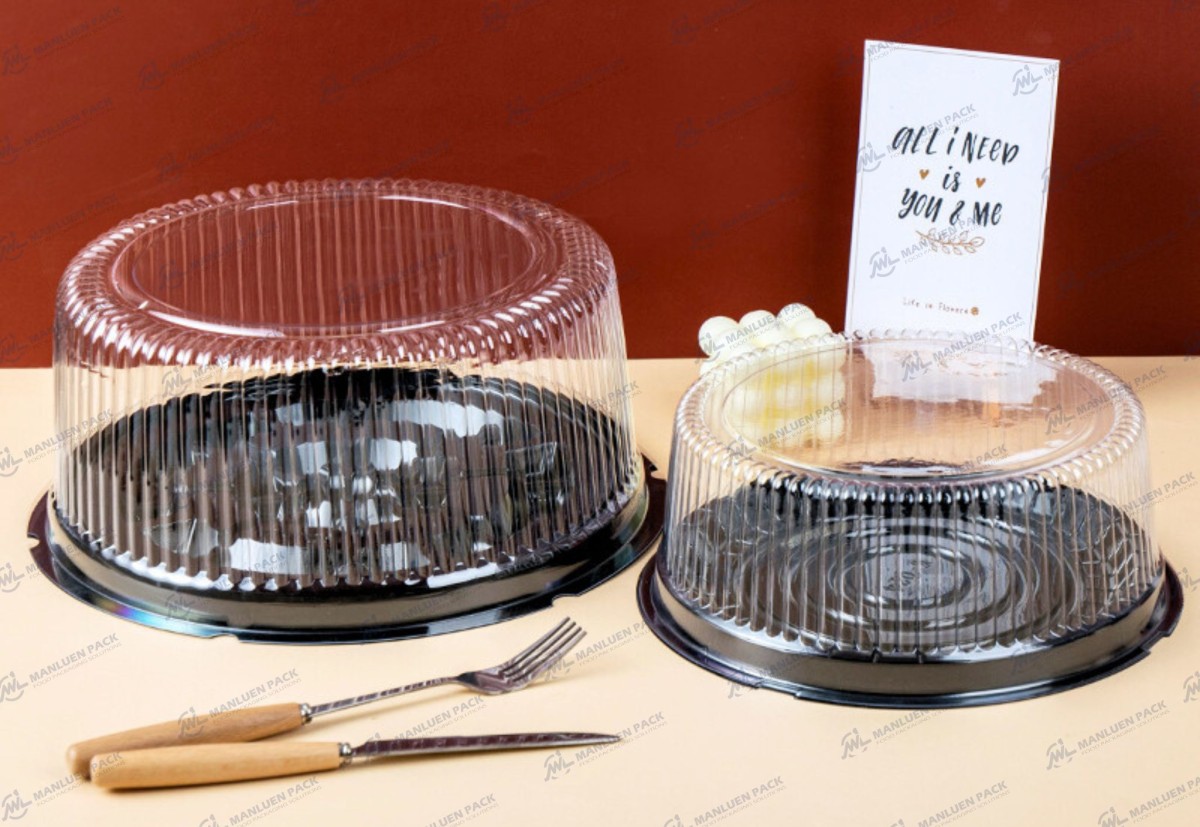
Clear cake packaging has a simple job. It keeps the cake visible and protects it during display, pickup, and transport. It must also be suitable for the intended food-contact conditions.
Polystyrene (PS) and polyethylene terephthalate (PET) are two plastics used for rigid, transparent cake packaging. Manufacturers can form them into trays, lids, clamshells, cupcake boxes, and full-size cake carriers. You can find a broader comparison in our guide to common food packaging materials.
Both materials can work well, but they do not perform in exactly the same way. The right choice depends on the cake, the container design, the storage conditions, and the way the package will be handled.
Buyers should consider the cake dimensions, lid clearance, closure strength, stacking, transport conditions, and available food-contact documents for the specific product. Manluen offers several formats in its cake container range.
What Is PS in Clear Cake Packaging?
PS stands for polystyrene. It can be thermoformed into lightweight, rigid trays, lids, and clear food containers.
In cake packaging, PS is commonly used when the container needs good stiffness and a clear view of the product. It can suit retail display, takeaway, storage, and normal transport conditions.
Why PS Is Used for Cake Boxes
Rigid PS holds its shape well in many display applications. Its stiffness helps the walls and lid remain upright without making the container unnecessarily heavy.
However, the material name does not tell buyers how the finished package will perform. Sheet thickness, ribs, corners, hinges, closures, and forming quality all affect the final result.
A thin container with weak corners can behave very differently from a reinforced container made from the same polymer.
What Buyers Should Check on a PS Container
PS offers useful rigidity, but some rigid PS designs can crack under impact. Buyers should therefore test the complete package rather than relying on a general material description.
Check the following points:
- Base stiffness under the weight of the cake and cake board.
- Lid clearance above icing, fruit, and decorations.
- Resistance to cracking around corners and hinges.
- Closure strength during lifting and handling.
- Stack stability inside the transport carton.
- Package performance at the intended storage temperature.
Food-Contact Requirements for PS
In the United States, 21 CFR 177.1640 covers polystyrene and rubber-modified polystyrene used as components of articles intended for food contact, subject to the provisions of that section.
This does not mean that every PS container is suitable for every food or use. The resin, additives, finished article, food type, temperature, and contact time still matter. Our guide to food-grade packaging explains why buyers must evaluate the complete package rather than the polymer name alone.
The FDA separates food-contact evaluations by food type and condition of use. Its categories distinguish room-temperature storage, refrigeration, freezing, hot filling, reheating, and cooking. Bakery products are also divided according to whether the surface contains free fat or oil.
Buyers can review these categories on the FDA’s Food Types and Conditions of Use for Food Contact Substances page. The relevant polymer regulations appear in 21 CFR Part 177.
What Is PET in Clear Cake Packaging?
PET stands for polyethylene terephthalate. It is widely used for rigid transparent food packaging because it combines clarity with useful toughness.
PET works well in cake packaging that must remain clear while tolerating handling during packing, display, pickup, and delivery.
Why PET Is Used for Cake Boxes
PET is common in clear clamshells, cupcake carriers, dome lids, and full-size cake containers. Compared with rigid PS, it is often selected when resistance to cracking and impact is an important design requirement. For more information about this packaging structure, see our clamshell container guide.
This does not mean every PET container is stronger than every PS container. Wall thickness, resin grade, ribs, hinges, geometry, and forming conditions all affect performance.
Buyers should test the finished container with the real product. A material comparison alone cannot show whether the lid will remain closed or whether the base will bend under the weight of a cake.
PET Examples for Different Cake Formats
A bakery may need separate packages for single servings, larger cupcake orders, and full cakes. Each container should match its intended product.
For one cupcake, muffin, or small dessert, Manluen’s CK-01 single-cupcake PET container measures 109 × 97 × 89 mm and uses a clear hinged design.
For larger orders, the CK-12 PET cupcake carrier measures 320 × 266 × 96 mm and provides 12 separate positions.
For a full cake, the WL-K09 round PET cake carrier measures Ø277 × 120 mm. It uses a clear dome lid and is designed around a nominal 9-inch cake format.
Food-Contact Requirements for PET
In the United States, 21 CFR 177.1630 covers polyethylene phthalate polymers used in plastics intended for food contact under prescribed conditions.
The section includes requirements relating to polymer composition, optional substances, specifications, and conditions of use. It should not be reduced to a general claim that all PET packaging is “FDA approved.”
A buyer should confirm that the exact PET material and finished container meet the requirements that apply to the intended food, temperature, and contact conditions.
PS vs. PET for Clear Cake Boxes
PS and PET can both work in clear bakery packaging. One is not automatically better than the other. Buyers should compare the properties that matter for the actual cake and distribution process.
| Factor | PS | PET |
|---|---|---|
| Product visibility | Provides clear, rigid packaging for bakery display | Commonly used for clear clamshells, lids, and cake carriers |
| Rigidity | Offers good stiffness in suitable thermoformed designs | Offers good rigidity when formed into reinforced structures |
| Impact resistance | Some rigid PS designs can crack under impact | Often selected when resistance to cracking is important |
| Typical formats | Clear trays, lids, and rigid display containers | Cupcake clamshells, compartment carriers, dome lids, and full cake carriers |
| Transport | Requires suitable geometry and protection from impact | Useful when the package will face frequent handling |
| Food-contact assessment | Check the specific product and intended conditions of use | Check the specific product and intended conditions of use |
| Microwave or oven use | Do not assume suitability unless the specific product states it | Do not assume suitability unless the specific product states it |
| Recycling | Depends on local collection, sorting, and container condition | Depends on local collection, sorting, and container condition |
Neither Material Is Always the Better Choice
PS can make sense when a package needs a light and stiff structure. PET can be useful when the package needs additional toughness during handling and transport.
The finished design matters as much as the polymer. Two containers made from the same material can perform differently because of their thickness, ribs, corners, hinges, and closures.
Buyers should compare finished samples under the same packing, stacking, storage, and transport conditions used in their own business.
How Clear Cake Boxes Support Bakery Operations
Product Visibility
Clear packaging lets customers and bakery staff see the icing, toppings, decoration, portion size, and general condition of the cake without opening the box.
This is useful for decorated cupcakes, mini cakes, cookies, and full cakes that rely on appearance at the point of sale.
Visibility also helps staff confirm that they packed the correct product before it reaches a pickup counter or delivery area.
Protection During Handling and Transport
A cake can still be damaged inside packaging made from a suitable food-contact material. Poor dimensions and weak closures often cause more immediate problems than the choice between PS and PET.
A lid that is too low can touch icing, fruit, chocolate work, or other decorations. A weak base can bend under the cake board. A loose closure can open when staff lift or stack the package.
Buyers should also check whether the package moves inside its transport carton. Excess space can allow the cake to slide, while tight packing can place pressure on the lid.
Faster Product Identification
Bakery staff often handle several products and orders at once. Transparent containers make visual checks easier.
Staff can identify different cupcakes, desserts, and decorated cakes without repeatedly opening each package. This can simplify counter service, pickup organization, and final order checks.
What Buyers Should Check Before Ordering
The material is only one part of the buying decision. Container dimensions, lid fit, closure strength, storage temperature, transport conditions, and documentation also matter. For a wider purchasing framework, read How to Choose the Right Food Packaging for Your Product.
1. Confirm Every Material in the Package
Ask the supplier to identify the material used for each food-contact part. Do not rely only on the description “clear plastic.”
Some containers use different materials for the lid and base. The WL-026 cake container, for example, should be evaluated as a complete package rather than by looking at the clear lid alone.
2. Check the Actual Dimensions
Measure the cake, cake board, decorations, and required headspace. For a round cake, check both diameter and height.
Do not assume that a nominal cake size gives the full internal dimensions of the container. Request a sample when the product has tall icing or delicate decoration.
3. Test the Lid and Closure
Place the real product inside the container. Confirm that the lid closes without touching the cake.
Lift, stack, and move the package. Check whether the closure remains engaged. For a hinged container, inspect the hinge after normal opening and closing.
4. Test Stacking and Transport
Test filled containers inside the actual transport carton. Look for:
- Lid deformation.
- Sidewall buckling.
- Base flexing.
- Cracked corners.
- Open closures.
- Movement of the cake.
- Pressure from packages stacked above it.
The material name cannot answer these questions. The finished package must work as a complete system.
5. Confirm the Intended Temperature
Clear PS and PET cake boxes are commonly used for display, storage, takeaway, and transport.
Do not treat them as microwave or oven containers unless the exact product is explicitly designed, labeled, and documented for that use.
A package used for refrigerated cake storage does not automatically meet the requirements for reheating or cooking.
6. Request Product-Specific Documents
A general statement about PS or PET is not a substitute for documentation covering the product being purchased.
Ask the supplier for information relevant to the exact material, finished package, intended food type, temperature, and conditions of use.
For U.S. applications, buyers should identify the applicable food-contact provisions. These may include 21 CFR 177.1640 for polystyrene and 21 CFR 177.1630 for polyethylene phthalate polymers.
7. Check Local Recycling Rules
A technically recyclable polymer is not necessarily accepted by every local recycling program.
Actual recovery depends on collection rules, sorting equipment, recycling capacity, end-market demand, package design, and food contamination.
Buyers should check the waste system in the market where the package will be used before making a recyclability claim.
U.S. and EU Food-Contact Rules
United States
U.S. food-contact requirements apply to specific substances and intended uses. A polymer name alone does not establish that every finished container is suitable for every food or temperature. Our article on which agency regulates food packaging explains the roles of the FDA, USDA, and other U.S. authorities.
21 CFR 177.1640 addresses polystyrene and rubber-modified polystyrene. 21 CFR 177.1630 addresses polyethylene phthalate polymers. Buyers who need a broader document checklist can also read our Plastic Food Packaging Compliance 2026 guide.
Both provisions contain conditions and specifications. Buyers should therefore confirm the regulatory basis and intended use of the exact container instead of accepting a general “FDA approved” claim.
European Union
EU food-contact rules use several layers of legislation.
Regulation (EC) No 1935/2004 provides the general framework for materials and articles intended to come into contact with food.
Commission Regulation (EU) No 10/2011 sets specific requirements for plastic materials and articles intended to contact food.
Commission Regulation (EC) No 2023/2006 covers Good Manufacturing Practice for food-contact materials.
The European Commission’s Food Contact Materials page explains this framework. Buyers should ask suppliers which rules and documents apply to the exact product rather than relying on a stand-alone “EU compliant” statement.
Why Choose Manluen for Clear Cake Packaging?
Manluen supplies food packaging for bakery, takeaway, catering, and other food-service applications. Buyers can review the company on the 회사 소개 page and check available company documents on the 인증서 page.
그것은 cake container category includes packages for individual desserts, cupcakes, and full cakes.
Before placing an order, buyers can ask about the material, dimensions, carton packing, intended use, available food-contact documents, and customization options.
Visit Manluen Pack to view the wider packaging range. You can also request a quote by providing the cake dimensions, packaging format, material preference, quantity, destination market, and intended use.
Sources and Further Reading
- Electronic Code of Federal Regulations: 21 CFR Part 177 — includes provisions covering polyethylene phthalate polymers and polystyrene.
- U.S. FDA: Food Types and Conditions of Use for Food Contact Substances — explains food categories and intended conditions of use.
- European Commission: Food Contact Materials — provides an overview of the EU food-contact framework and GMP requirements.
- EUR-Lex: Commission Regulation (EU) No 10/2011 reference — existing reference retained from the original article. Buyers should check the current consolidated text when reviewing requirements.
- U.S. FDA: Summary of Color Additives for Use in Cosmetics — existing reference retained from the original article. This cosmetics page is not a primary source for PS or PET food-packaging compliance.
자주 묻는 질문
Can PS or PET cake boxes go in the microwave?
Do not assume that they can. Clear PS and PET cake containers are usually intended for display, storage, takeaway, and transport.
Only microwave a package when the specific product is designed, labeled, and documented for that use. For a detailed explanation of microwave labels and conditions of use, read Can You Microwave Food in a Plastic Container?. The same caution applies to oven use.
How do I choose between PS and PET for a cake box?
Start with the finished package requirements. Check the cake dimensions, lid height, base stiffness, closure, impact exposure, stacking, transport method, and storage temperature.
PS can provide good stiffness in rigid thermoformed packaging. PET is often selected when the package needs a tougher clear structure. Test finished samples under the conditions used in your business.
How can I verify food-contact compliance?
Request documents for the specific product rather than a general statement about PS or PET.
Confirm the material, food type, temperature, contact time, and intended conditions of use. For U.S. applications, identify the relevant provisions in 21 CFR. For EU applications, check the general framework, the plastic-specific requirements, and GMP requirements.
If a supplier offers several products made from the same polymer, do not assume that one report automatically covers every size, design, or material combination.
결론
PS and PET can both be used in clear cake packaging. PS provides useful stiffness for many rigid designs. PET is often selected when the container also needs greater resistance to cracking during handling.
The polymer is only one part of the package. Wall thickness, lid clearance, closure design, stacking, storage, and transport all affect performance.
Buyers should test the finished container with the actual cake and verify the food-contact documents for the specific product. This gives a more reliable answer than a general claim that one plastic is always better or safer than another.

ManLuen 플라스틱 포장 회사는 20년 이상 플라스틱 식품 포장 생산에 특화되어 있습니다. 저희 제품은 100% 순수 원료와 BPA-Free PP, PS, OPS로 만들어졌으며, FDA 및 유럽 표준을 준수합니다.
 KO
KO  EN
EN  ZH
ZH  FR
FR  PT
PT  ES
ES  JA
JA