
What Is Polystyrene Packaging?
Polystyrene packaging is packaging made from polystyrene (PS), a styrene-based thermoplastic used for rigid trays, transparent containers, lids, cups and insulating foam. It carries resin identification code #6, which identifies the polymer family rather than guaranteeing local recycling acceptance. The main forms serve different purposes: GPPS offers clarity and stiffness; HIPS is rubber-modified for greater toughness; OPS is oriented for selected clear packaging; and EPS and XPS are cellular foams used for cushioning or insulation. These forms are not interchangeable in heat performance, handling or regulation.
For food businesses, the decision should start with the food, temperature, closure and destination market. This guide explains the material forms, manufacturing, food-contact requirements, recycling, restrictions and practical purchasing checks.
Polystyrene Food Packaging: Product Examples
Polystyrene packaging is available in many shapes and formats. For chilled food-service applications, rigid PS trays are commonly paired with transparent lids made from OPS, PET, or other suitable materials. Manluen Pack offers sushi packaging models with PS among the listed material options. The product range includes different tray sizes, colors, decorative patterns, and lid configurations for restaurants, supermarkets, prepared-food counters, and wholesale distributors.
Wholesale Sushi Trays with PS Material Options

WL-0.6 Small Sushi Tray
A compact rectangular format for smaller chilled sushi portions.
Listed material options: PS/PP/PET/OPS. Confirm the PS base and selected lid material.

WL-05 Sakura Sushi Tray
A broader tray for mixed sushi assortments and prepared-food display.
Listed material options: PS/PP/PET/OPS. Confirm the PS base and selected lid material.
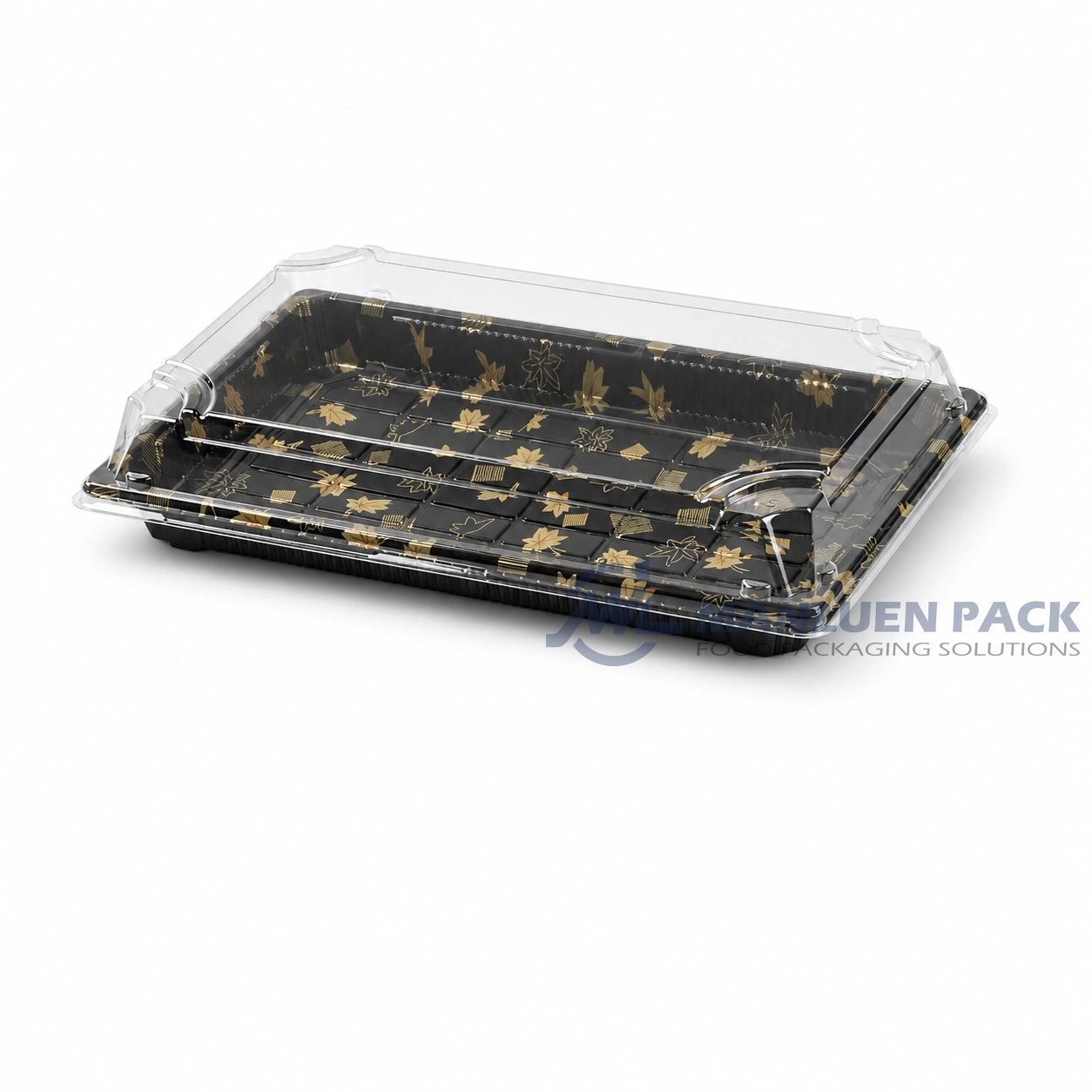
WL-10 Black and Gold Sushi Tray
A decorative rectangular format for arranged sushi presentation.
Listed material options: PS/OPS,PS/PET,PP/OPS,PP/PET. Confirm the PS base and selected lid material.
Featured products: WL-0.6 Small Sushi Tray (600 sets/CTN), WL-05 Black Sakura Sushi Tray (400 sets/CTN), and WL-10 Black and Gold Sushi Tray (300 sets/CTN). Material options vary by product. Specify the required PS base and lid material when requesting a quotation. A complete sushi container is not necessarily made entirely from polystyrene. Explore All Wholesale Sushi Trays
What Is Polystyrene Made Of?
Polystyrene is a synthetic polymer produced by polymerizing styrene monomers. Styrene contains a vinyl group attached to a phenyl group, and its polymerization produces long molecular chains with the repeating formula (C8H8)n. Most conventional commercial polystyrene is amorphous, meaning its molecular chains do not form the highly ordered crystalline structures found in certain other polymers. This structure contributes to the optical clarity and relatively high stiffness of general-purpose polystyrene, but it also helps explain the material’s limited toughness and temperature resistance in some applications. Manufacturers modify polystyrene through rubber modification, orientation, foaming, and other processing methods to obtain different performance characteristics.
Key Properties of Polystyrene Packaging
| Property | Typical Characteristic | Packaging Significance |
|---|---|---|
| Material Name | Polystyrene (PS) | A thermoplastic used in rigid and foam packaging |
| Resin Identification Code | #6 | Identifies PS resin, not guaranteed recycling acceptance |
| Density of Solid PS | Typically around 1.04–1.06 g/cm³ | Relevant to material weight and container design |
| Appearance | Clear, translucent, or opaque depending on grade | Suitable for different retail display requirements |
| Stiffness | Relatively high for common rigid PS grades | Supports shaped trays and thin-wall products |
| Impact Resistance | Limited in GPPS; improved in HIPS | Influences handling and shipping durability |
| Glass Transition | Often approximately 90–105°C for ordinary PS grades | Relevant to softening and dimensional stability |
| Water Resistance | Generally resistant to liquid water | Useful for certain food-service applications |
| Gas Barrier | Limited compared with some specialized packaging materials | Not automatically suitable for high-barrier food packaging |
| Recyclability | Technically recyclable in suitable systems | Actual collection and recovery remain limited in many locations |
| Biodegradability | Not readily biodegradable under ordinary conditions | Not conventional compostable packaging |
These are general material characteristics. Finished packaging performance depends on the PS formulation, thickness, processing history, geometry, and intended conditions of use. Foam PS products also have substantially different apparent densities and insulation characteristics from solid PS.
Types of Polystyrene Packaging
Polystyrene is available in several forms. Understanding the differences is important because a transparent OPS bakery box, a black HIPS food tray, and a white EPS foam container do not offer identical performance.
| Type | Main Characteristics | Common Packaging Applications |
|---|---|---|
| GPPS | Clear, rigid, glossy, relatively brittle | Selected transparent containers, cups, rigid lids |
| HIPS | Rubber-modified, improved toughness, generally opaque | Food trays, rigid packaging bases, selected containers |
| OPS | Oriented PS with high clarity and useful stiffness | Clear clamshells, bakery boxes, transparent food lids |
| EPS | Lightweight expanded foam with cushioning and insulation | Insulated containers, shipping protection, fish boxes |
| XPS | Extruded foam with a relatively uniform cellular structure | Foam sheets, selected formed trays, insulation products |
General-Purpose Polystyrene (GPPS)
GPPS is usually clear, rigid and glossy, making it useful where visibility and shape retention matter. It can be brittle under impact or concentrated stress; packages facing rough handling may require a modified grade, structural changes or a different polymer.
High-Impact Polystyrene (HIPS)
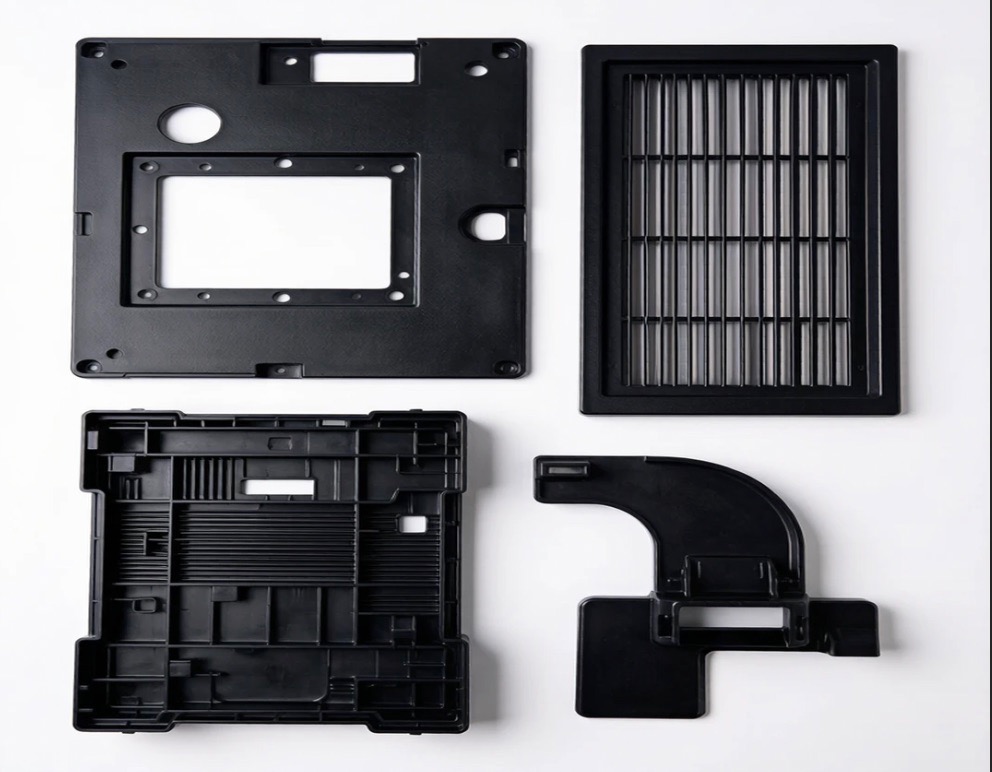
HIPS contains a dispersed rubber phase, commonly polybutadiene, that improves toughness relative to ordinary GPPS. It is useful for selected thermoformed trays and packaging bases. Rubber modification generally reduces transparency, so an opaque base and clear lid may use different materials. A black PS tray should not be called HIPS unless its grade is confirmed.
Oriented Polystyrene (OPS)
OPS is made by stretching PS sheet under controlled conditions. Orientation changes its structure and provides useful clarity and stiffness for thin-wall clamshells, bakery packs and display lids. Heat-related shrinkage and cracking remain considerations. See the OPS material guide for the process and application details.
Expanded Polystyrene (EPS)
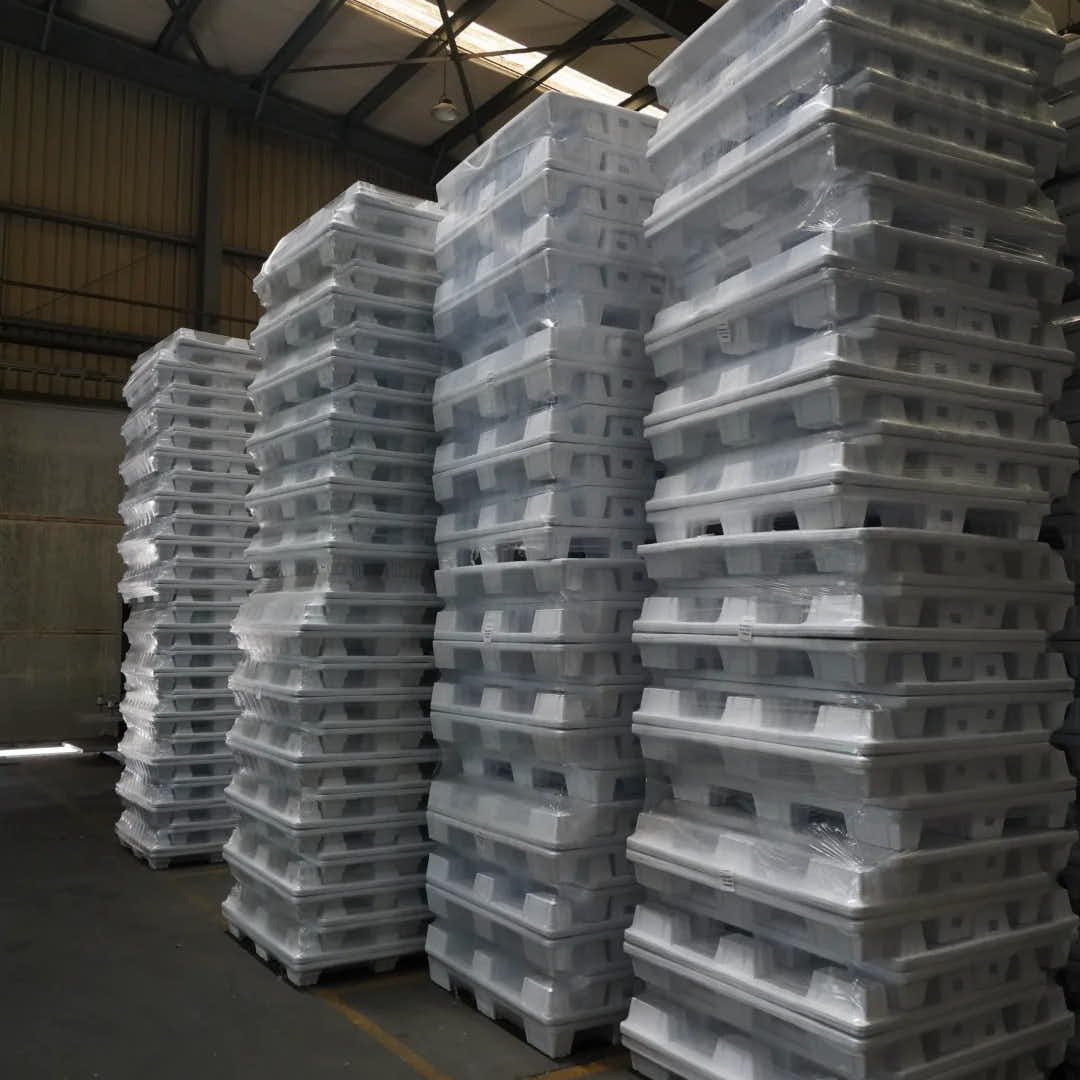
EPS is made from expandable PS beads that form a lightweight cellular structure with useful cushioning and thermal insulation. Applications include protective inserts, fish boxes and selected food-service containers. Its bulky, low-density form increases storage and transport demands during collection; insulation does not establish food-contact or heating suitability.
Extruded Polystyrene Foam (XPS)
XPS is produced by extrusion foaming. Foam sheet can be thermoformed into selected packaging, while other XPS products are designed for building insulation. EPS bead molding and XPS extrusion are different processes; specify the actual foam type and product rather than treating all PS foams as identical.
Polystyrene vs. Styrofoam: Are They the Same?
No. Polystyrene is the polymer family, while Styrofoam™ is a registered brand name associated with specific extruded polystyrene insulation products. In everyday language, particularly in North America, people often call white foam cups, takeaway boxes, and shipping inserts “Styrofoam.” However, many of those products are made from expanded polystyrene or other polystyrene foam forms rather than Styrofoam-branded insulation material. For packaging specifications and commercial purchasing, the correct material name should be used. The trademark owner distinguishes its XPS insulation from EPS cups and packaging. Terms such as GPPS, HIPS, OPS, EPS, and XPS provide more useful technical information than the generic use of “Styrofoam.”
What Is Polystyrene Packaging Used For?
Polystyrene packaging serves several industries, but its applications can be grouped into food packaging, protective shipping packaging, and insulated packaging.
1. Sushi Trays and Prepared Food Packaging
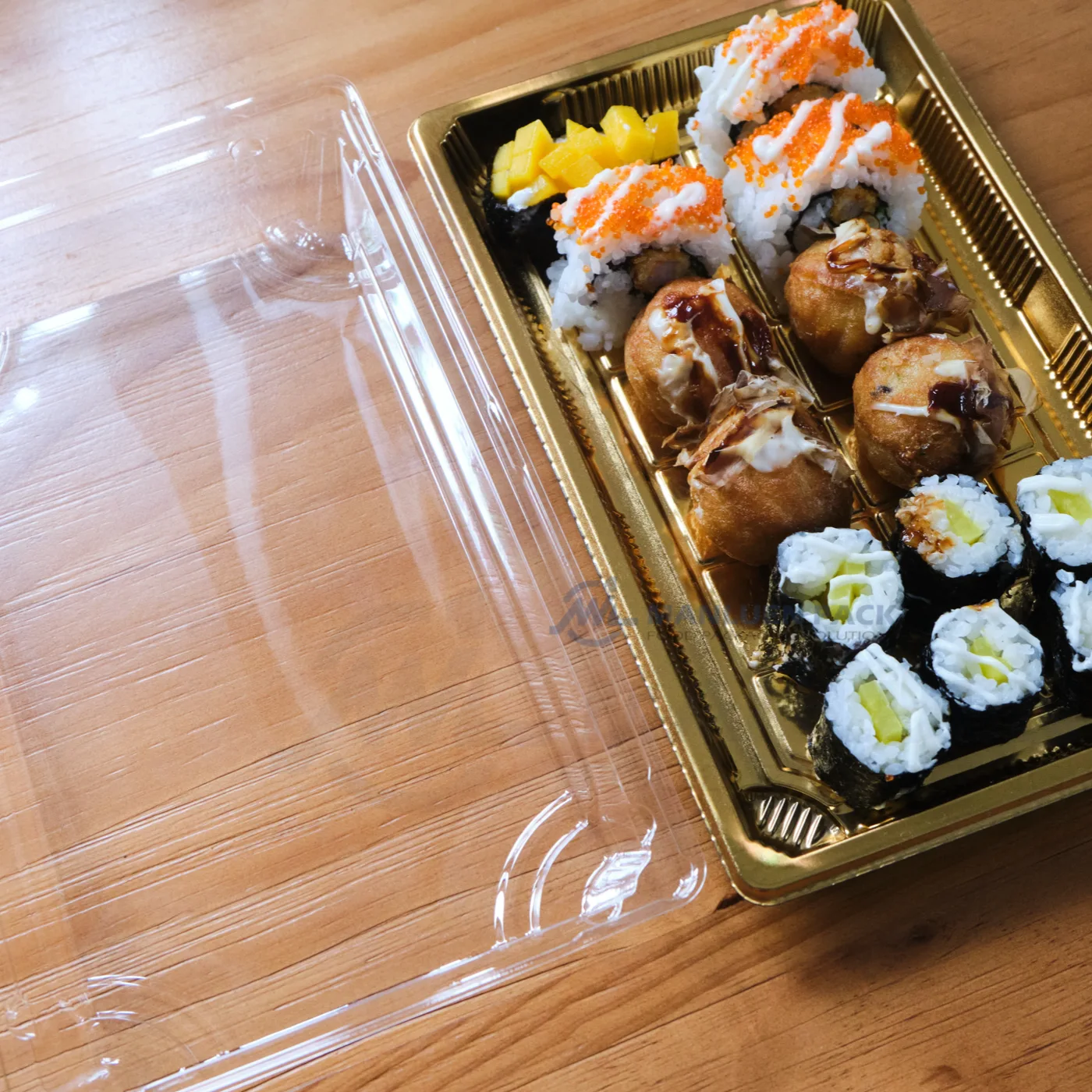
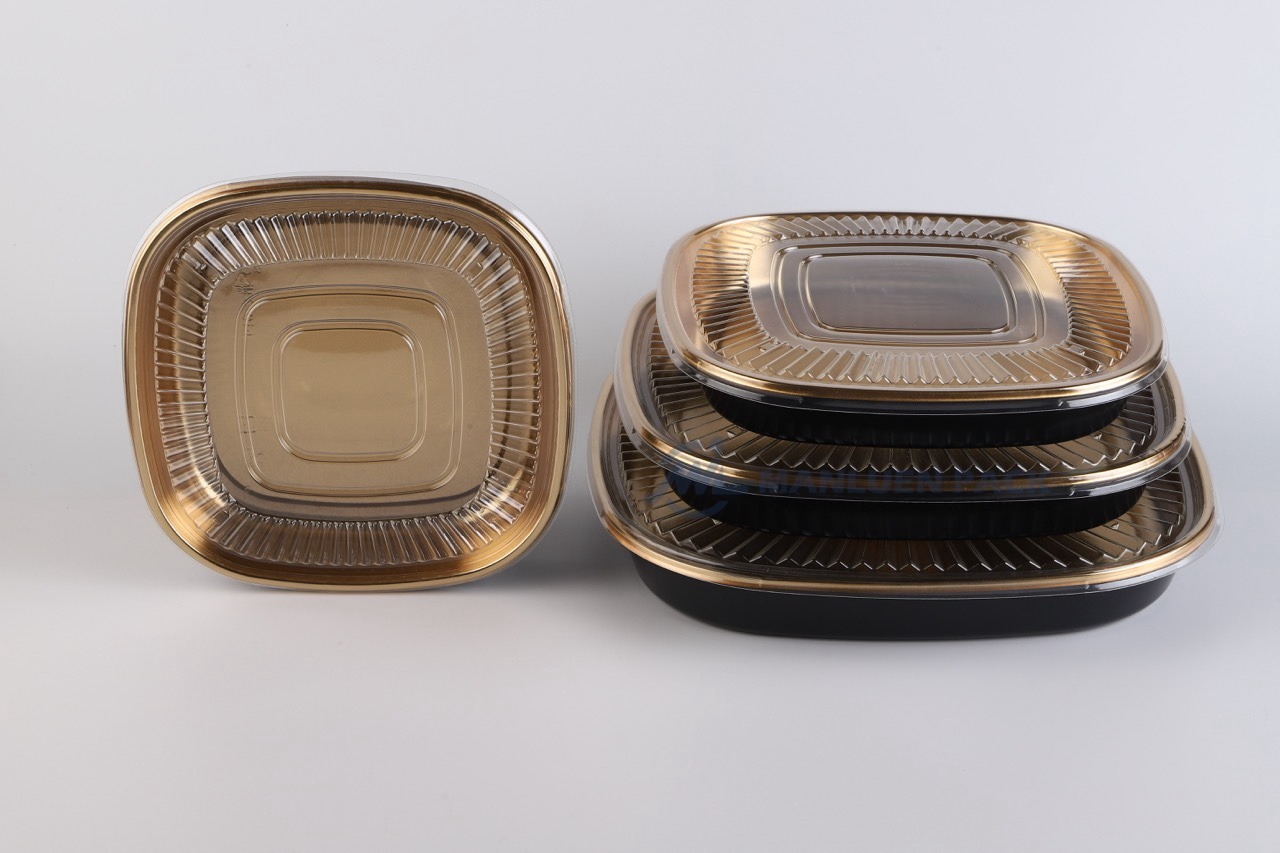
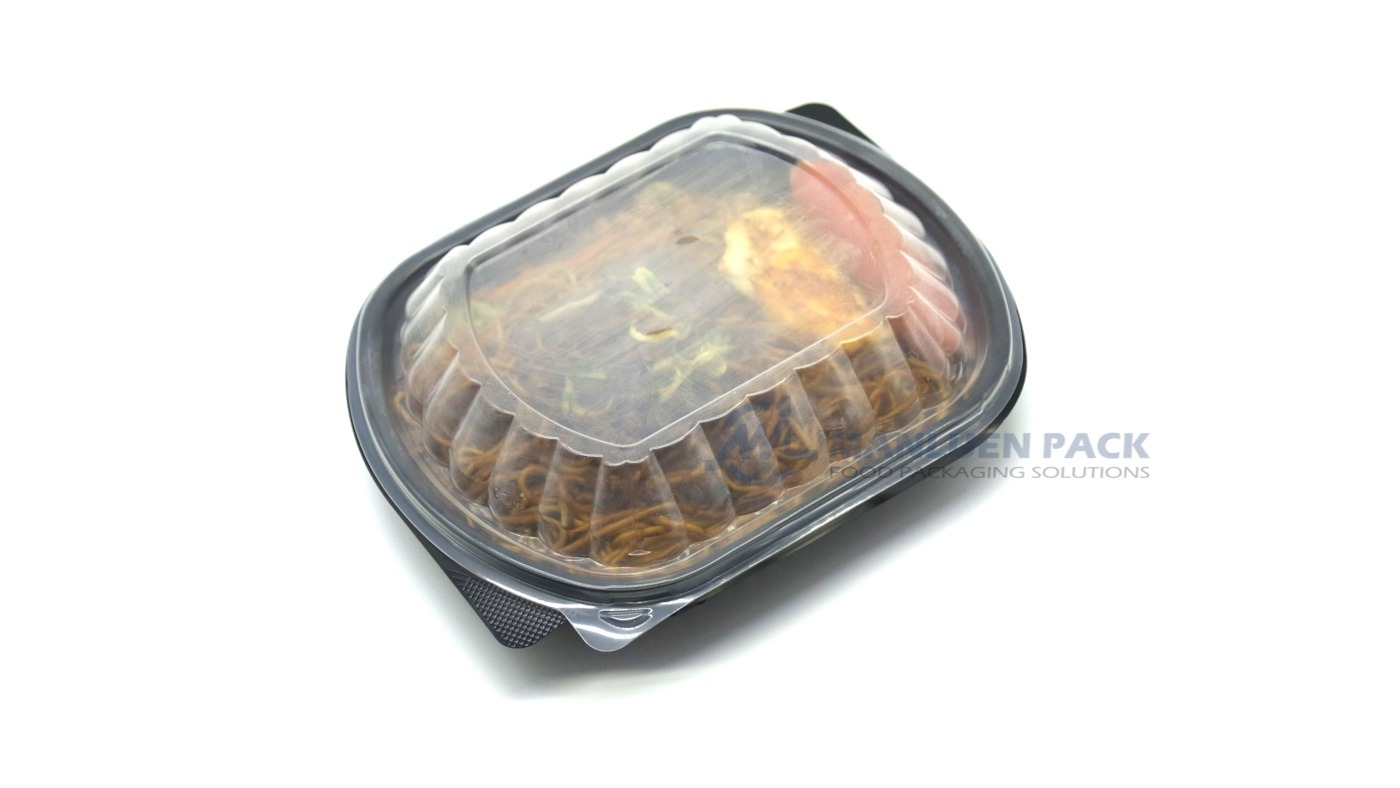
Rigid PS trays are commonly used for chilled sushi, sashimi, prepared food assortments, and retail takeaway products. They can provide a shaped base with a relatively economical material structure and allow manufacturers to create decorative patterns, compartments, and different color finishes. Transparent lids may be made from OPS, PET, or other suitable plastics depending on the product specification. For example, Manluen’s WL-10 sushi tray has listed configurations combining a PS base with either an OPS or PET lid. Selecting the correct material combination is important for appearance, closure compatibility, and food-contact documentation. View WL-10 Sushi Tray Material Options
2. Transparent Clamshell and Bakery Packaging
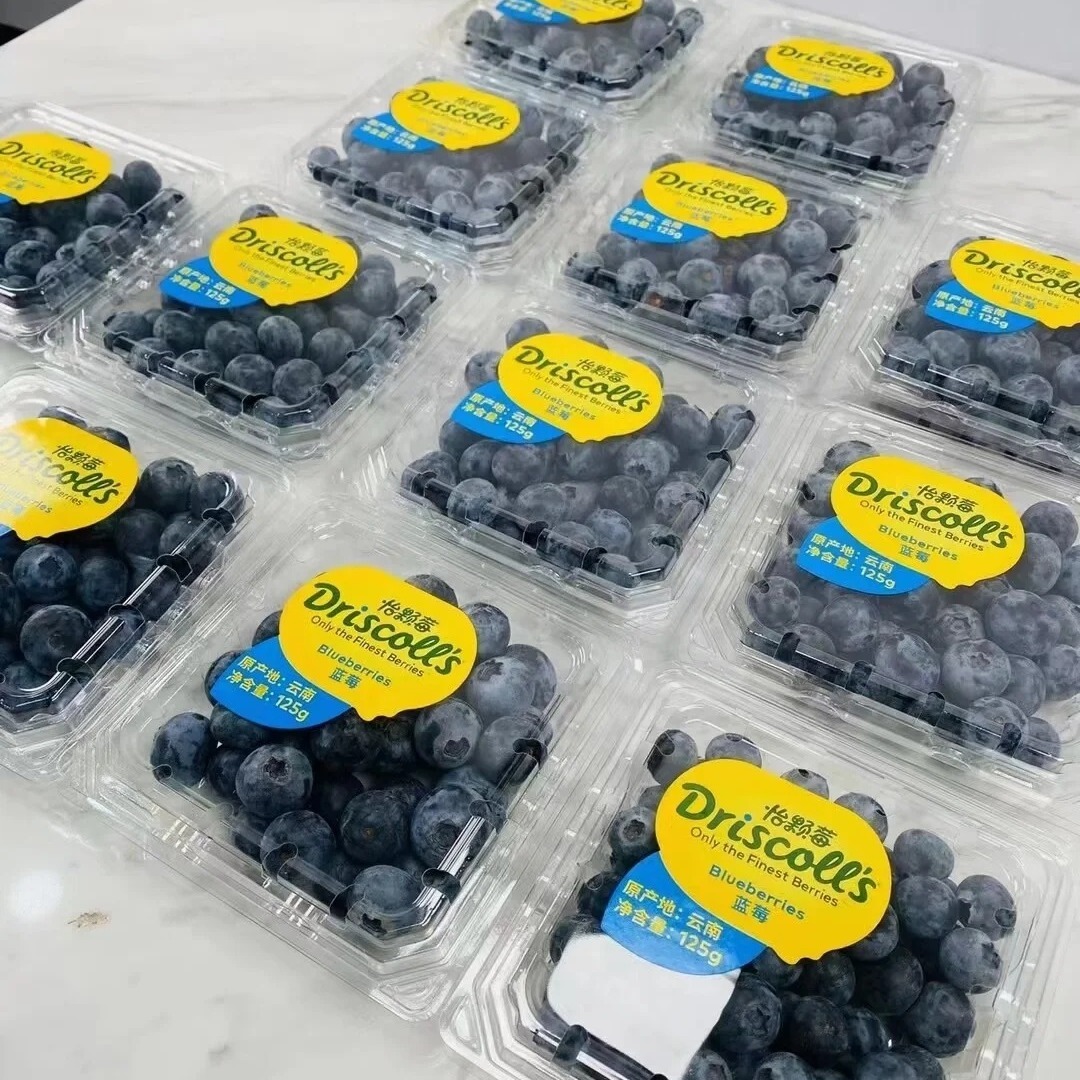
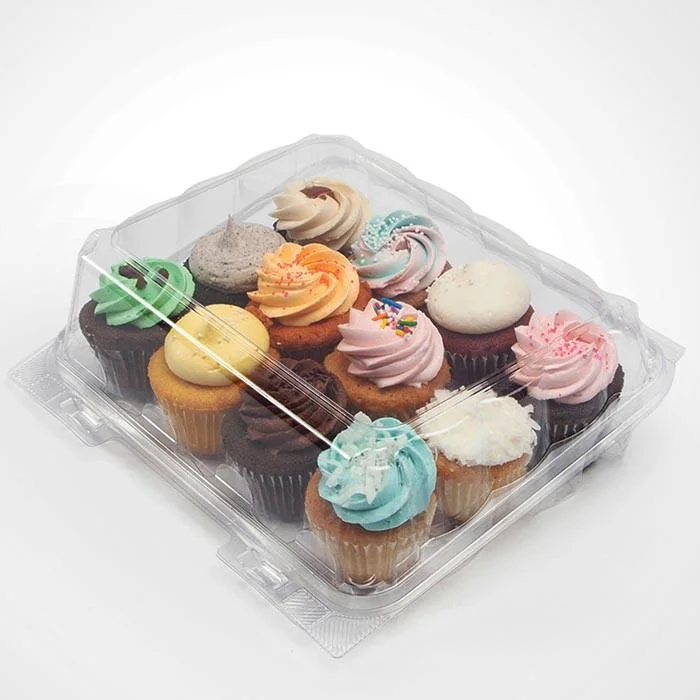
Transparent OPS containers are commonly used for bakery products, snacks, fruit, sushi assortments, and ready-to-go food displays. Their clear hinged structure allows customers to see the contents while providing a convenient one-piece opening and closing design. Container depth, hinge strength, closure fit, and stacking requirements influence suitability for different foods.
Wholesale OPS Clamshell Containers

WL-CM001 Small OPS Clamshell
A compact hinged format for fruit, snacks and small prepared-food portions.
Listed material: OPS.

WL-CM003 Rectangular OPS Clamshell
A wider hinged format for sushi assortments, bakery items and food display.
Listed material: OPS.
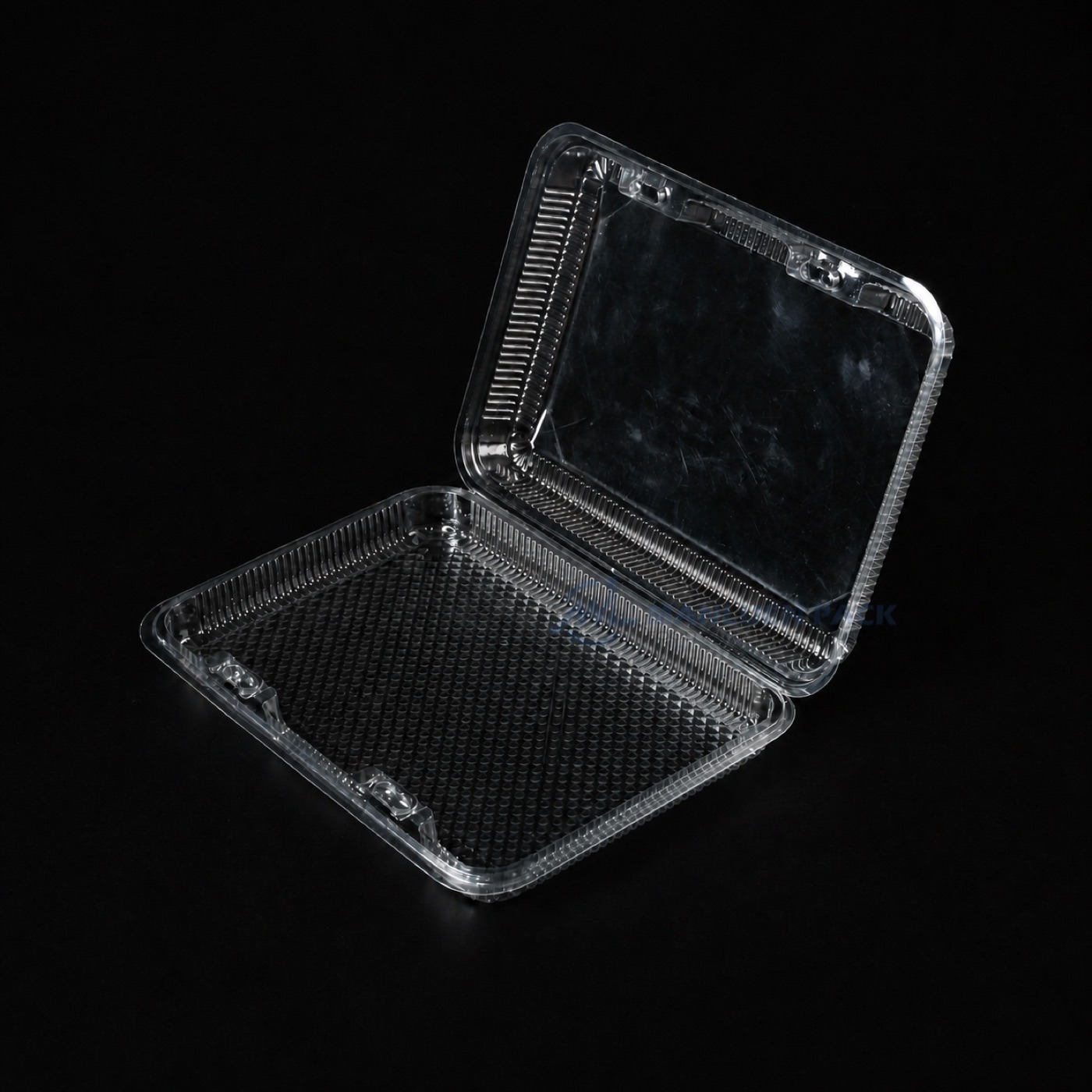
WL-CM004 OPS Bakery Box
A shallow, wide bakery format for cookies, pastries and assorted baked goods.
Listed material: OPS.
Manluen’s transparent OPS clamshell range includes WL-CM001 (152×85×70 mm; 500 PCS/CTN), WL-CM003 (215×155×55 mm; 400 PCS/CTN), and WL-CM004 (285×205×50 mm; 250 PCS/CTN). These products are identified as OPS rather than PET. They illustrate how an oriented polystyrene material can be used for transparent food display packaging. Explore Wholesale Clamshell Containers
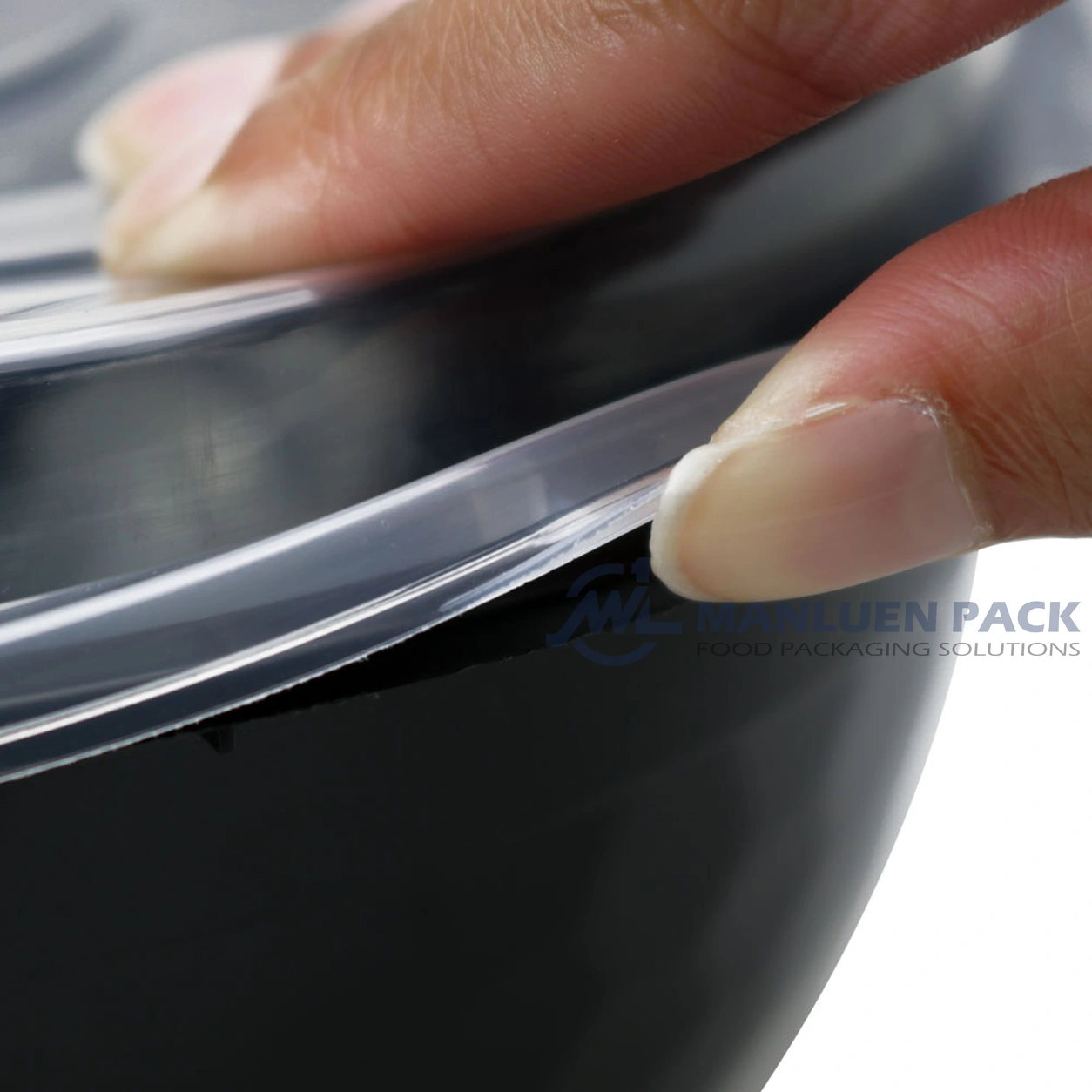
3. Disposable Cups, Lids, and Tableware
Polystyrene is also used in disposable cups, beverage lids, cutlery, plates, and food-service accessories. Rigid PS and foam PS may be selected for different purposes. For example, a rigid PS drinking cup may prioritize shape and clarity, while a suitable foam cup is designed to provide insulation. Because these products can differ greatly in their material structure, temperature suitability must be verified for the particular item.
4. Protective and Shipping Packaging
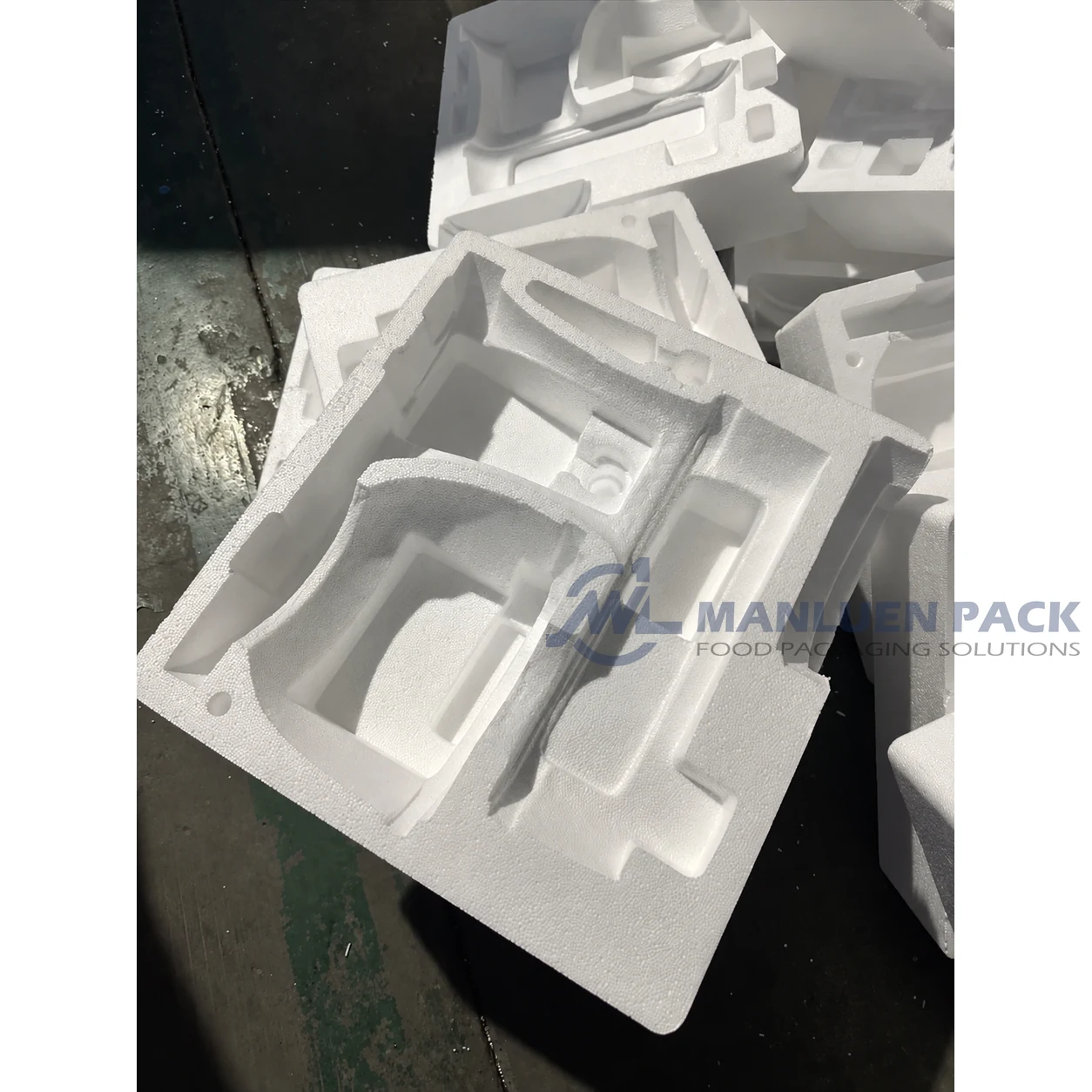
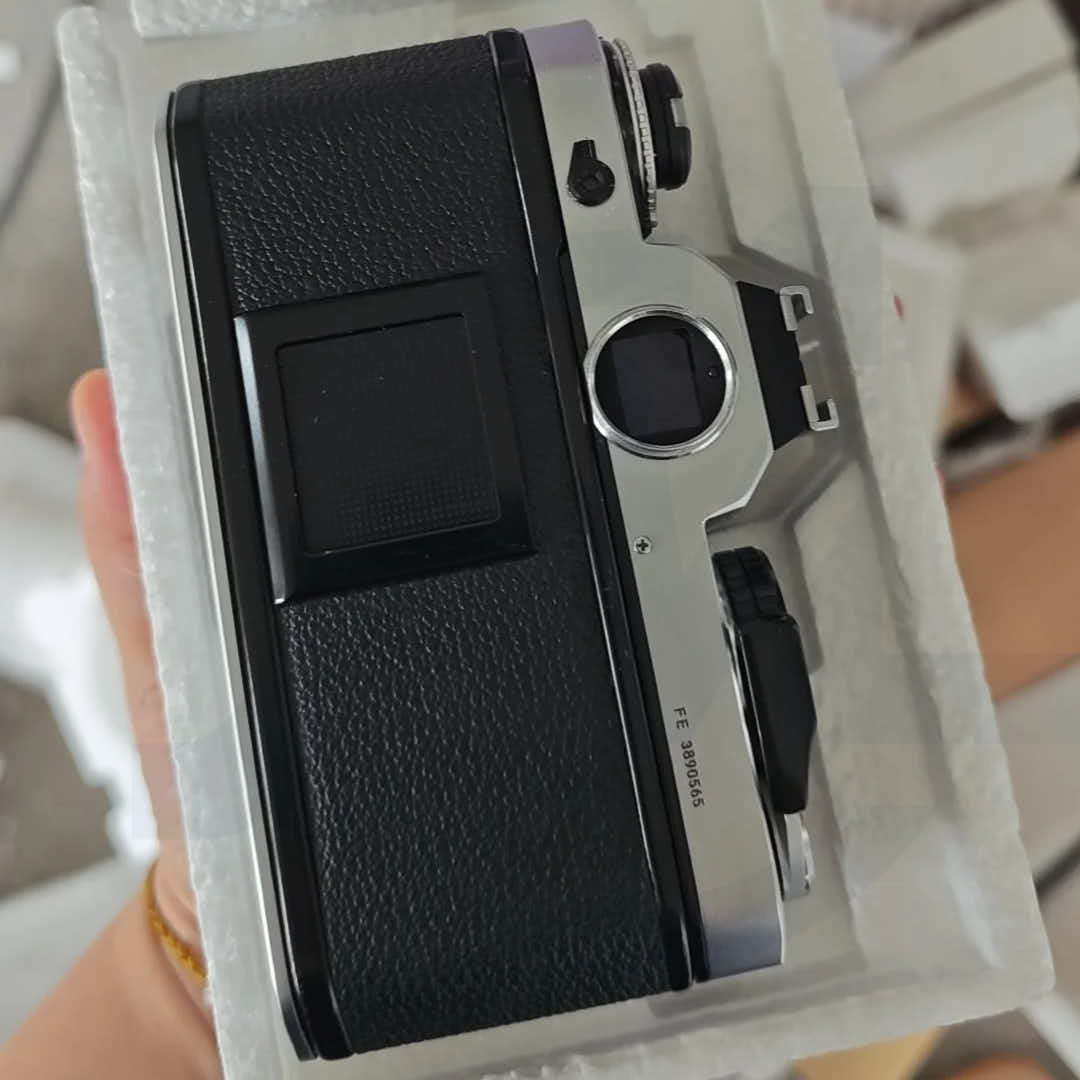
EPS is commonly used to protect electronics, appliances, glassware, and other products during transportation. Manufacturers can produce molded inserts, protective corners, and custom cushioning shapes designed to fit particular products. The foam structure can absorb part of the energy generated during handling and impacts, helping reduce product movement and damage. Packaging performance depends on density, geometry, the weight of the protected product, and expected transport conditions.
5. Insulated Seafood and Temperature-Sensitive Packaging
EPS is widely used for fish boxes, seafood containers, produce transport, and selected temperature-sensitive shipping systems. Its cellular structure helps reduce heat transfer, which can support insulation performance. However, insulation alone does not establish that a package can maintain a required cold-chain temperature. Temperature-sensitive shipments also need appropriate cooling media, package design, transport procedures, and validation.
How Is Polystyrene Packaging Manufactured?
Polystyrene packaging can be manufactured through injection molding, sheet extrusion, thermoforming, orientation, and foam molding. The process selected depends on the material grade and required package structure.
Injection Molding
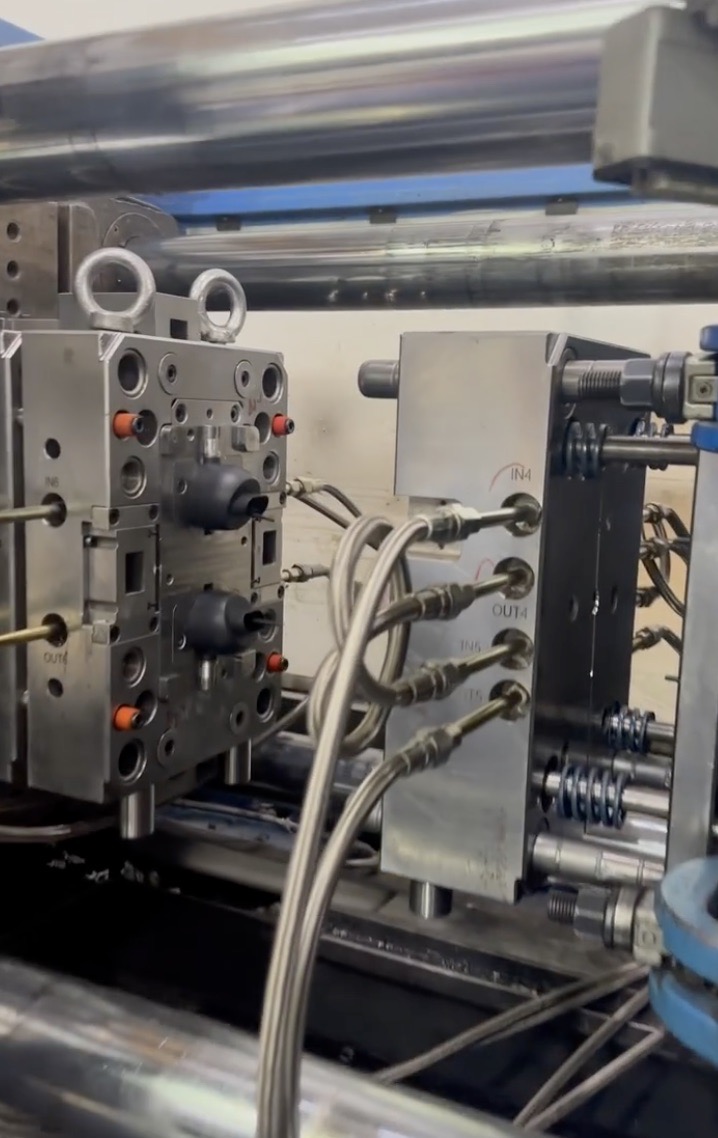
Injection molding is commonly used for certain rigid polystyrene products, including cups, lids, and other molded items. PS resin is heated and injected into a mold cavity, where it cools and solidifies into the required shape. Tool design and processing conditions influence surface appearance, dimensional accuracy, and mechanical performance.
Sheet Extrusion and Thermoforming
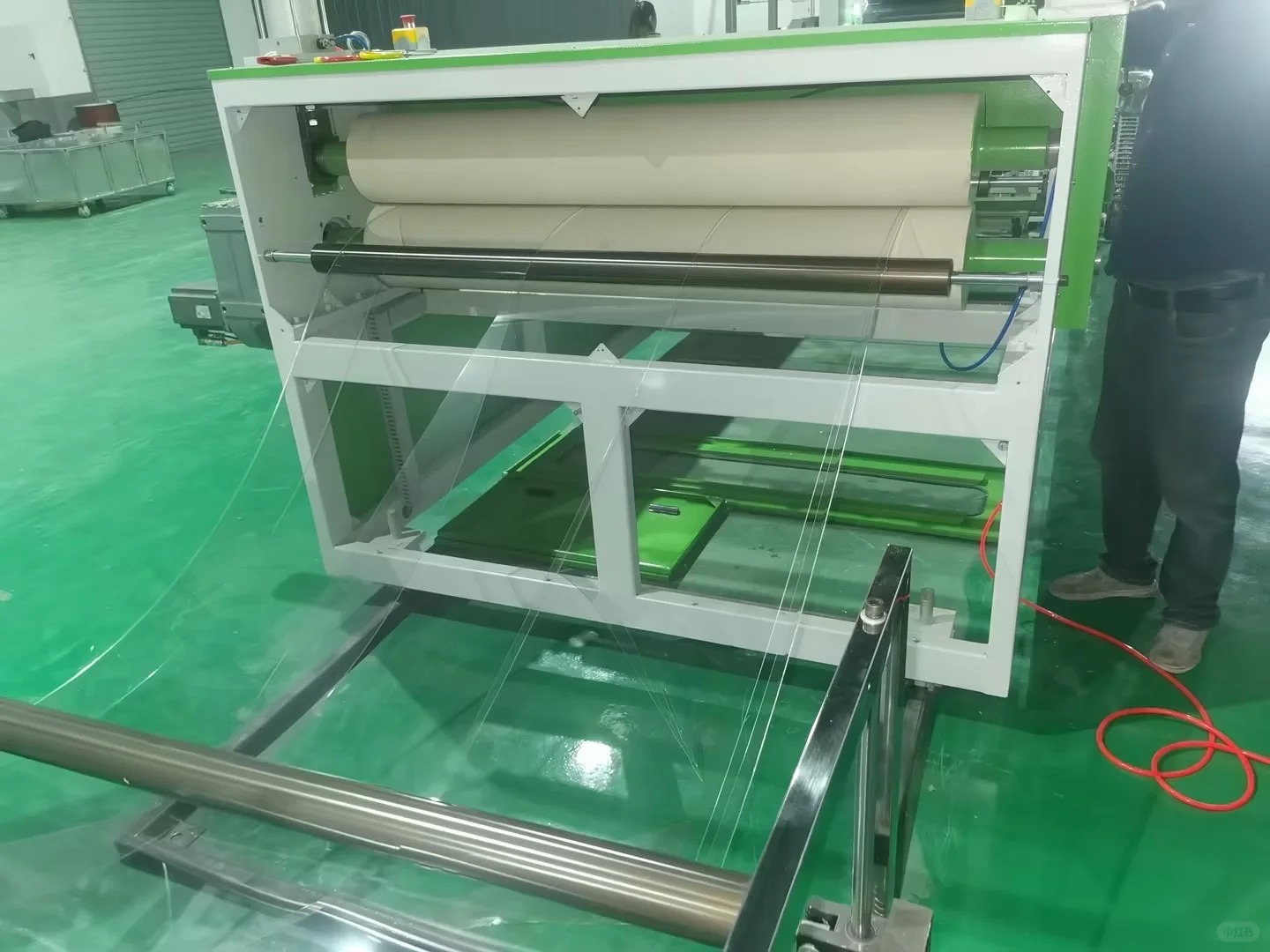
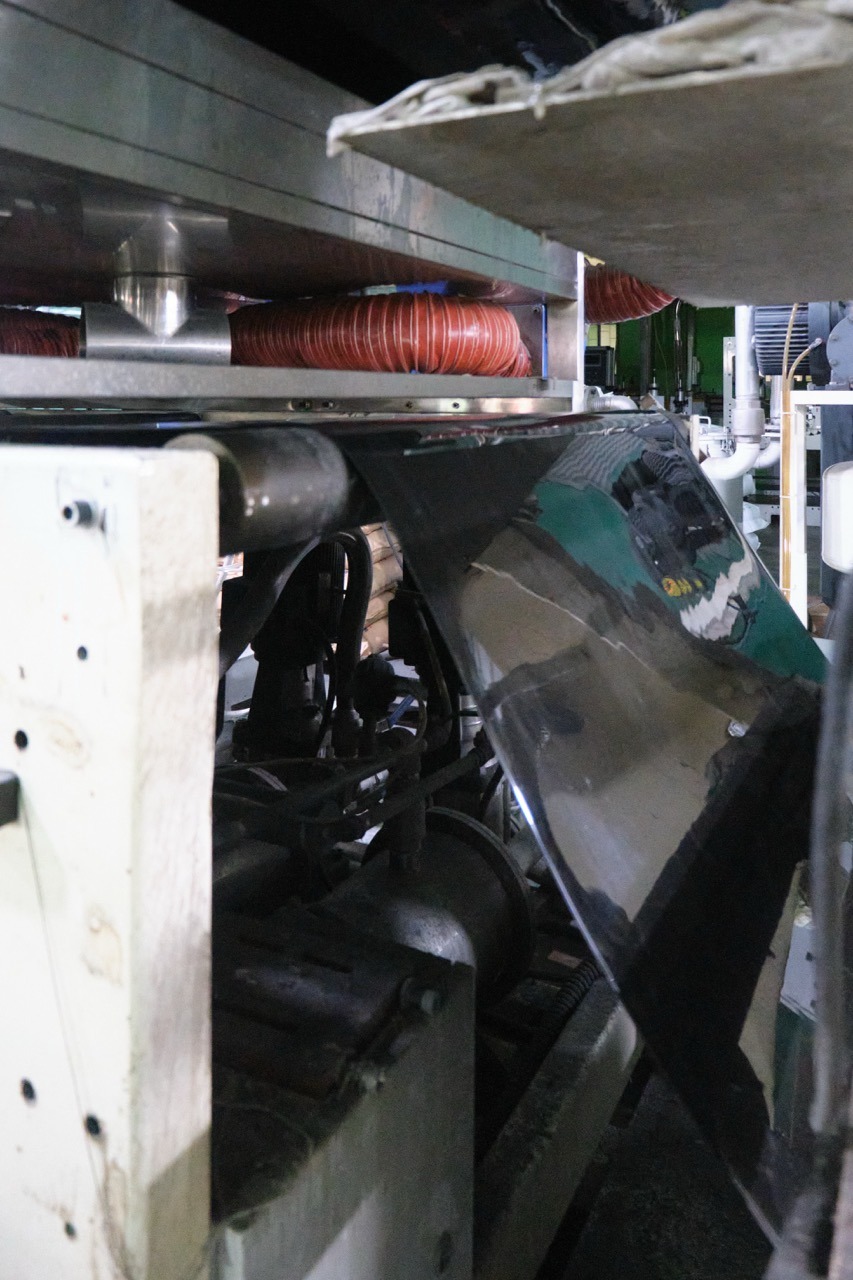
Thermoforming is widely used for rigid PS packaging and selected foam-sheet packaging. PS pellets are first melted and extruded through a flat die into sheet, then cooled and supplied in rolls or fed to an integrated line. During thermoforming, the sheet is heated to an appropriate forming temperature and shaped using vacuum, pressure, molds, or a combination of forming methods. The finished product is then cooled, trimmed, and inspected. For food trays, sheet thickness and material distribution influence rigidity, impact behavior, and stacking strength. The final wall thickness may differ across corners, sidewalls, and the container base. This makes packaging design and manufacturing control important parts of product quality.
OPS Orientation and Forming
OPS production involves stretching suitable polystyrene sheet under controlled conditions. This changes its orientation and can improve selected optical and mechanical characteristics. The resulting material can be formed into clear food containers, clamshells, and other transparent packaging. Since oriented PS can exhibit heat-related shrinkage and cracking under unsuitable conditions, manufacturers must consider both processing requirements and the intended use of the finished package.
EPS Bead Expansion and Molding
Expandable beads are pre-expanded, conditioned and placed in a mold, where heating fuses them into a cushioning or insulating shape. This is distinct from extrusion foaming followed by thermoforming, which is used for certain foam-sheet trays. Neither process is the same as forming a solid PS food tray.
Advantages and Limitations of Polystyrene Packaging
Polystyrene remains commercially useful because it can provide different combinations of stiffness, transparency, insulation, and cost efficiency. However, its limitations must be considered alongside those benefits.
| Advantages | Limitations |
|---|---|
| Rigid PS can be economical and easy to form | GPPS can be brittle under impact |
| GPPS and OPS can provide good clarity | HIPS is generally less transparent |
| HIPS offers improved toughness | Performance still depends on formulation and geometry |
| EPS provides useful insulation and cushioning | Foam waste can be costly to collect and transport |
| Different molding methods support varied designs | Common PS packaging has limited high-temperature suitability |
| PS can be technically recycled | Local recycling acceptance is often limited |
For packaging buyers, these characteristics should be compared with actual application requirements rather than used as universal claims about every polystyrene product.
Is Polystyrene Packaging Safe for Food?
Polystyrene can be used for food-contact packaging when its material formulation and finished product comply with applicable requirements for the intended food, temperature, and duration of contact. However, not every PS package is automatically suitable for hot foods, microwave heating, or all food types. Food-contact safety must be assessed using the finished material and its intended conditions of use.
Styrene vs. Polystyrene: What Is the Difference?
Styrene is the monomer; polystyrene is the polymer formed by joining styrene molecules. The U.S. National Toxicology Program classifies styrene as reasonably anticipated to be a human carcinogen. That hazard classification is not a risk assessment of every finished PS food container. Food-contact evaluation considers residual styrene, migration and exposure under the actual food, time and temperature conditions.
Is Polystyrene FDA Approved?
In the United States, 21 CFR 177.1640 establishes requirements for polystyrene and rubber-modified polystyrene used in specified food-contact applications. Compliance depends on the specific material formulation and applicable conditions of use. The existence of a food-contact regulation does not mean that every item marked PS #6 is automatically suitable for any food or temperature. Commercial buyers should request appropriate supplier documentation covering the intended application.
Polystyrene Food Contact in the European Union
In the European Union, applicable food-contact requirements include Regulation (EC) No 1935/2004 and Regulation (EU) No 10/2011, as amended. These rules establish requirements relating to food-contact safety, permitted substances, migration, and supporting compliance documentation. Buyers should confirm that the selected material and finished packaging are suitable for the relevant food and contact conditions.
Can Styrene Migrate from Polystyrene Packaging?
Migration of residual styrene and certain other substances from polystyrene food-contact materials has been studied. Migration behavior can depend on temperature, food composition, contact duration, and the formulation of the finished package. For example, some fatty or alcoholic food-contact conditions may require particular attention during material evaluation. The fact that migration can occur does not automatically establish an unacceptable health risk. Regulatory compliance involves assessing relevant substances and exposure against applicable requirements. Food packaging suppliers should therefore avoid absolute claims that all PS containers are either completely harmless or inherently unsafe.
Is Polystyrene Packaging Microwave Safe?
Use PS packaging for microwave heating only when the finished product is specifically rated for that use. Neither resin code #6 nor the polymer’s glass-transition temperature establishes a heating limit. Ordinary sushi trays, OPS display packs and foam containers should not be reheated without appropriate instructions. Confirm the food type, heating time, temperature and lid handling. A rated base does not automatically validate its lid, and microwave suitability does not establish conventional-oven suitability. The FDA recommends cookware manufactured for microwave use.
Is Polystyrene Packaging Recyclable?
Polystyrene is technically recyclable, but many polystyrene packaging products are not accepted by ordinary curbside recycling programs. Actual recycling depends on material type, collection availability, contamination, sorting technology, and the market for recovered PS. The #6 resin identification code identifies the polymer family. It does not guarantee that the package will be recycled.
Rigid Polystyrene Recycling
Rigid polystyrene products can be processed through suitable recycling systems involving collection, sorting, cleaning, size reduction, and melt reprocessing. However, food residues, labels, mixed materials, coloring, and local collection limitations can affect whether a particular item is accepted. OPS and HIPS are part of the broader PS material family, but their actual recycling acceptance depends on the specific program and product characteristics.
Why Is EPS Foam Difficult to Recycle?
EPS presents additional collection challenges because it has a low apparent density. Large volumes of foam can occupy significant transport and storage space while containing relatively little polymer by weight. Used food containers may also be contaminated with oils, sauces, or other food residues. Specialized EPS recycling operations may use compaction or densification to reduce volume before further processing. For example, an EPS recycler may accept clean protective packaging and fish boxes while refusing used food-service cups or contaminated trays. These restrictions are often operational requirements of the collection system rather than proof that the polymer itself cannot be recycled.
Can Polystyrene Be Chemically Recycled?
Polystyrene can also be processed through certain chemical recycling technologies, including thermal depolymerization and other methods that recover chemical feedstocks. Some technologies aim to recover styrene or produce other chemical products from PS waste. However, technical feasibility does not guarantee widespread commercial availability. Energy requirements, feedstock quality, economics, and processing infrastructure remain important considerations.
What About Black Polystyrene Packaging?
Some carbon-black pigments interfere with conventional near-infrared sorting, but not every black formulation behaves identically. Detectable pigments and different sorting systems can change the outcome. Ask whether the actual package is accepted and recoverable in its intended recycling stream, rather than assuming that all black plastic is either recyclable or unrecyclable.
Is Polystyrene Packaging Biodegradable?
Conventional rigid PS and PS foam are not readily biodegradable under ordinary environmental conditions and should not be marketed as compostable. Weathering can fragment discarded items into smaller plastic pieces. Research into biological or chemical breakdown under specific conditions does not mean a tray or foam box will rapidly biodegrade in soil, seawater or home compost.
Is Recyclable the Same as Biodegradable?
No. Recyclability refers to whether materials can be recovered and processed into new materials or products. Biodegradability concerns biological breakdown under defined conditions. A material can be technically recyclable without being biodegradable, and a biodegradable material is not necessarily accepted by local composting systems. These characteristics should be evaluated separately when selecting packaging.
Is Polystyrene Packaging Banned?
Polystyrene packaging is restricted in certain markets, but there is no single worldwide ban covering every PS packaging type. Regulations differ by country, state, municipality, product format, and intended application. Many policies specifically target disposable EPS or XPS foam food-service products rather than all rigid polystyrene packaging.
Polystyrene Packaging Restrictions in the United States
Restrictions vary by state and locality, including product definitions, exemptions and implementation dates. For example, New York’s foam-ban guidance distinguishes covered foam products from rigid, non-foamed PS food containers. This example does not establish permission in another jurisdiction; check the specific market and product category.
Polystyrene Packaging Regulations in the European Union
The Single-Use Plastics Directive (EU) 2019/904 restricts specified EPS food containers, beverage containers and beverage cups. The food-container category has defined conditions, including immediate consumption and food ready to eat without further preparation. Regulation (EU) 2025/40 generally applies from 12 August 2026, but its Article 67(5) amendment explicitly covering EPS and XPS in these categories applies from 12 February 2029. Do not describe that particular amendment as already applicable before this date. These provisions are not a blanket ban on all rigid GPPS, HIPS or OPS packaging; other EU and national requirements still need review.
What Should Packaging Importers Check?
Before purchasing PS packaging for a regulated market, buyers should identify the exact polymer and packaging format, determine whether the product is disposable food-service packaging, and review any applicable local restrictions. Where a specific PS product cannot be used, an alternative material should be selected based on both legal requirements and actual food-packaging performance.
Polystyrene vs. PET, PP, and Bagasse Packaging
Polystyrene is not necessarily the most suitable material for every packaging application. Buyers should compare alternatives according to food temperature, visibility, strength, environmental requirements, and budget.
| Material | Main Advantages | Important Limitations | Common Food Packaging Uses |
|---|---|---|---|
| PS / HIPS | Stiffness, formability, potentially economical production | Temperature limits, impact behavior, local recycling and regulatory restrictions | Sushi trays, food bases, selected disposable containers |
| OPS | Clarity and thin-wall stiffness | Heat sensitivity and possible cracking | Bakery clamshells, clear food boxes, lids |
| EPS / XPS Foam | Lightweight cushioning and thermal insulation | Collection challenges and some legal restrictions | Insulated containers, foam trays, protective packaging |
| PET | High clarity, toughness, useful barrier performance | Ordinary APET is not automatically microwave-safe | Clear food trays, clamshells, lids, beverage bottles |
| PP | Toughness, chemical resistance, suitable higher-temperature grades | Transparency and barrier properties vary | Takeaway boxes, bento containers, selected microwavable trays |
| Bagasse | Plant-fiber-based packaging, potential compostability with suitable specifications | Moisture resistance, coatings, composting infrastructure, product-dependent performance | Food trays, takeaway boxes, plates |
When Should You Choose Polystyrene Instead of PET?
PS or HIPS can be considered for rigid packaging applications where cost, stiffness, decorative appearance, and suitable cold-food performance are priorities. PET food packaging can be considered when clarity, toughness or particular barrier properties are priorities. For clear bakery containers, OPS and PET may both be considered, but the final choice should reflect the package’s dimensions, mechanical demands, temperature conditions, and available recycling options.
When Is PP a Better Choice?
PP is commonly considered for food packaging applications requiring greater toughness or higher-temperature performance. Some PP products are specifically designed for microwave reheating, although microwave suitability still depends on the finished package and its components. For products intended only for chilled display, PS may remain a suitable option when the finished package meets the required food-contact and structural specifications.
Are Paper or Bagasse Containers Better Alternatives?
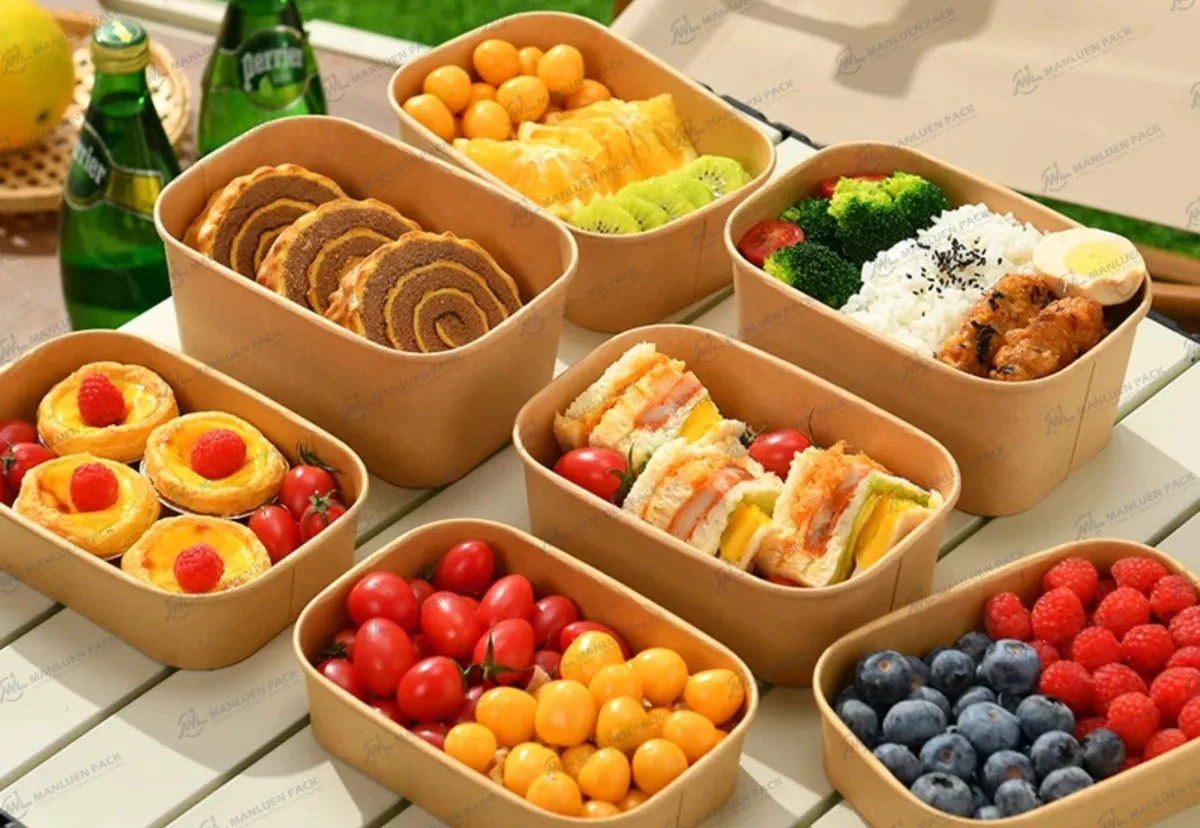
Paper and bagasse packaging can be appropriate alternatives for some food-service applications, particularly where specific plastic restrictions apply. However, they should not automatically be assumed environmentally superior in every application. Food-contact requirements, moisture and grease resistance, coatings, material weight, disposal infrastructure, and overall packaging performance must all be considered.
How to Choose Polystyrene Packaging for Your Business
For restaurants, distributors, supermarkets, and food manufacturers, choosing polystyrene packaging requires more than comparing material prices. The finished package must meet the actual requirements of the food and distribution process.
| Selection Factor | Questions Buyers Should Ask |
|---|---|
| Material Type | Is the product GPPS, HIPS, OPS, EPS, or another PS formulation? |
| Food Application | Will it contain sushi, bakery products, seafood, snacks, or prepared meals? |
| Temperature | Is it designed for chilled, ambient, frozen, or specifically validated heated use? |
| Transparency | Does the food need to remain visible during display? |
| Structure | Are the dimensions, wall thickness, compartments, and stacking strength suitable? |
| Lid Compatibility | What materials are used for the base and lid, and how do they fit together? |
| Food Contact | What documentation supports the intended food-contact conditions? |
| Regulations | Are the material and packaging format permitted in the target market? |
| Recycling | Will the destination market accept the actual packaging configuration? |
| Wholesale Supply | What are the carton quantities, MOQ, material options, and customization requirements? |
Match the Packaging to the Food
A sushi tray may prioritize chilled-food presentation, secure lid fit, and convenient stacking. A transparent bakery clamshell may need sufficient height to protect delicate decorations. A food tray carrying heavier portions may require a different wall thickness or material formulation. These differences are why selecting the right packaging should begin with the intended application rather than a general assumption that one plastic is best for all food products.
Check Both Base and Lid Materials
Some food containers combine more than one material. For example, a sushi box may use a PS base with a transparent OPS or PET lid. Its complete structure, food-contact conditions, and recycling implications should be evaluated accordingly. Buyers should request material details for each component rather than assuming that the entire container uses the same resin.
Compare Standard Packaging with Custom Designs
Standard packaging sizes may offer practical sourcing advantages, while custom dimensions, colors, and designs can help businesses meet more specialized requirements. Custom products may involve mold development, material selection, sampling, and production planning. The commercial suitability depends on production quantity and the agreed specifications. Before placing a bulk order, buyers should evaluate samples using their actual food products, operating temperatures, storage conditions, and transportation methods.
Wholesale Polystyrene Food Packaging from Manluen Pack
Manluen Pack manufactures and supplies food packaging for restaurants, supermarkets, delis, sushi shops, bakeries, catering businesses, and packaging distributors. Our product range includes sushi trays with PS material options and transparent OPS clamshell containers, alongside alternative packaging materials such as PP, PET, and bagasse. Different sizes, colors, and product configurations are available across the collection, allowing commercial buyers to choose packaging according to the intended food application and purchasing requirements. Wholesale minimum orders generally start from 30 cartons or 5,000 pieces, depending on the product. Specific material combinations, carton quantities, customization options, and final order requirements should be confirmed before purchasing.
To request a quotation, please provide your intended food application, product dimensions, required material, preferred lid combination, target market, and estimated order quantity. Contact Manluen Pack for Wholesale Packaging Quotes
Frequently Asked Questions About Polystyrene Packaging
What Is Polystyrene Packaging Made From?
Polystyrene packaging is made from polystyrene, a thermoplastic polymer manufactured from styrene monomers. It can be processed into rigid plastic products or foamed into lightweight cellular materials.
What Is the Difference Between PS and HIPS?
GPPS is generally clear and rigid but relatively brittle. HIPS is modified with a rubber phase to improve toughness, usually with reduced transparency. The better choice depends on the specific packaging application.
Is Polystyrene Safe for Food Packaging?
Polystyrene can be used for food-contact applications when the finished product complies with relevant requirements for the intended food, temperature, and contact duration. General PS material identification does not guarantee suitability for every application.
Is Polystyrene Packaging Microwave Safe?
Polystyrene packaging should not be assumed microwave-safe. Only use a specific product for microwave heating when its manufacturer confirms that it is designed and suitable for the intended heating conditions.
Can Polystyrene Packaging Be Frozen?
Some polystyrene packaging products can be suitable for chilled or frozen applications. However, low-temperature toughness and resistance to damage depend on the material grade and container design.
Is Polystyrene Packaging Recyclable?
Polystyrene is technically recyclable, but many conventional recycling programs do not accept PS food packaging or EPS foam. Actual recycling availability depends on the packaging type and local collection system.
Is Polystyrene Packaging Biodegradable?
No. Conventional polystyrene is not readily biodegradable under ordinary environmental conditions and should not be treated as compostable packaging.
Is Polystyrene the Same as Styrofoam?
No. Polystyrene is a polymer family. Styrofoam is a registered brand name associated with certain XPS insulation products, although people often use the word informally for other PS foam packaging.
Is Polystyrene Packaging Banned?
Some countries, states, and municipalities restrict specific polystyrene products, particularly EPS or XPS foam food-service packaging. Restrictions vary by material type, product format, and jurisdiction, so buyers should check the requirements of their target market.
Which Is Better for Food Packaging, PS or PET?
PS may be suitable for economical rigid trays and certain display applications, while PET often provides greater toughness and excellent clarity. The best choice depends on the actual food, packaging design, operating temperature, and recycling requirements.
Can Polystyrene Food Packaging Be Customized?
Selected PS and OPS packaging products may be available in different dimensions, colors, patterns, and material combinations. Customization availability depends on the specific product and production requirements.
Conclusion
Choose polystyrene packaging by its material form and finished-package performance. Clear OPS clamshells, rigid PS bases and EPS shipping inserts solve different problems. Verify food contact, temperature, closure, handling and local restrictions before purchasing. Compare samples with the real food and delivery process, then confirm the base and lid materials and complete-set price. Explore Manluen’s sushi trays and transparent clamshell containers, or request a wholesale quotation for the intended application.
References and Further Reading
- U.S. FDA. 21 CFR 177.1640 — Polystyrene and Rubber-Modified Polystyrene. Food-contact material requirements.
- European Parliament and Council. Regulation (EC) No 1935/2004. General food-contact material requirements.
- European Commission. Regulation (EU) No 10/2011. Plastic food-contact materials and articles.
- European Parliament and Council. Directive (EU) 2019/904. Restrictions addressing certain single-use plastic products.
- European Parliament and Council. Regulation (EU) 2025/40. Packaging and packaging waste requirements and amendments.
- National Toxicology Program. Styrene — Report on Carcinogens Profile. Styrene hazard classification.
- Dart Container. Expanded Polystyrene Foam Material Resources. Foam packaging applications and manufacturing information.
- StyroCycle. EPS Recycling Resources. Recycling collection and material acceptance information.
- Universal Foam Products. EPS Packaging and Shipping Solutions. Protective packaging design and applications.
- Wikipedia. Polystyrene. General polymer structure, material forms, applications, and references.
- New York State DEC — Polystyrene Foam Ban. Product scope and rigid-PS distinctions.
- DuPont — Styrofoam Is Not a Cup. Trademark and EPS/XPS distinction.
- FDA — Microwave Ovens. Microwave cookware guidance.

ManLuen Plastic Packaging Company, which is specialized in the production of Plastic Food Packaging for more than 20 years. Our products are made from 100% virgin and BPA-Free PP, PS, and OPS comply with FDA and European Standards.
 EN
 ZH
 FR
 PT
 ES
 KO
 JA