
Introduction
PET food packaging is packaging made from polyethylene terephthalate, a lightweight thermoplastic polyester used in clear food trays, clamshells, lids, beverage bottles and packaging films. It combines transparency with useful stiffness and toughness, making it a practical option for chilled food display, fruit, bakery products and sushi packaging. The material designation matters: transparent APET is commonly used for chilled and ambient applications; CPET is engineered for selected higher-temperature uses; and rPET identifies recycled content rather than a heat-resistance grade. A PET lid may also be paired with a base made from another material.
PET carries resin identification code #1 and can be recycled through suitable systems, but local acceptance varies by packaging format. It is not readily biodegradable under ordinary environmental conditions. This guide explains its material forms, manufacturing, food-contact requirements, recycling and purchasing considerations.

PET Food Packaging Examples from Manluen
These product pages list PET either as the material or among the available options. Product photos show the format, not proof of the resin used in the pictured sample.
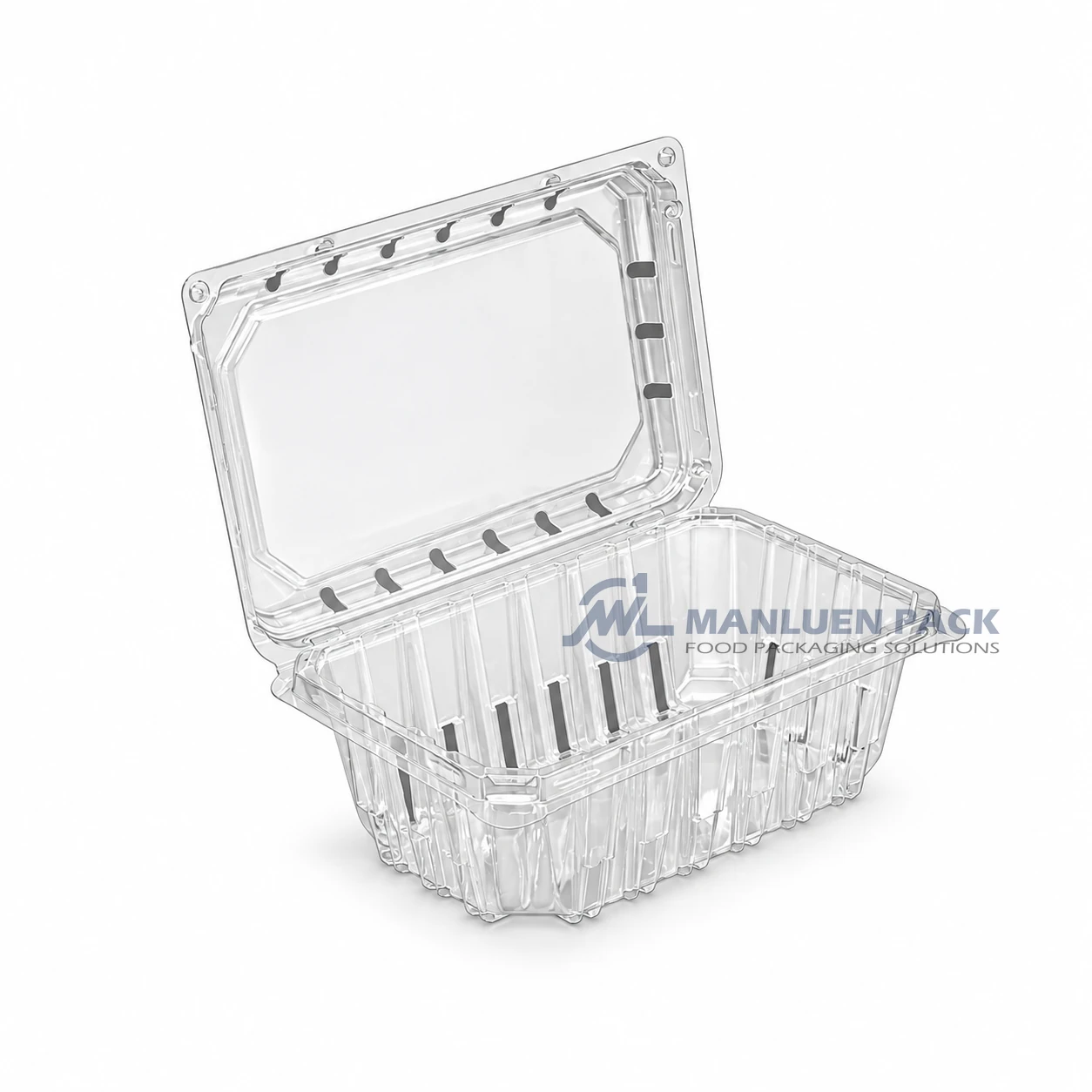
ML-500C1 PET Berry Clamshell
A clear hinged format for blueberry and other small-fruit retail portions.
Listed material: PET.

WL-550 Round Food Bowl
A round bowl format for salad and prepared-food presentation, with material configurations to confirm before ordering.
Listed material options: PP/PET/OPS. Confirm the PET component and final base-and-lid configuration.
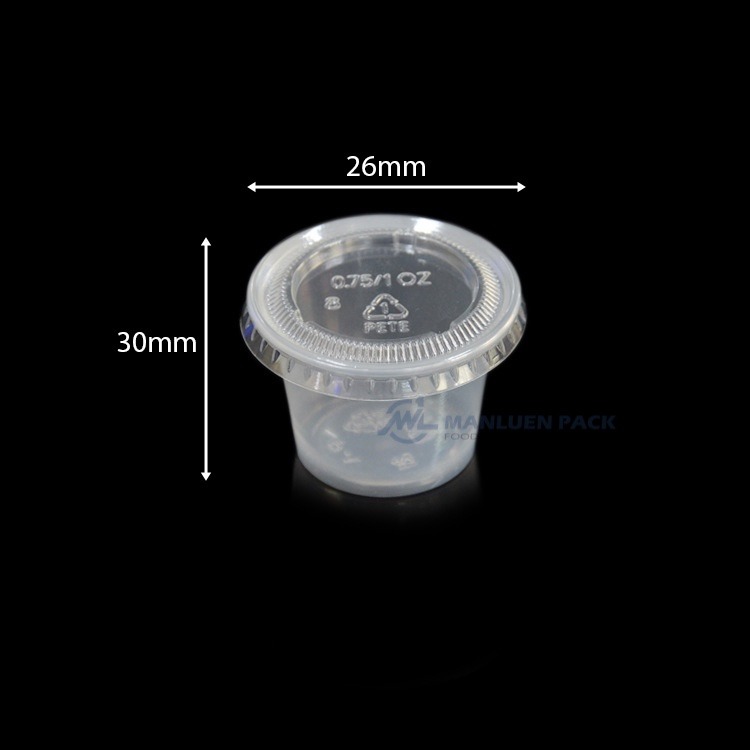
WL-1OZ Portion Cup
A small portion-cup format for dressings, dips and condiments packed separately from the main food.
Listed material options: PP/PET. Confirm the PET component and final base-and-lid configuration.
What Is PET Made Of?
PET stands for polyethylene terephthalate, a thermoplastic polyester generally produced from terephthalic acid, or dimethyl terephthalate, and ethylene glycol. Polymerization creates long chains that can be processed into sheets, containers, films and bottle preforms. Processing controls the balance between amorphous and semicrystalline structures, influencing clarity, stiffness and thermal behavior. Moisture, contamination and repeated heat exposure can degrade the polymer during processing, which is why drying and manufacturing controls matter. The review by Nisticò examines these relationships across PET production, properties and recycling.
Key Properties of PET Food Packaging
| Property | Typical Characteristic | Relevance to Food Packaging |
|---|---|---|
| Full Name | Polyethylene Terephthalate | Identifies the polymer used in packaging |
| Material Family | Thermoplastic polyester | Can be processed into sheets, containers, and films |
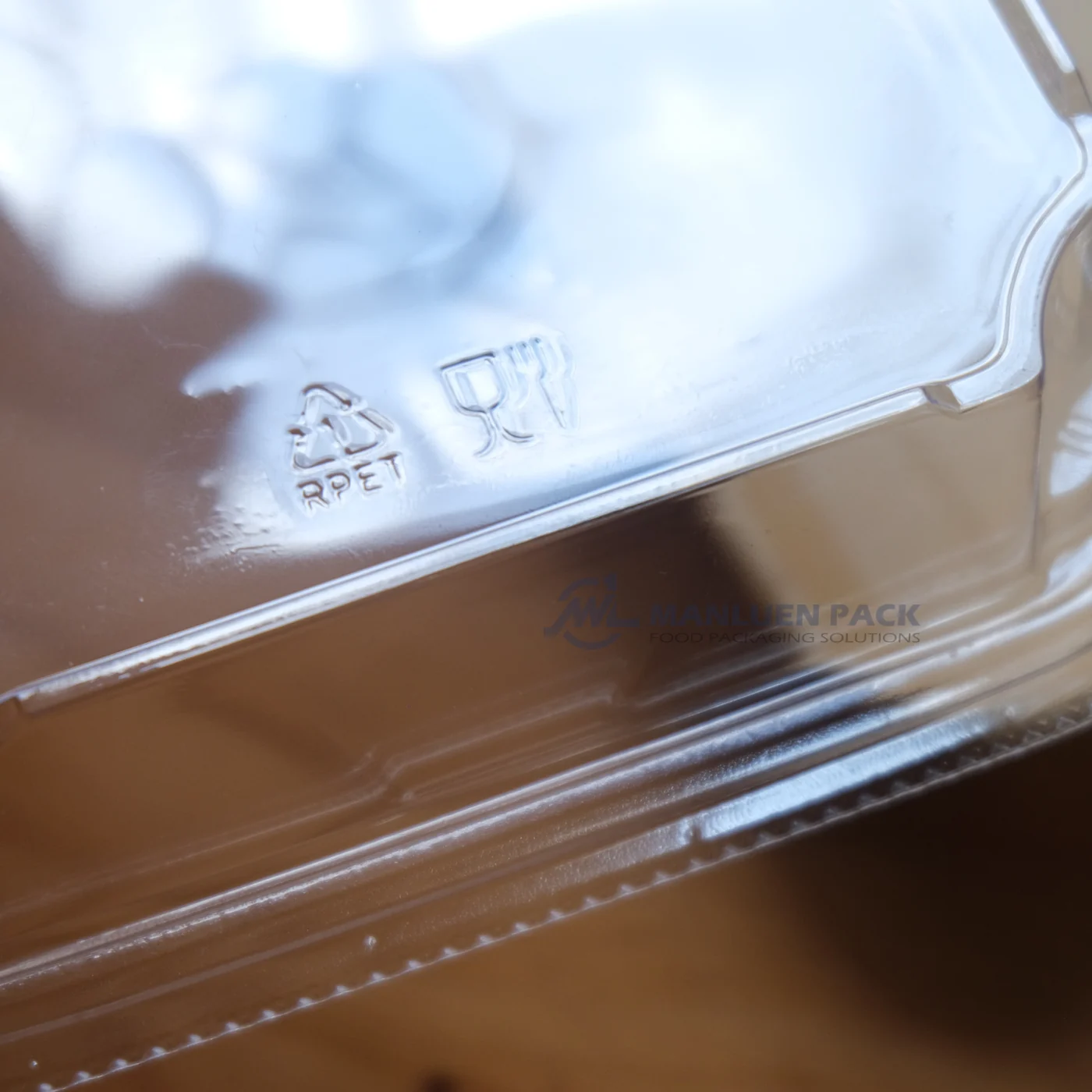
| Resin Identification Code | #1 PET | Identifies the resin, not guaranteed recycling acceptance |
| Typical Density | Approximately 1.29–1.39 g/cm³ (amorphous); 1.37–1.40 g/cm³ (semicrystalline) | Affects material weight and packaging design |
| Transparency | High in common transparent grades | Supports food visibility and retail display |
| Mechanical Performance | Useful stiffness, strength, and toughness | Helps protect packaged products during handling |
| Gas Barrier | Generally better oxygen barrier than common PE and PP grades | Relevant to suitable sealed packaging systems |
| Moisture Performance | Useful moisture barrier characteristics | Supports certain food packaging applications |
| Glass Transition | Reported ranges: 60–84°C (amorphous); 68–80°C (semicrystalline) | Helps explain why standard APET has heat limitations |
| Melting Range | Approximately 255–265°C for semicrystalline PET in the cited review | A processing property, not the safe-use temperature |
| Recyclability | Can be mechanically or chemically recycled | Depends on packaging design and local infrastructure |
| Biodegradability | Not readily biodegradable under normal environmental conditions | Should not be marketed as compostable PET |
These values describe general PET material characteristics. Finished packaging performance depends on the material grade, sheet thickness, crystalline structure, additives, forming conditions, and complete container design.
Why Is PET Used for Food Packaging?
PET provides a combination of visual, mechanical, and processing properties that makes it valuable in many food packaging applications. Its benefits are particularly noticeable in transparent packaging designed for retail presentation.
1. Excellent Transparency for Food Display
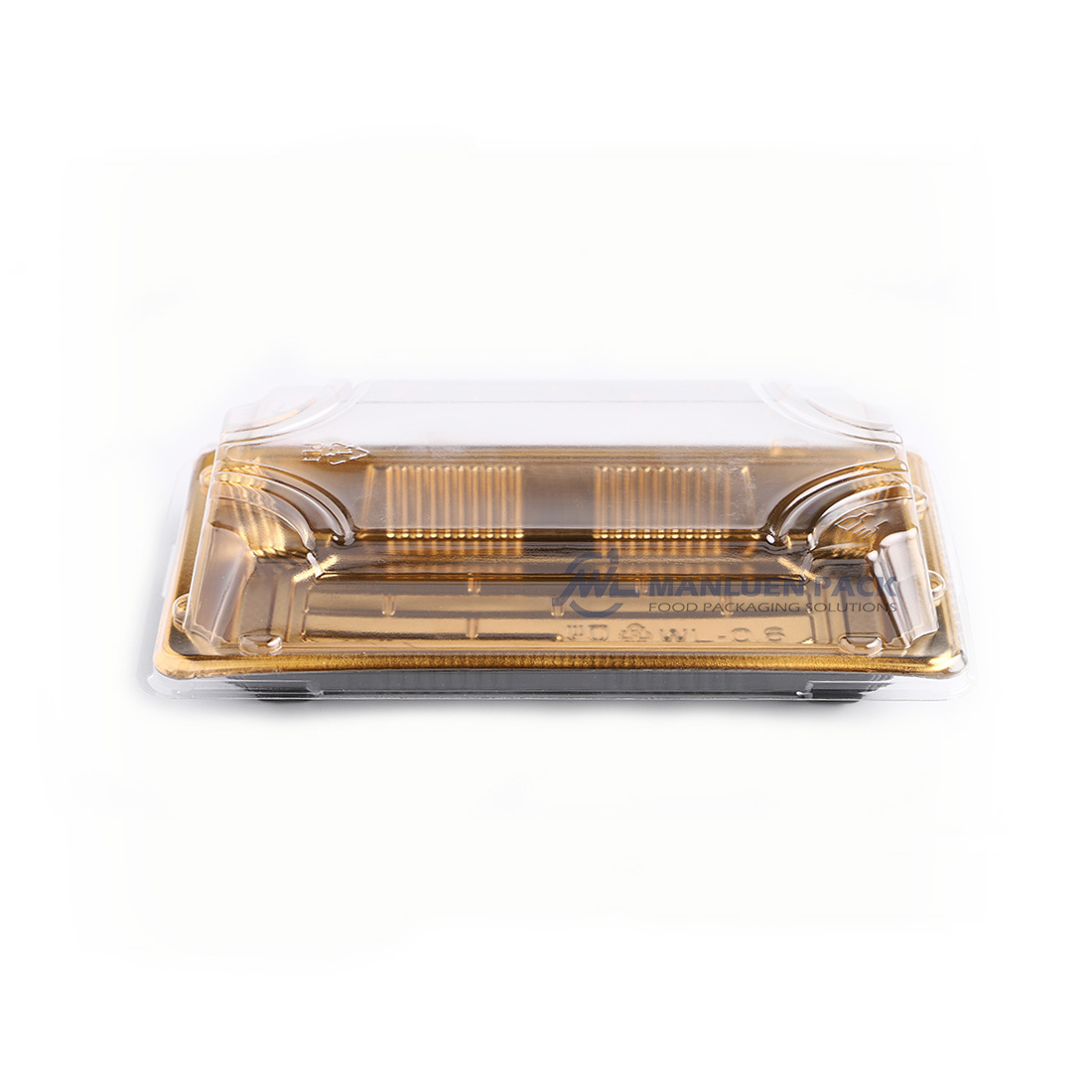
Transparent PET allows customers to inspect sushi, fruit, salads and bakery items without opening the package. In chilled retail displays, the lid must also provide enough clearance and manage condensation appropriately. A clear PET lid can be paired with a different tray-base material; specify the two components separately.
2. Good Strength and Impact Resistance
Properly designed PET containers provide stiffness and toughness to protect delicate foods during packing, distribution and display. They are lighter than many comparable glass packages and avoid glass-type shattering, but they can still crack or deform under excessive loads, impact or unsuitable temperatures. Test the finished structure, including corners, hinges and stacking features.
3. Useful Gas and Moisture Barrier Properties
PET generally provides a better oxygen barrier than common PE and PP grades under comparable test conditions. Its moisture barrier can also be useful, but performance varies with thickness, temperature, humidity and package construction. Resin barrier properties do not establish the barrier performance of a complete package. Gaps, vents and snap-fit closures can allow air exchange. Foods requiring extended shelf life may need a validated combination of barrier layers, lidding film, heat sealing and modified atmosphere packaging.
4. Lightweight Packaging and Efficient Handling
PET can reduce packaging weight compared with glass in suitable applications. Actual handling and freight benefits depend on container dimensions, wall thickness, nesting and loading efficiency. Reinforcing ribs, shaped corners and controlled material distribution can support lighter thermoformed designs, but reducing sheet thickness must not compromise food protection.
5. Versatile Packaging Shapes and Designs
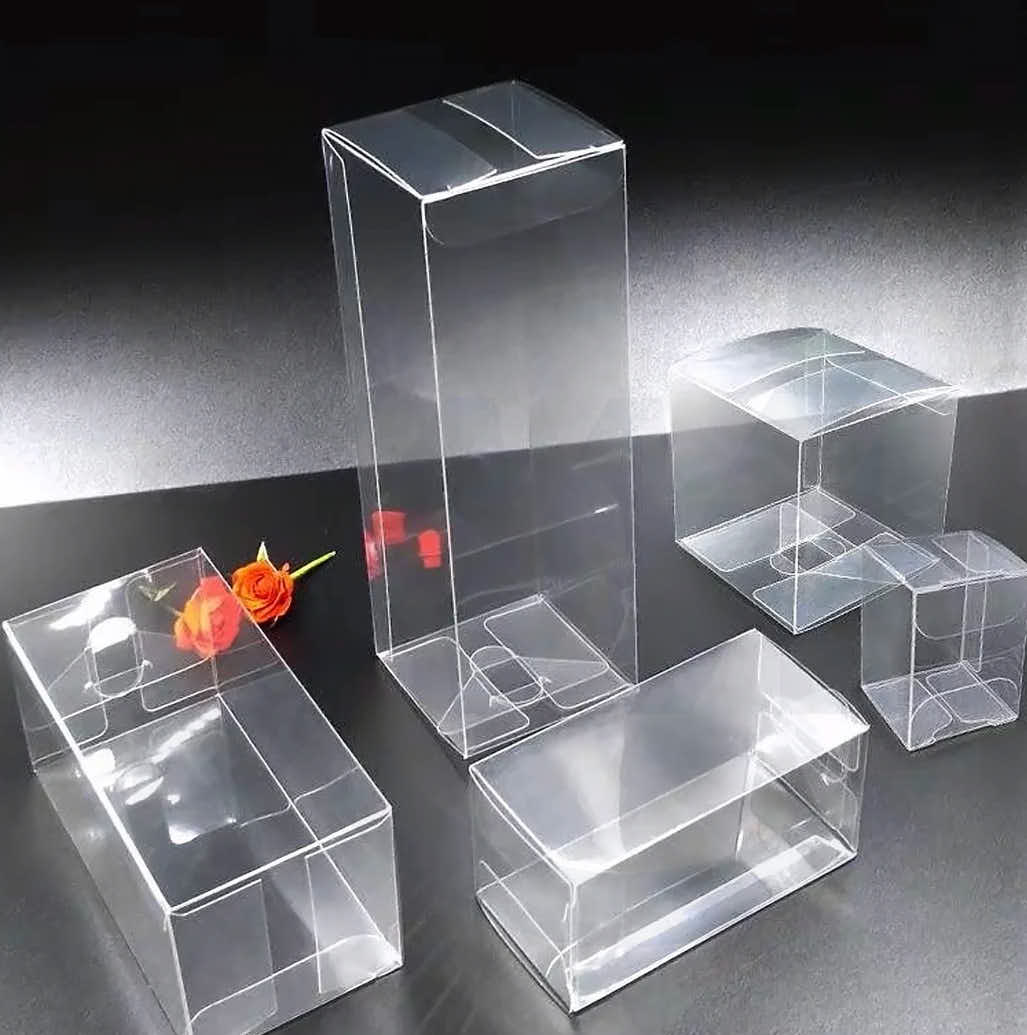
PET can be formed into trays, hinged clamshells, bakery boxes, produce punnets, lids, bottles and films. Each format requires an appropriate grade and process: a bottle, an APET display tray and an ovenable CPET meal tray are not interchangeable products.
What Is PET Food Packaging Used For?
PET is used across many food and beverage packaging applications. For Manluen Pack and similar rigid packaging manufacturers, thermoformed food containers and transparent packaging components are particularly relevant.
Clear Food Trays and Sushi Containers
Clear lids help present sushi, chilled meals and salads while protecting them during routine handling. A package may combine a PET lid with a PS or PP tray base, so confirm component materials, closure fit and the intended chilled-storage conditions. Explore Manluen’s sushi tray collection for available formats and material options.
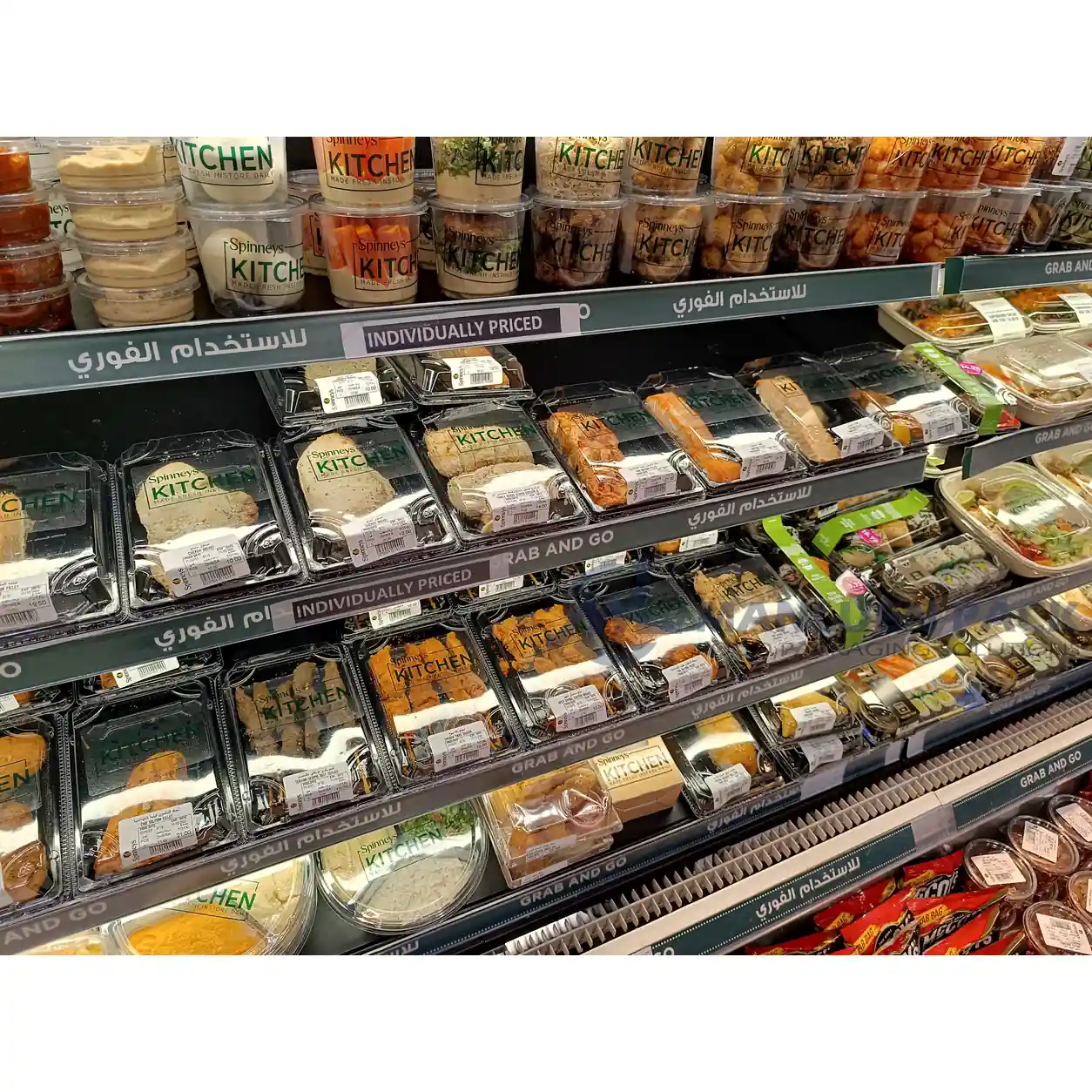
Sushi Packaging with PET Material Options
For sushi trays, request the required base and lid materials separately. The following listings include PET options; they do not establish that every supplied set is entirely PET.

WL-20B Boat-Shaped Sushi Tray
A boat-shaped base-and-lid format for arranged sushi takeaway portions.
Listed material options: PS/OPS/PET. Confirm the PET component and final base-and-lid configuration.
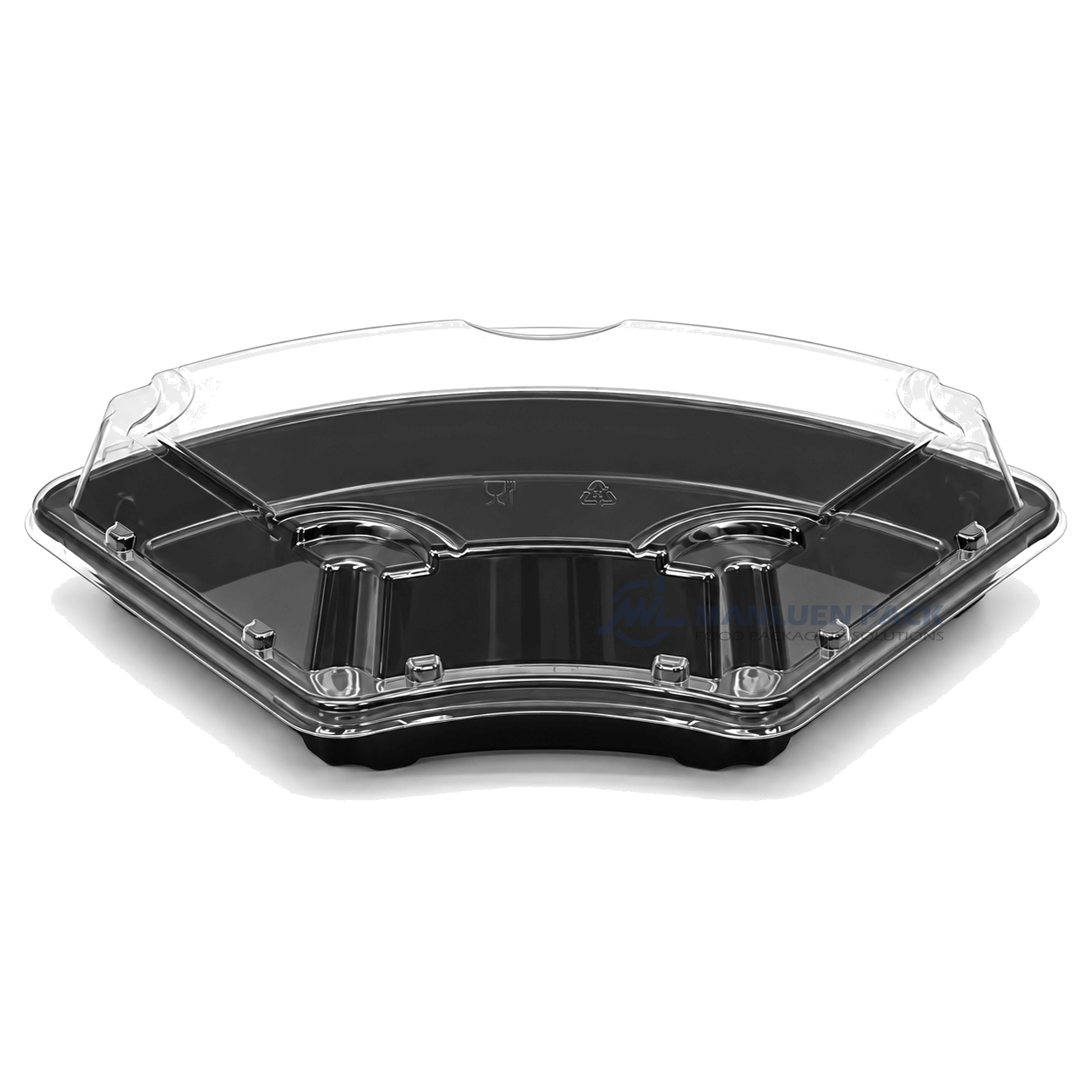
WLC-017 Fan-Shaped Sushi Tray
A curved fan-shaped format with a clear lid for chilled sushi presentation.
Listed material options: PS/OPS/PET. Confirm the PET component and final base-and-lid configuration.

WL-250 Round Divided Platter
A compartment platter for sharing assortments and keeping different food items organized.
Listed material options: PS/PP/PET/OPS. Confirm the PET component and final base-and-lid configuration.
Fresh Produce and Fruit Clamshells
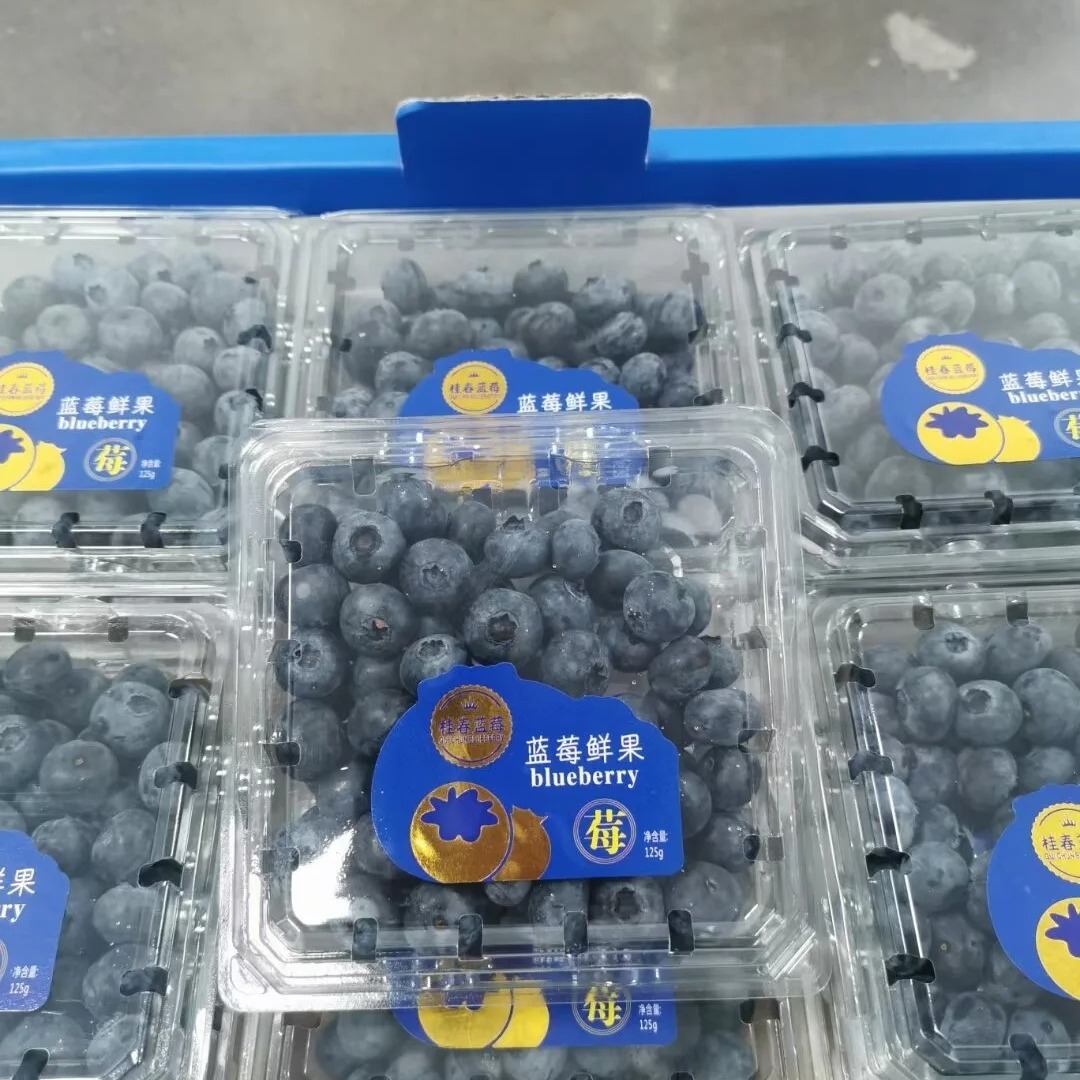
PET and qualified rPET can be used for clear berry, grape and tomato clamshells. In addition to footprint and depth, evaluate ventilation and condensation under the actual cold chain. PET does not automatically provide anti-fog performance; that requires the appropriate surface treatment or other validated design features.
Bakery and Dessert Packaging
Transparent PET cake domes, pastry boxes and clamshells show the food while providing a protective structure. Choose sufficient clearance for toppings and decorations, and test lid fit and stacking. Allow baked goods to reach the package’s specified filling temperature before packing; ordinary clear PET is not ovenware.
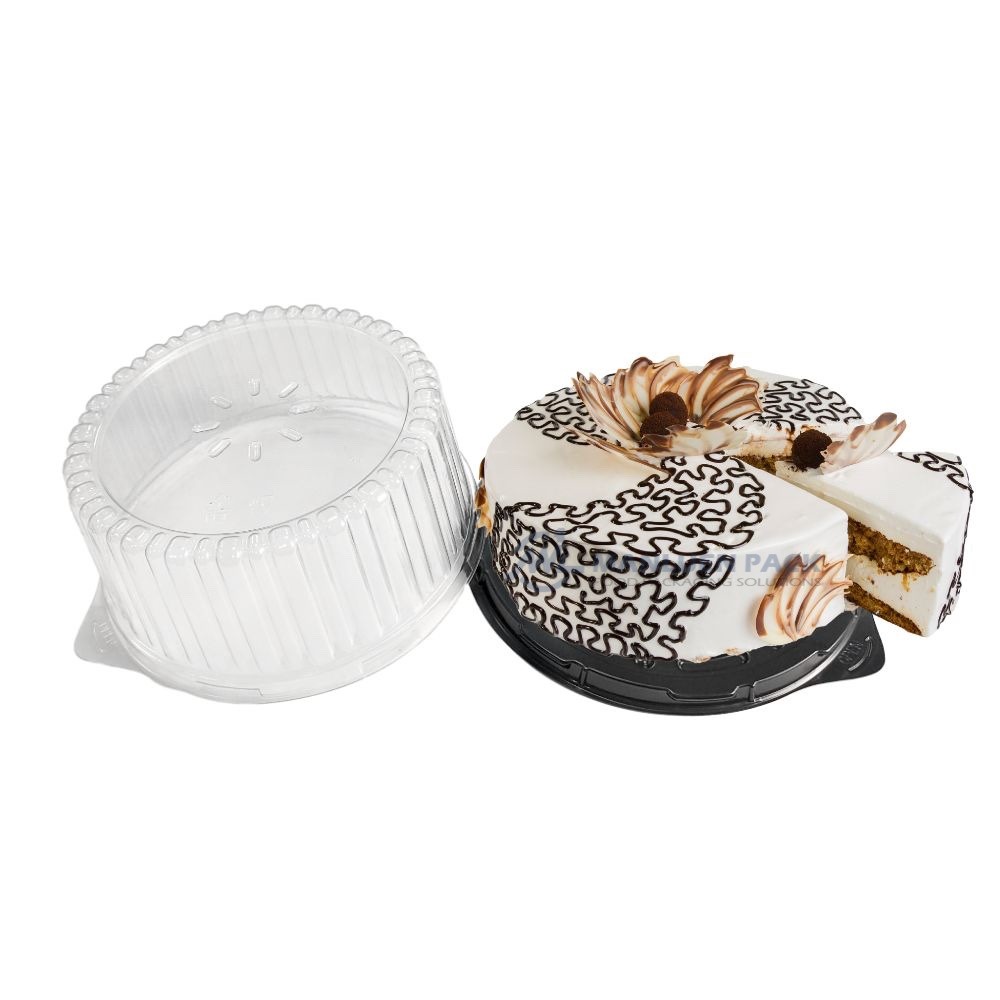
PET Cake Display and Transport Formats
For cakes, compare the usable interior and dome clearance with the finished product. These formats illustrate transparent bakery packaging; they are not evidence of microwave, oven or freezer suitability.
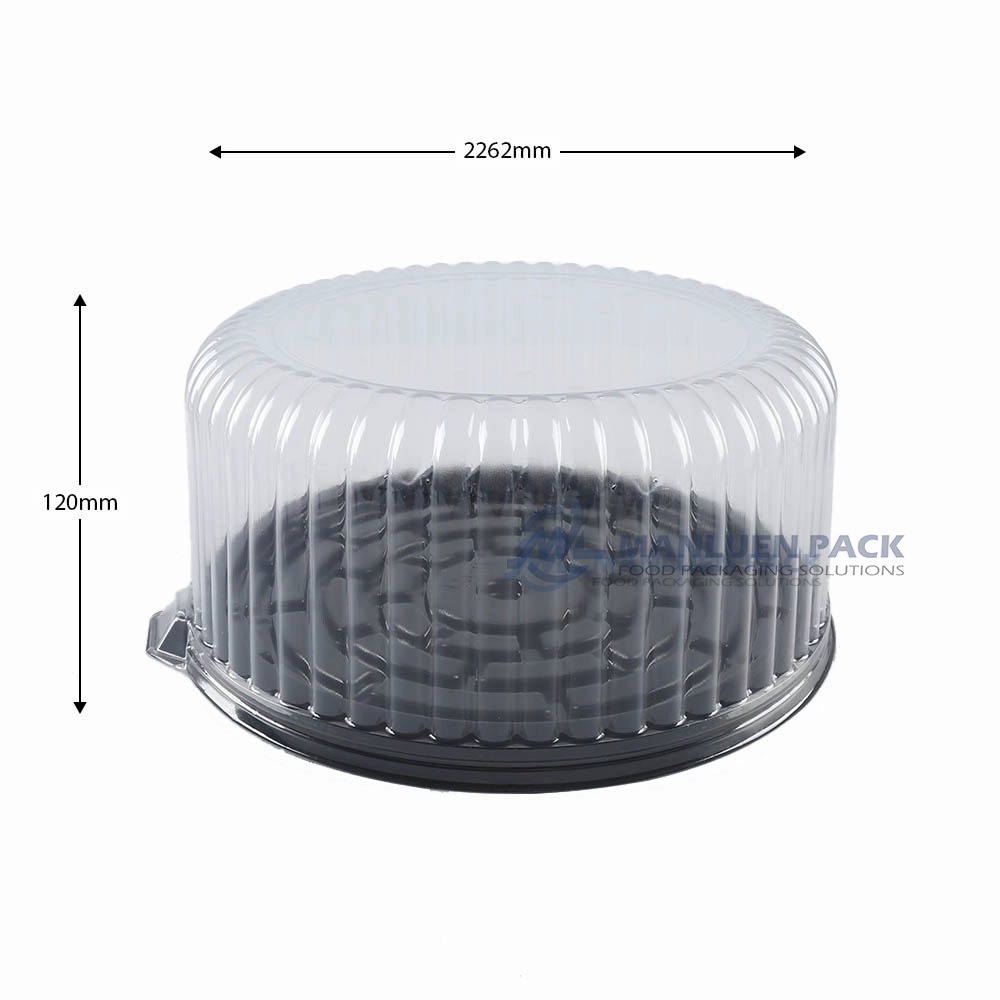
WL-K09 Round Cake Carrier
A round cake base with a clear dome for bakery display and transport. Check the usable cake diameter and decoration clearance.
Listed material: PET.
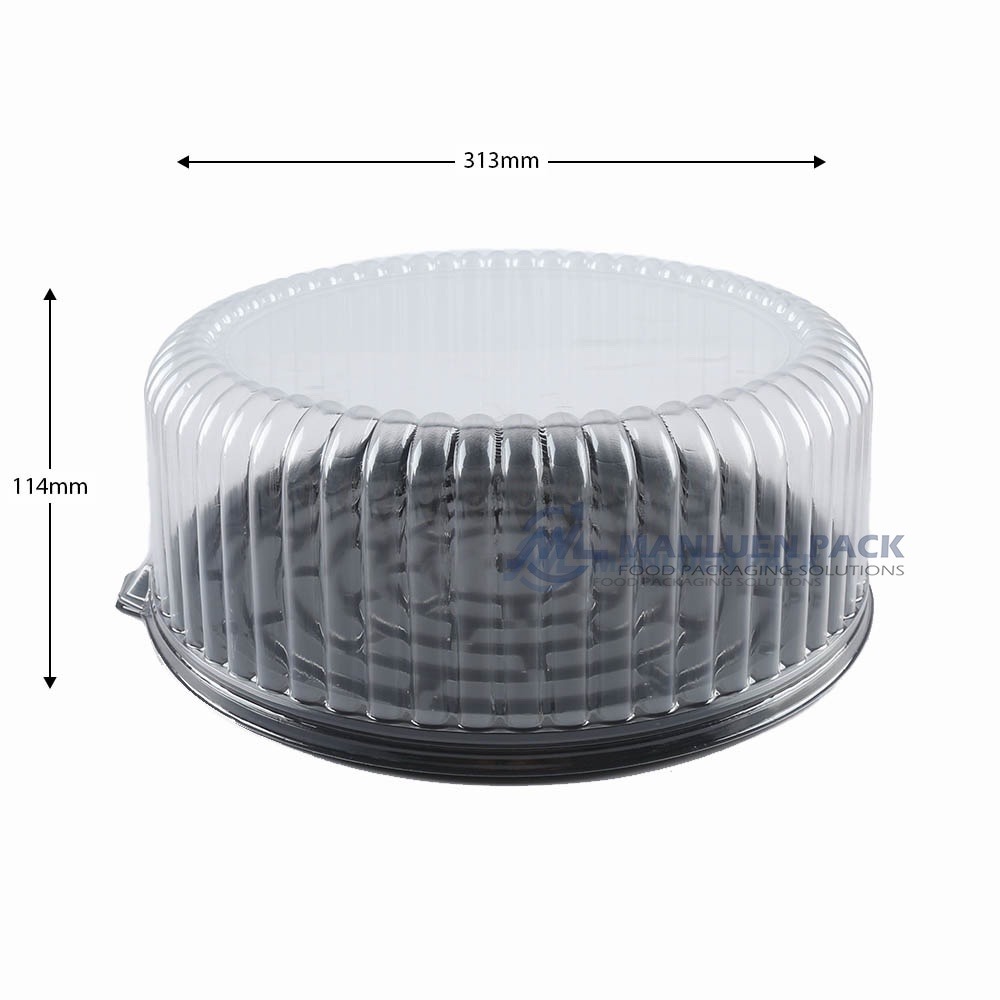
WL-K11 Large Cake Carrier
A larger cake-carrier format with a clear dome. Confirm the current technical drawing and matching base before ordering.
Listed material: PET.
Meat, Seafood, and Deli Packaging
PET-based trays can be used for chilled meat, seafood and prepared foods. For modified atmosphere packaging (MAP), the tray, barrier structure, lidding film, seal, gas mixture and storage temperature must be validated together. An ordinary snap-fit PET tray is not automatically a MAP system. Hot meals or reheating require a separately specified and tested package.
Beverage Bottles and Flexible Packaging Films
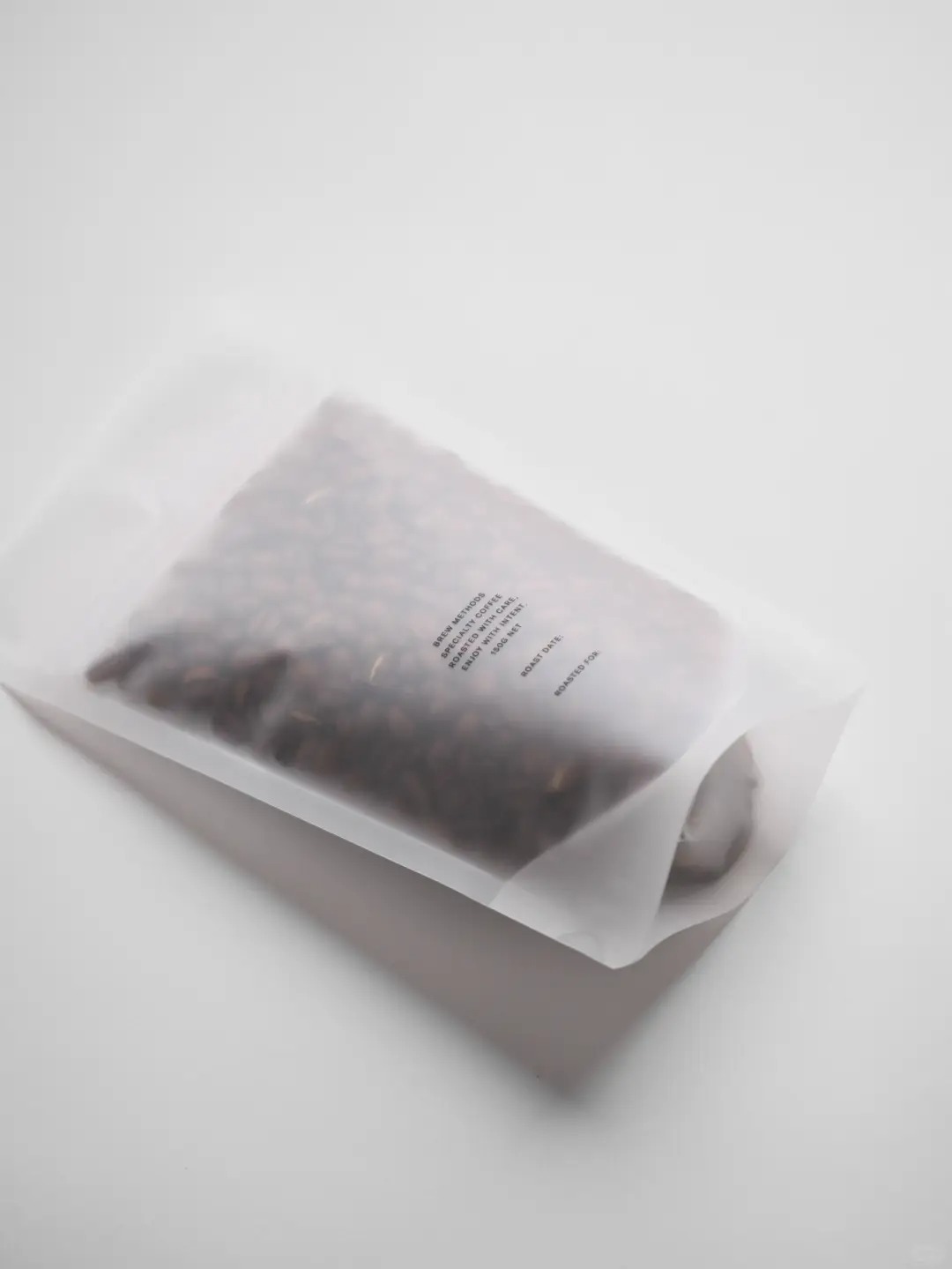
Beverage bottles are commonly made by injection stretch blow molding, while PET films may be biaxially oriented and combined with sealant or barrier layers. These processes differ from rigid-tray thermoforming. A transparent or frosted pouch is not proof of a PET structure: request the film-layer specification before making material or recyclability claims.
Types of PET Used in Food Packaging
PET packaging is available in several material forms. APET, CPET, PETG, BoPET, and rPET describe different material characteristics, processing methods, or raw-material origins. They are not necessarily mutually exclusive categories.
| Material | Main Characteristic | Typical Packaging Applications |
|---|---|---|
| APET | Amorphous PET, commonly transparent | Clear food trays, bakery boxes, produce clamshells |
| CPET | Crystallized PET designed for certain higher-temperature applications | Selected ovenable or microwave-rated food trays |
| PETG | Glycol-modified PET copolyester | Specialized transparent formed packaging |
| rPET | PET produced using recycled material | Suitable new food packaging and other products |
| BoPET | Biaxially oriented PET film | Flexible packaging and laminated films |
APET: Transparent Food Packaging
Amorphous PET is commonly used for clear thermoformed fruit packs, bakery boxes, salad trays and sushi packaging components. Ordinary APET should not be put in a microwave or conventional oven unless the specific finished product is rated for that use.
CPET: Packaging for Higher-Temperature Applications
Crystallized PET can be engineered for selected microwave and conventional-oven meal trays. Use only the manufacturer’s validated temperature, time and appliance instructions, including any restrictions on lids or films. CPET performance cannot be transferred to ordinary transparent APET.
PETG: Modified PET for Specific Applications
PETG is a glycol-modified PET copolyester with different crystallization and processing behavior. It can be used for selected transparent formed products, but it is not interchangeable with APET in food-contact approval or recycling. PETG is classified as a low-compatibility material in the TCEP PET tray design guidelines.
rPET: Recycled PET Material
rPET describes PET made using recovered material. It identifies feedstock origin, not a separate heat-resistance grade or a guarantee of food-contact suitability. For purchasing, specify the recycled-content percentage and whether it is post-consumer or pre-consumer, then confirm the recycling process and finished formulation are suitable for the intended food contact.
How Is PET Food Packaging Manufactured?
PET packaging is produced using different methods depending on the finished product. The two most relevant processes for rigid packaging are sheet extrusion followed by thermoforming, and injection stretch blow molding for bottles.
PET Sheet Extrusion and Thermoforming
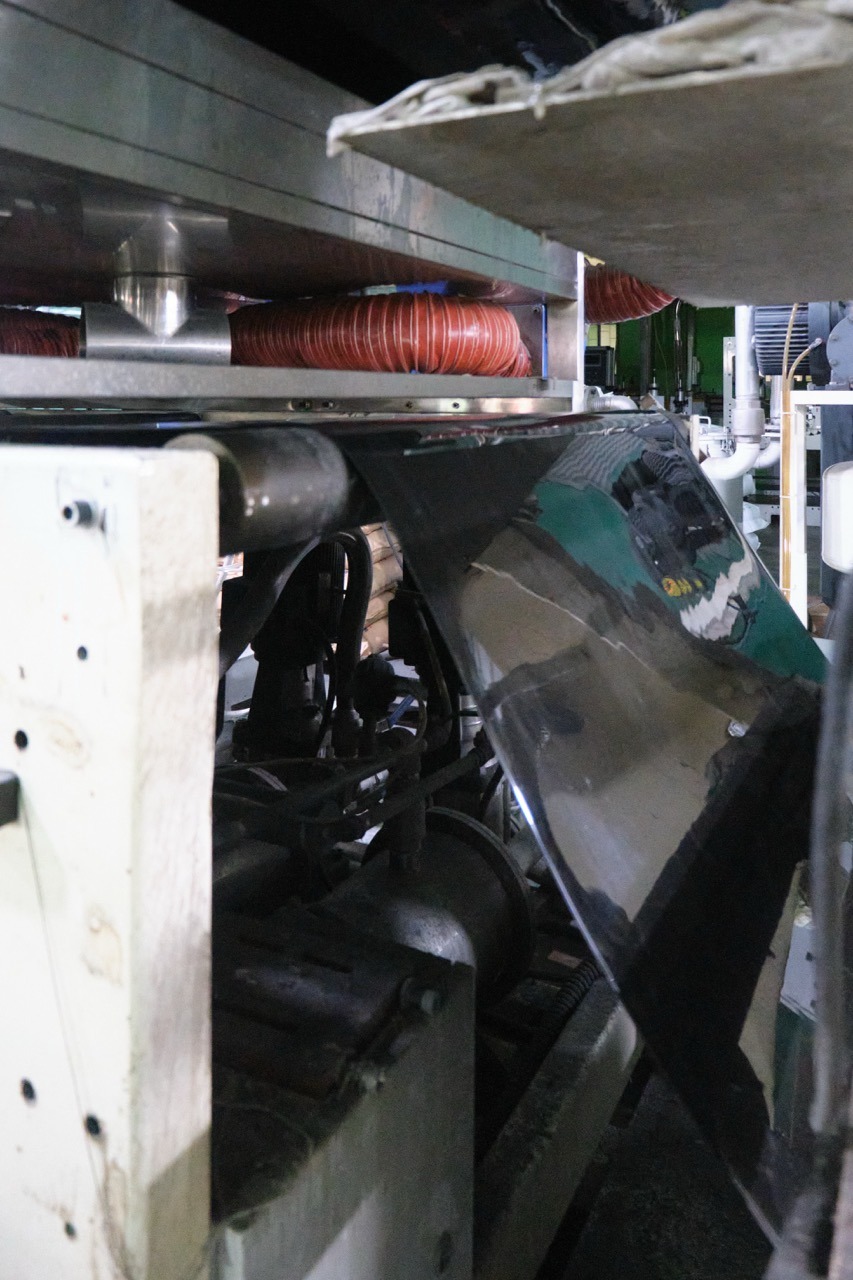
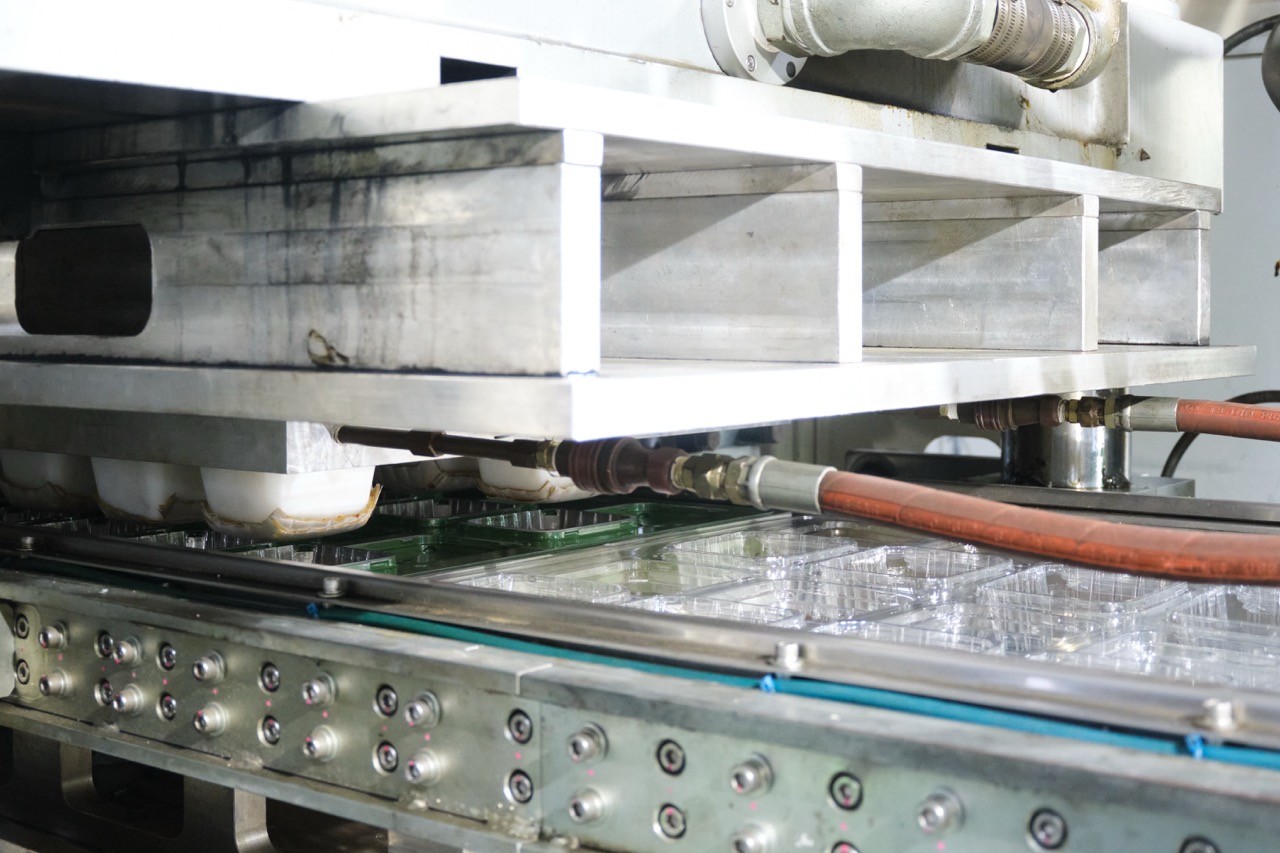
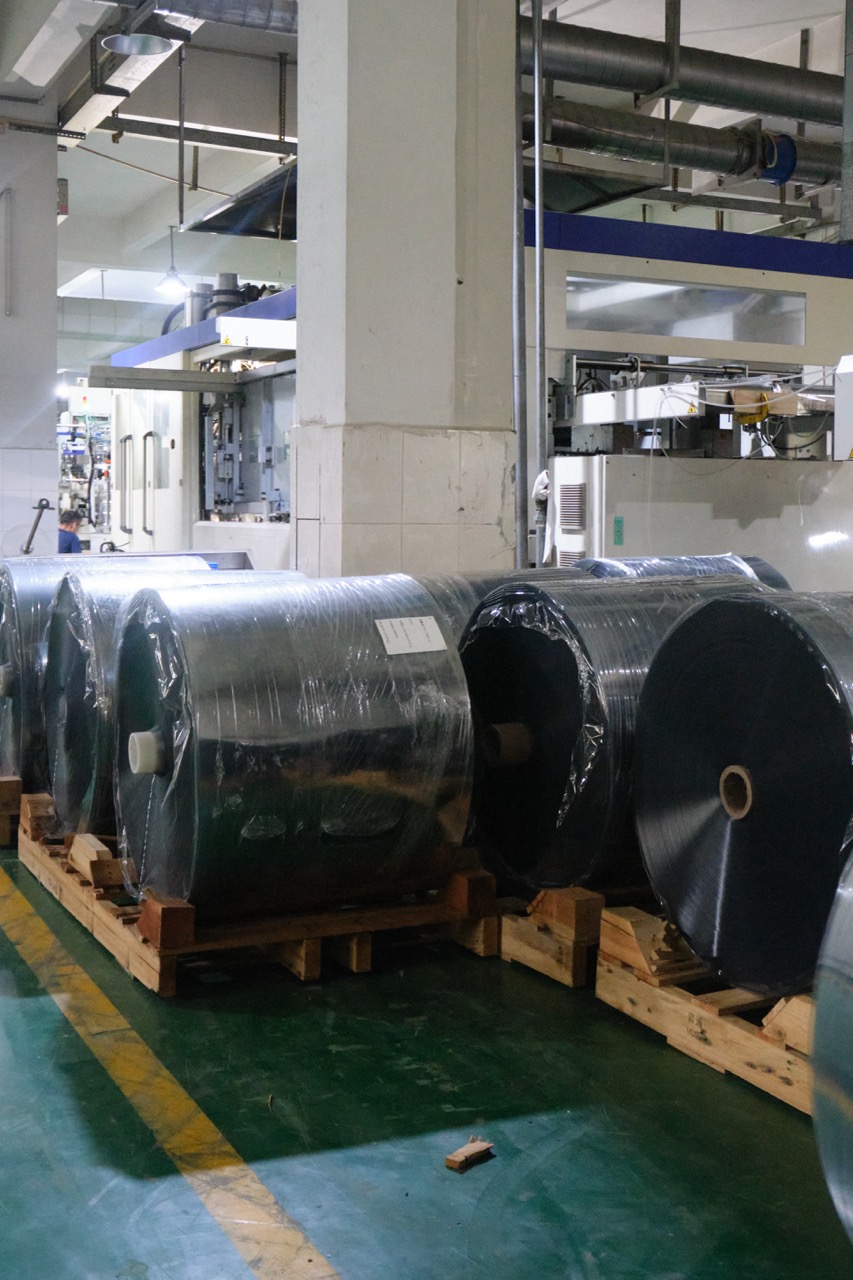
Transparent PET food trays, clamshells, and other rigid containers are commonly produced through thermoforming. The manufacturing process begins with suitable PET resin, which is prepared and processed into plastic sheet. The sheet is then heated, shaped, cooled, and trimmed through thermoforming to create the finished packaging. A typical process includes the following stages:
- Material selection and preparation: Suitable PET resin or an appropriately qualified recycled-content formulation is selected. Moisture control is important before melt processing.
- Sheet extrusion: PET is melted and formed into sheet with controlled thickness and suitable material properties.
- Thermoforming: The sheet is heated and shaped using molds, vacuum, pressure, or other forming methods.
- Cooling and trimming: The formed material is cooled and trimmed to produce the required container shape.
- Quality inspection: Finished products are evaluated for dimensions, appearance, closure fit, and other specified requirements.
PET is hygroscopic, meaning it can absorb moisture from the surrounding environment. If excessive moisture remains during melt processing, hydrolytic degradation can reduce polymer molecular weight and affect product performance. Material quality may also be evaluated using intrinsic viscosity (IV), which is related to polymer molecular weight and processing behavior. Appropriate resin drying, temperature control, and manufacturing conditions are therefore important for consistent PET packaging quality. For thermoformed food containers, sheet thickness and material distribution also influence structural performance. A package’s actual wall thickness after forming can vary between its base, corners, and sidewalls.
Injection Stretch Blow Molding
PET beverage bottles are commonly manufactured by injection stretch blow molding. In this process, PET is molded into a preform that is subsequently reheated, stretched, and inflated inside a bottle-shaped mold. This differs from thermoforming, which begins with plastic sheet rather than a bottle preform.
Flexible PET Film Production
PET can also be extruded into films and stretched to produce biaxially oriented PET (BoPET). BoPET is used in various flexible packaging applications, often as part of multilayer structures containing other materials for heat sealing, moisture resistance, or specialized barrier performance. These mixed-material structures may have different recycling requirements from simple mono-material PET food trays.
PET vs. PP, PS, OPS, and HDPE for Food Packaging
Although PET is a widely used packaging material, it is not automatically the best choice for every food product. Different plastics offer different characteristics in transparency, impact resistance, heat performance, cost, and processing.
| Material | Key Characteristics | Typical Food Packaging Uses |
|---|---|---|
| PET | High clarity, useful strength, stiffness, and oxygen barrier properties | Transparent trays, clamshells, food lids, bottles |
| PP | Good toughness and chemical resistance; selected grades support higher-temperature use | Takeaway containers, bento boxes, selected microwavable meal trays |
| PS | Useful rigidity and moldability; properties vary by grade | Food trays, lids, disposable packaging |
| OPS | Transparent oriented polystyrene with useful stiffness | Clear clamshells, bakery displays, transparent lids |
| HDPE | Good toughness, chemical resistance, and moisture barrier performance | Milk bottles, selected food containers and caps |
PET vs. PP: Which Is Better?
PET is commonly chosen for clear chilled or ambient displays. Suitable PP grades and container designs are often preferable for hot meals or microwave reheating. Compare actual products for clarity, impact resistance, sealing and the required temperature, rather than choosing by the resin name alone.
PET vs. PS and OPS
PET often offers a useful balance of clarity and toughness. PS and OPS packaging can provide rigidity and clear display formats, with different impact and thermal behavior. Compare equivalent finished packages for thickness, closure, handling and local recycling acceptance.
PET vs. HDPE
PET generally offers greater optical clarity and a better oxygen barrier than natural HDPE in comparable structures. HDPE is widely used for its toughness, chemical resistance and moisture barrier, including milk bottles and other containers. Product requirements determine which balance is more useful.
Is PET Plastic Safe for Food Packaging?
Yes. PET is widely used for food-contact packaging and can be safe for its intended use when the material formulation, finished product, and contact conditions comply with applicable food safety requirements. However, the PET name alone does not guarantee that every container can safely contact every type of food under every temperature condition. Food-contact suitability depends on the materials used, possible migration, food composition, contact duration, temperature, manufacturing controls, and packaging components.
Is PET Plastic FDA Approved?
In the United States, PET food-contact applications may be covered by applicable FDA regulations, including 21 CFR 177.1630 — Polyethylene Phthalate Polymers. The applicable regulatory basis and restrictions depend on the finished formulation and intended food-contact conditions. Therefore, buyers should not interpret a general claim such as “FDA-approved PET” as unrestricted approval for all foods, temperatures, or applications. For commercial purchasing, appropriate documentation should identify the relevant materials and intended conditions of use.
Is PET Food Packaging Safe in the European Union?
In the European Union, PET food-contact materials are subject to applicable legislation, including Regulation (EC) No 1935/2004 and Regulation (EU) No 10/2011, as amended. These requirements address aspects of food-contact material safety, including applicable substance restrictions and migration requirements. Suppliers and importers should confirm whether the finished packaging is supported by appropriate declarations, testing, and other relevant documentation for its intended use.
Does PET Plastic Contain BPA or Phthalates?
Standard PET polymer chemistry does not use bisphenol A (BPA) as a building block. PET also does not normally require the ortho-phthalate plasticizers associated with certain flexible PVC formulations. The word “terephthalate” in polyethylene terephthalate should not be confused with the common group of ortho-phthalate plasticizers. However, these facts about PET polymer chemistry do not establish that every finished package is free from all possible contaminants, additives, or other substances. If a purchaser requires a specific BPA-free, phthalate-free, or other restricted-substance declaration, the claim should be supported by the relevant finished-product documentation.
Can Chemicals Migrate from PET into Food?
As with other food-contact materials, PET must be evaluated for relevant substance migration under its intended use conditions. Certain PET production processes use catalysts containing antimony compounds, and research has examined the possible migration of trace substances from PET containers under different conditions. The presence of a potential migrant does not automatically mean that a finished food package presents an unacceptable health risk. Regulatory assessments consider the identity and amount of migrating substances together with expected exposure and applicable limits. Food type, contact time, temperature, material formulation, and recycled-content processing can all influence the evaluation. For this reason, commercial buyers should request appropriate food-contact documentation rather than relying on absolute claims that PET releases no substances.
Can PET Food Packaging Be Microwaved or Heated?
Do not heat an ordinary transparent PET container unless the finished product is expressly rated for that use. APET can deform far below PET’s polymer melting temperature; the melting point is not a safe-use limit. Certain CPET packages are designed for microwave or oven heating. Confirm the appliance, temperature, duration, food type and whether the lid or film must be removed. The FDA recommends cookware specifically manufactured for microwave use.
PET Plastic Recycling: Is PET Food Packaging Recyclable?
PET plastic is recyclable and is identified by resin identification code #1. It can be processed into new bottles, food packaging, fibers, sheets, and other products through suitable recycling systems. However, the fact that PET is technically recyclable does not guarantee that a particular food tray will be collected or recycled in a specific location. Actual recycling depends on consumer collection, sorting technology, package design, contamination levels, processing capacity, and end markets for recovered materials.
How Is PET Plastic Recycled?
Mechanical recycling generally involves sorting, grinding, washing, drying and reprocessing PET into flakes, pellets or sheet. Chemical recycling uses processes such as depolymerization to recover smaller components for further manufacturing. The routes differ in feedstock requirements, energy use, yield and commercial availability; neither makes every PET package locally recyclable.
Are PET Bottles and PET Food Trays Recycled the Same Way?
PET beverage bottles and PET thermoformed food containers share the same basic polymer, but they do not necessarily follow identical recycling routes. Beverage bottles have established collection and processing systems in many regions. PET trays, clamshells, tubs, and other thermoforms may face additional sorting challenges due to their shapes, labels, adhesives, attached films, and potential contamination. According to NAPCOR’s PET thermoform recycling information, PET thermoforms can be recycled through suitable systems, although actual acceptance varies. NAPCOR reported that approximately 264 million pounds of PET thermoformed packaging were collected for recycling in the United States and Canada in 2024.
This demonstrates that PET thermoform recycling operates at a commercial scale, but the collection figure should not be confused with the recycling rate of all PET trays placed on the market.
Does the Recycling Symbol #1 Mean a PET Tray Will Be Recycled?
No. The #1 resin code identifies PET, not collection eligibility. A local program may accept bottles but exclude trays, and incompatible layers or attached components can complicate recovery. Check the destination market’s guidance for the exact package before making a recyclability claim.
How Does Packaging Design Affect PET Recycling?
Recyclability depends on more than the resin used for the main container. Labels, adhesives, inks, colorants, lidding films, absorbent pads, coatings, and multilayer constructions can influence sorting and reprocessing. For example, a clear mono-material PET tray may be easier to handle within a suitable PET recycling stream than a package containing incompatible plastic layers. The Thermoforms Circularity Evaluation Platform (TCEP) provides design guidelines addressing material compatibility in PET tray recycling. These guidelines can help packaging designers assess whether individual components are compatible, conditionally compatible, or potentially disruptive to established PET tray recycling processes.
Can PET Be Recycled More Than Once?
Yes, through suitable processing, but repeated mechanical recycling can cause quality losses from moisture, thermal exposure and contamination. Sorting, process control and appropriate restoration technologies can help maintain useful properties. Avoid claiming that every package can be recycled infinitely without material loss.
Can Recycled PET Be Used for Food Packaging?
Yes, suitably processed recycled PET (rPET) can be used in food-contact packaging. However, not all recycled PET is automatically acceptable for direct contact with food. The U.S. FDA’s guidance on recycled plastics in food packaging identifies potential contamination, material suitability, and recycling process evaluation as important considerations. In the European Union, Regulation (EU) 2022/1616, as amended, establishes requirements for recycled plastic materials and articles intended to contact food. For packaging buyers, the key issue is whether the actual recycled material, production process, and finished product are suitable for the intended food-contact conditions.
Is PET Plastic Biodegradable?
Conventional PET is not readily biodegradable under ordinary environmental conditions. Discarded PET food packaging should not be expected to break down rapidly in soil, freshwater, seawater or home compost. Industrial or laboratory depolymerization is a different process from natural degradation after disposal.
Is PET Plastic Compostable?
Conventional PET containers are not designed to meet compostability requirements and should not go into food-waste compost collection. If compostability is a purchasing requirement, select a separately specified material with relevant certification and confirm acceptance by the intended collection and treatment program.
Can PET Be Broken Down by Bacteria or Enzymes?
Research, including Yoshida et al. (2016), has demonstrated biological PET breakdown under specific conditions. PETase and related enzymes are relevant to emerging depolymerization technologies, but ordinary packaging does not become compostable merely because specialized biological processes can degrade PET.
Is Biodegradable Packaging Better Than PET?
Neither biodegradability nor recyclability alone establishes the better environmental choice. Compare food protection, material quantity and the collection and treatment route that will actually be used. Compostable packaging needs an accepting treatment system; PET needs a suitable recycling stream.
Is PET Food Packaging Environmentally Friendly?
PET can offer environmental advantages in certain packaging applications, particularly through material efficiency, reduced weight compared with some alternatives, and the use of suitable recycled content. However, PET is generally derived from fossil-based raw materials, is not naturally biodegradable under ordinary conditions, and can contribute to plastic pollution when mismanaged. A realistic environmental assessment should consider the complete packaging life cycle, including raw-material production, manufacturing energy, packaging weight, transportation, food protection, collection, recycling, and disposal. For example, lightweight PET bottles may perform favorably in certain life-cycle comparisons with alternative beverage containers. However, results from beverage bottle studies should not automatically be applied to bakery clamshells or PET food trays.
For thermoformed food packaging, the actual material quantity, recycled content, food waste prevention, and end-of-life system are important considerations.
Virgin PET vs. rPET
Virgin PET uses newly manufactured feedstock; rPET uses recovered material. Replacing virgin resin with suitable rPET can reduce demand for new feedstock, but the overall impact depends on collection, recycling, energy, transport and package design. Environmental claims should state the actual recycled-content level and their assessment basis.
How to Choose PET Food Packaging for Your Business
Choosing the right PET packaging involves more than selecting a transparent container. Restaurants, supermarkets, distributors, and food manufacturers should evaluate their actual food products and the conditions in which the packaging will be used.
| Selection Factor | What Buyers Should Check |
|---|---|
| Food Type | Sushi, salads, fruit, bakery items, seafood, meat, or prepared meals |
| Temperature Requirements | Chilled, ambient, frozen, hot-filled, or reheated use |
| Material Grade | APET, CPET, suitable rPET formulation, or alternative material |
| Container Dimensions | Length, width, height, internal capacity, and food clearance |
| Structural Performance | Wall thickness, stiffness, stacking, impact resistance, and handling |
| Closure and Sealing | Lid compatibility, snap-fit closure, ventilation, or heat-sealing requirements |
| Food-Contact Compliance | Appropriate documentation for the intended food, time, and temperature |
| Recyclability | Material combinations, design compatibility, and local collection programs |
| Commercial Requirements | Carton quantity, minimum order, colors, customization, and delivery |
Choose Packaging According to the Food
Different foods create different packaging requirements. A transparent sushi container may prioritize lid clarity, secure fit, and stable presentation. A fruit clamshell may require ventilation, while a bakery package may need additional lid clearance to protect delicate decorations. Products requiring an airtight seal, special gas barrier, or hot-food performance may require different packaging designs or materials.
Check Material Thickness and Structure
For thermoformed PET packaging, the starting sheet thickness and the final wall-thickness distribution both influence the container’s mechanical performance. A thicker sheet does not automatically guarantee the most efficient packaging design, and a thinner package is not necessarily appropriate for heavier food products. Packaging manufacturers may use suitable container geometry, reinforcing ribs, and structural features to balance material use and product protection. Buyers should request samples and evaluate them using their actual food, filling method, storage conditions, and transport requirements.
Confirm the Full Packaging Material Combination
A food container may consist of components made from different plastics. For example, a sushi tray may combine a PS or PP base with a transparent PET lid. The correct purchasing specification should identify the materials used for each component, not simply describe the complete package as PET. This distinction can also affect food-contact documentation, temperature performance, and recycling considerations.
Wholesale PET Food Packaging and Alternatives from Manluen Pack
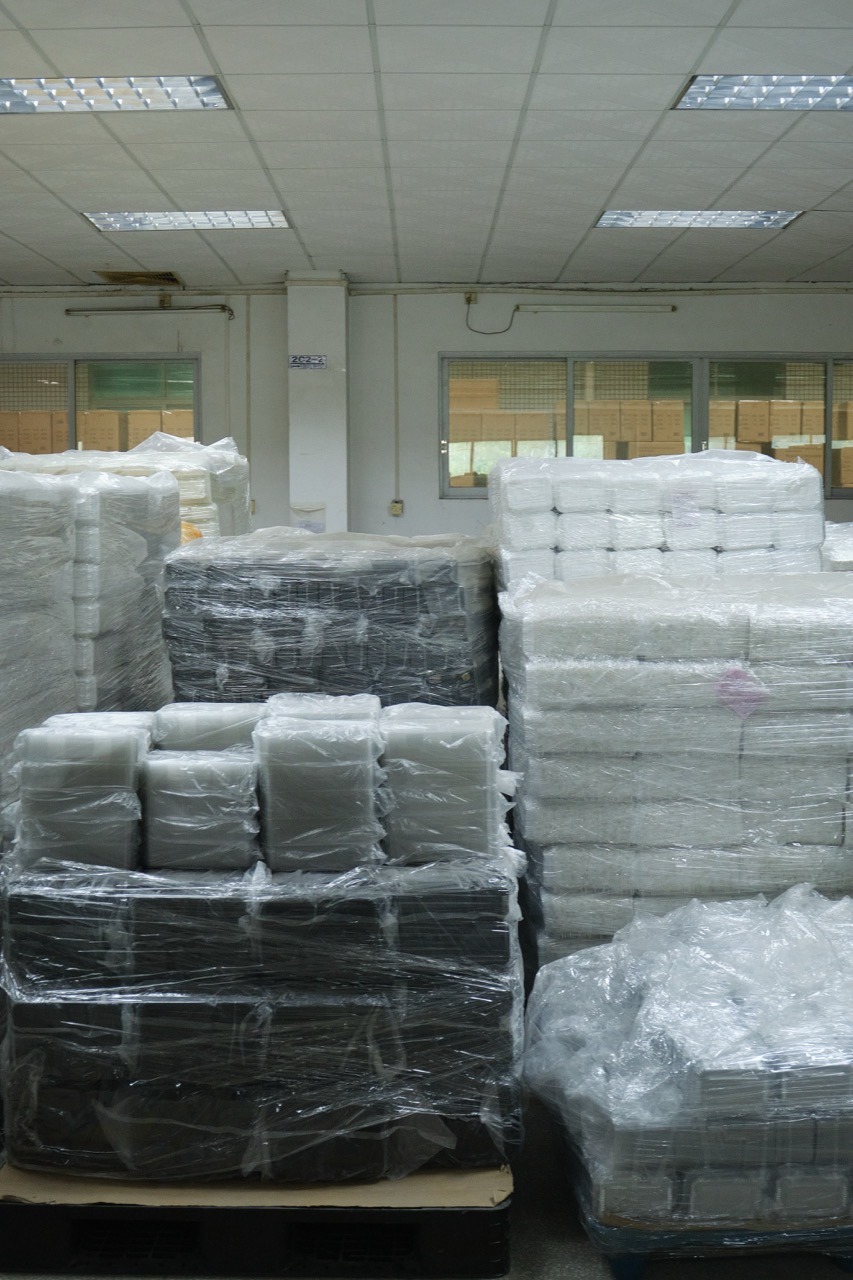
Manluen Pack manufactures and supplies wholesale food packaging for restaurants, supermarkets, bakeries, delis, prepared-food businesses, and packaging distributors. Our product range includes packaging options using PET, PP, PS, OPS, and bagasse, with different shapes, sizes, colors, and packaging structures. For clear retail presentation, buyers can explore our sushi trays and clamshell containers. For takeaway meals requiring different temperature or structural properties, our bento box range provides additional packaging options. Not every transparent container in these collections uses PET. Product materials and specifications should be confirmed for the selected SKU. We can discuss available packaging sizes, material options, colors, and appropriate customization requirements for commercial purchasing.
Wholesale orders generally start from 30 cartons or 5,000 pieces, depending on the selected product. Final minimum quantities, carton specifications, and customization availability should be confirmed when requesting a quotation. For product recommendations and bulk pricing, contact Manluen Pack with your intended food application, required dimensions, destination market, and estimated purchasing quantity.
Frequently Asked Questions About PET Food Packaging
What Does PET Stand for in Food Packaging?
PET stands for polyethylene terephthalate, a thermoplastic polyester commonly used for beverage bottles, transparent food trays, clamshell containers, and packaging films.
Is PET Plastic Safe for Food?
Yes, PET can be used safely in food-contact applications when the finished material and package meet the applicable requirements for the intended food, contact duration, and temperature.
Is PET Plastic BPA-Free?
Standard PET polymer chemistry does not require BPA as a building block. For specific BPA-free claims relating to finished food packaging, buyers should review the supplier’s applicable documentation.
Is PET Plastic Recyclable?
Yes. PET can be recycled mechanically or chemically through suitable systems. However, collection and recycling acceptance vary by region and packaging format, and PET food trays may not be accepted wherever PET bottles are collected.
Is PET Plastic Biodegradable?
No. Conventional PET is not readily biodegradable under ordinary environmental conditions and should not be treated as compostable. Enzymatic PET recycling research does not make ordinary PET packaging naturally biodegradable.
Can PET Food Containers Go in the Microwave?
Standard transparent APET food containers should not be assumed microwave-safe. Some specialized CPET trays are designed for particular heating applications, but the finished product must be verified for the intended conditions.
Can PET Packaging Be Used in a Freezer?
Freezer suitability depends on the PET grade and finished container design. Low-temperature toughness, impact performance, and handling requirements should be checked for the specific product.
What Is the Difference Between PET and rPET?
PET identifies the polymer, while rPET refers to PET manufactured using recovered material. rPET may be suitable for food packaging when the recycling process and finished product meet applicable requirements.
What Is the Difference Between APET and CPET?
APET is commonly used for transparent food packaging, while CPET is engineered for particular applications requiring greater heat resistance. Their properties and operating conditions should not be treated as identical.
What Is the Difference Between PET and PETG?
PETG is a modified PET copolyester with different crystallization and processing characteristics. It is used in selected transparent and specialty packaging applications.
Is PET Better Than PP for Food Packaging?
PET is often preferred for high-clarity food displays, while suitable PP containers are frequently selected for applications involving higher temperatures or microwave reheating. The best material depends on the finished product’s intended use.
Can PET Food Packaging Be Made from 100% Recycled Material?
Some PET packaging can be manufactured with high recycled-content levels, potentially including 100% recycled PET where technically feasible. Food-contact applications require suitable recycled feedstock, processes, and regulatory compliance.
Does PET Packaging Keep Food Fresh?
PET offers useful barrier properties, but actual food freshness depends on the complete packaging system, including sealing, ventilation, food characteristics, and storage conditions. A clear PET clamshell is not automatically airtight.
Where Can I Buy PET Food Packaging Wholesale?
PET food packaging can be sourced through packaging manufacturers and distributors. Manluen Pack offers wholesale food packaging with PET and alternative material options for sushi, bakery, deli, and takeaway applications.
Conclusion
PET is a practical option for clear food display, provided the finished package matches the food and handling conditions. Specify the material form, each component, required seal and temperature limits; do not infer oven suitability, food-contact compliance or local recyclability from the PET name alone. For wholesale purchasing, compare samples with your real portions, verify documentation and calculate the complete base-and-lid cost. Explore Manluen Pack’s food packaging solutions or contact our team with your preferred format, dimensions, material configuration, order quantity and destination.
References and Further Reading
- NAPCOR. What Is PET? — PET definitions, material properties, applications, and packaging information.
- NAPCOR. PET Thermoform Recycling — recycling systems, PET trays, clamshells, and commercial recovery challenges.
- Roberto Nisticò (2020). Polyethylene Terephthalate (PET) in the Packaging Industry. Polymer Testing, 90, 106707 — material properties, processing, degradation, and recycling.
- SpecialChem. Polyethylene Terephthalate (PET): How to Select the Right Grade? — polymer characteristics and processing considerations.
- U.S. FDA. 21 CFR 177.1630 — Polyethylene Phthalate Polymers — food-contact requirements for applicable PET materials.
- U.S. FDA. Recycled Plastics in Food Packaging — considerations for recycled food-contact plastics.
- European Parliament and Council. Regulation (EC) No 1935/2004 — general food-contact material requirements.
- European Commission. Regulation (EU) No 10/2011 — applicable requirements for plastic food-contact materials and articles.
- European Commission. Regulation (EU) 2022/1616 — requirements for recycled plastic food-contact materials.
- TCEP. Design Guidelines for PET Trays — material compatibility and recycling-oriented tray design.
- Yoshida et al. (2016). A Bacterium That Degrades and Assimilates Poly(ethylene terephthalate). Science, 351, 1196–1199 — research on biological PET depolymerization.
- U.S. FDA. Microwave Ovens — guidance on microwave cookware and manufacturer instructions.

ManLuen Plastic Packaging Company, which is specialized in the production of Plastic Food Packaging for more than 20 years. Our products are made from 100% virgin and BPA-Free PP, PS, and OPS comply with FDA and European Standards.
 EN
 ZH
 FR
 PT
 ES
 KO
 JA