
Introduction
Kraft brown paper boxes are used for takeaway meals, sushi, bakery products, snacks and retail food displays. They are light, easy to print and available in many shapes. The natural brown finish also gives food a simple presentation without requiring a heavily printed surface.
Still, a brown box is not automatically greaseproof, microwave-safe, recyclable or compostable. Its performance depends on the paperboard, coating, seams, adhesive, ink, lid and intended use. Buyers need to evaluate the finished package rather than judge it by color alone.
This guide focuses on choosing and sourcing kraft brown paper boxes for food service. It explains common formats, food applications, barrier choices, customization, compliance and supplier checks. For a wider comparison of paper, plastic, fiber and other options, see ManLuen’s food packaging materials guide. Buyers reviewing environmental targets can also use the 2026 sustainable packaging supplier guide.

What Are Kraft Brown Paper Boxes?
A kraft brown paper box is a paperboard package with a natural brown appearance. It may be folded, glued, pressed or paired with a separate lid. Some boxes use unbleached fiber, but appearance alone does not prove the fiber source, recycled content or bleaching process.
Food boxes often include more than paper. A coating may improve grease or moisture resistance. A clear lid or window may be made from PET or another polymer. Printed boxes also contain ink, varnish and adhesive. These components affect performance, food-contact compliance and disposal instructions.
Common formats include:
- folding takeaway cartons for sandwiches, fried food and light meals;
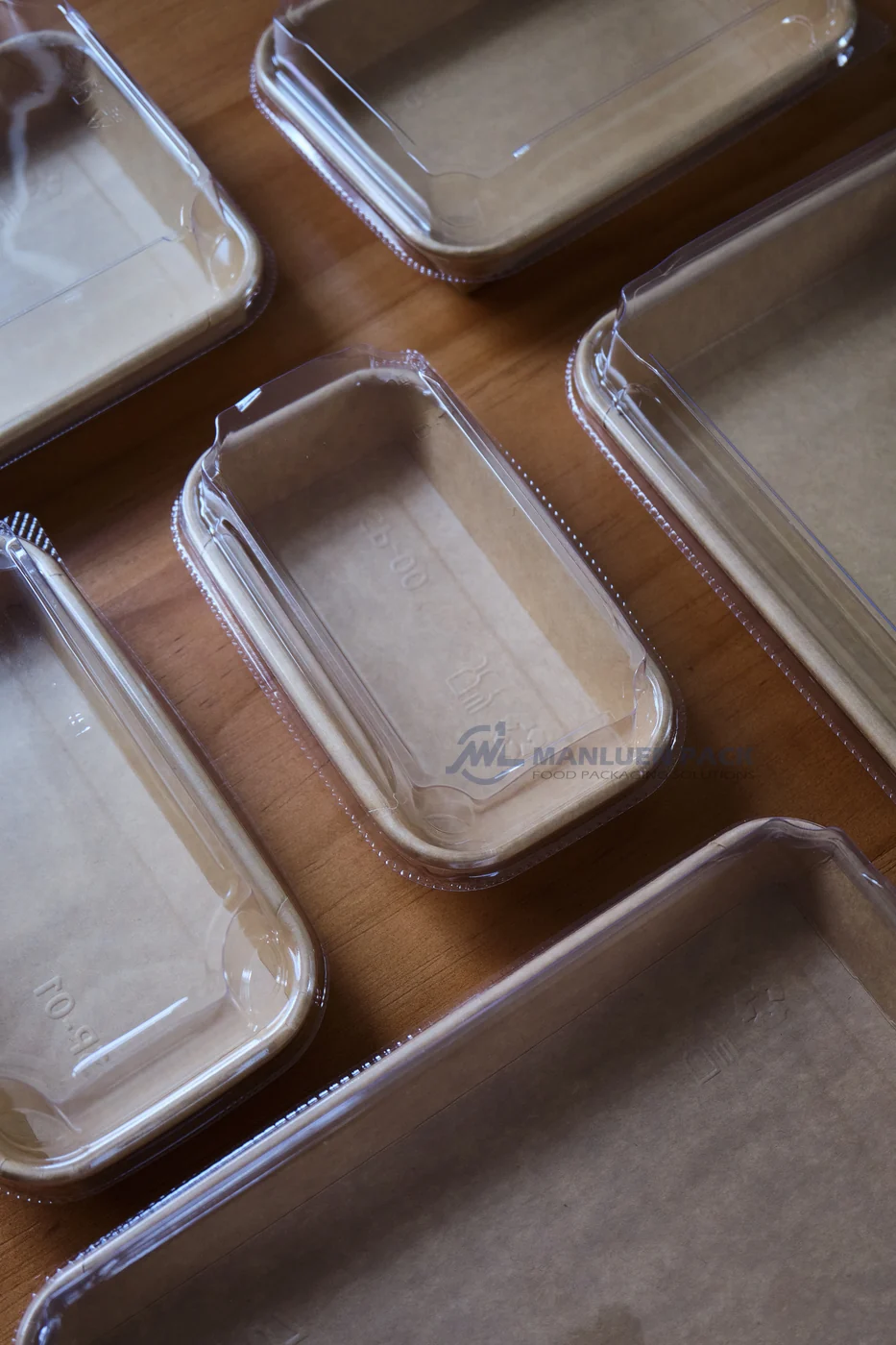
- kraft paper sushi trays with clear lids;
- bakery and cake boxes with solid or windowed tops;
- paper bowls and tubs for meals that need a moisture barrier;
- compartment boxes for set meals; and
- vented cartons for hot food that releases steam.
These formats serve different jobs. A bakery box protects shape and presentation. A sushi tray needs a fitted lid and clear product visibility. A hot-food carton must manage grease, steam and delivery time. One material description cannot replace a product-specific test.
Where Kraft Brown Paper Boxes Work Best
Kraft paper packaging works best when the structure matches the food. The following applications show what buyers should check before choosing a format.
Sushi and Chilled Prepared Food
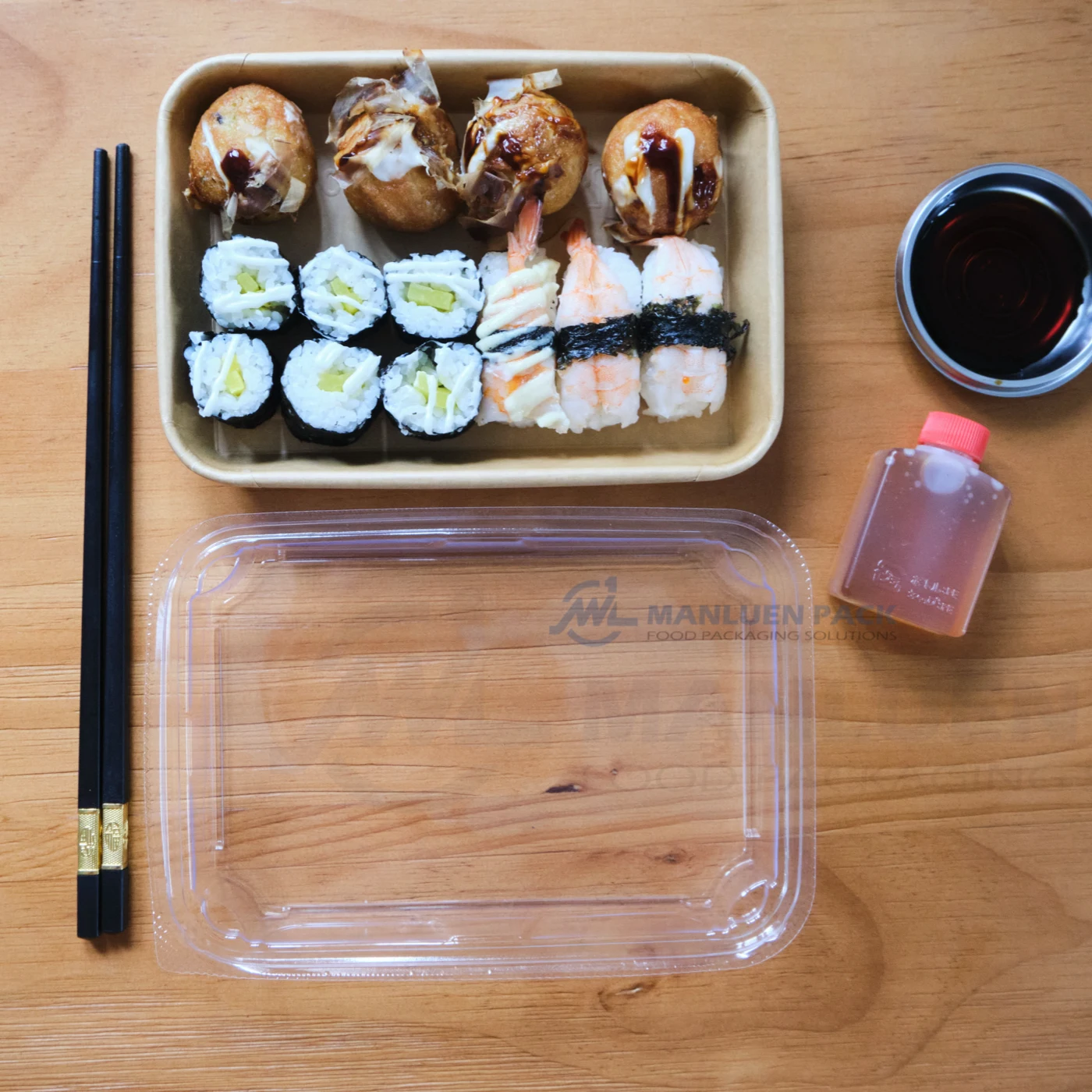
A kraft base with a clear lid gives customers a full view of sushi, desserts and cold prepared food. ManLuen’s sushi tray range includes paper-base formats for covered takeaway display.
Two current examples are the compact 0# kraft paper sushi tray, with a 138 × 78 × 24 mm base, and the larger 3# kraft paper sushi box, with a 165 × 113 × 24 mm base. Both use kraft paper bases and separate clear PET lids. The products have different carton quantities and external dimensions, so buyers should order by model rather than by a general size name.
Cakes, Cupcakes and Pastries
Bakery packaging must support the product without touching delicate toppings. Confirm the usable internal height as well as the base width. A window can improve display, but it adds another material to the box and may change recycling instructions.
For larger desserts, browse the cake container range and compare the internal dimensions, closure and carrying method with the finished cake. A sample test is especially important for tall cakes, cupcakes with frosting and products that release oil or moisture.
Takeaway Meals and Bento Service
Meal boxes may need compartments, a secure lid and enough stiffness for stacking. The box must also remain stable after contact with warm, moist food. Buyers comparing sectioned formats can review the bento box category.
Do not assume that every paper bento box is leakproof. Sauces can move between compartments or enter folded seams. Test the real meal at the normal filling temperature and delivery time.
Soups, Noodles and Wet Foods
Soup and curry place more pressure on a container than bread or sushi. They normally require a purpose-built bowl or tub with a suitable barrier and rim. A basic folding carton should not be used as a liquid container unless the supplier has designed and tested it for that use.
For wet foods, compare dedicated food bowls instead of relying on a generic kraft box. Check the lid fit, fill line, temperature limit and resistance to prolonged contact.

How the Box Structure Affects Performance
Paperboard Weight and Stiffness
Board weight affects strength, but it is only one factor. Fiber composition, moisture, grain direction, folds and corner design also affect how the box behaves. A heavy board can still fail if the seams open or the structure softens after contact with food.
Ask for the board specification and finished-box dimensions. Then test the box under the expected stack load. This matters when meals are packed in delivery bags or cartons several layers high.
Grease and Moisture Barriers
Plain paper absorbs grease and water. Many food boxes use a barrier coating or liner to slow penetration. The correct barrier depends on the recipe, serving temperature and contact time.
Fried food may need stain resistance and ventilation. Salads may need protection from dressing and condensation. Warm rice and pasta can soften an unsuitable base even when the food does not appear very wet.
Ask the supplier to identify the coating. Terms such as “food-grade coating” or “eco coating” are not enough. Buyers need the material name, use limits and supporting food-contact documents.
Lids, Windows and Closures
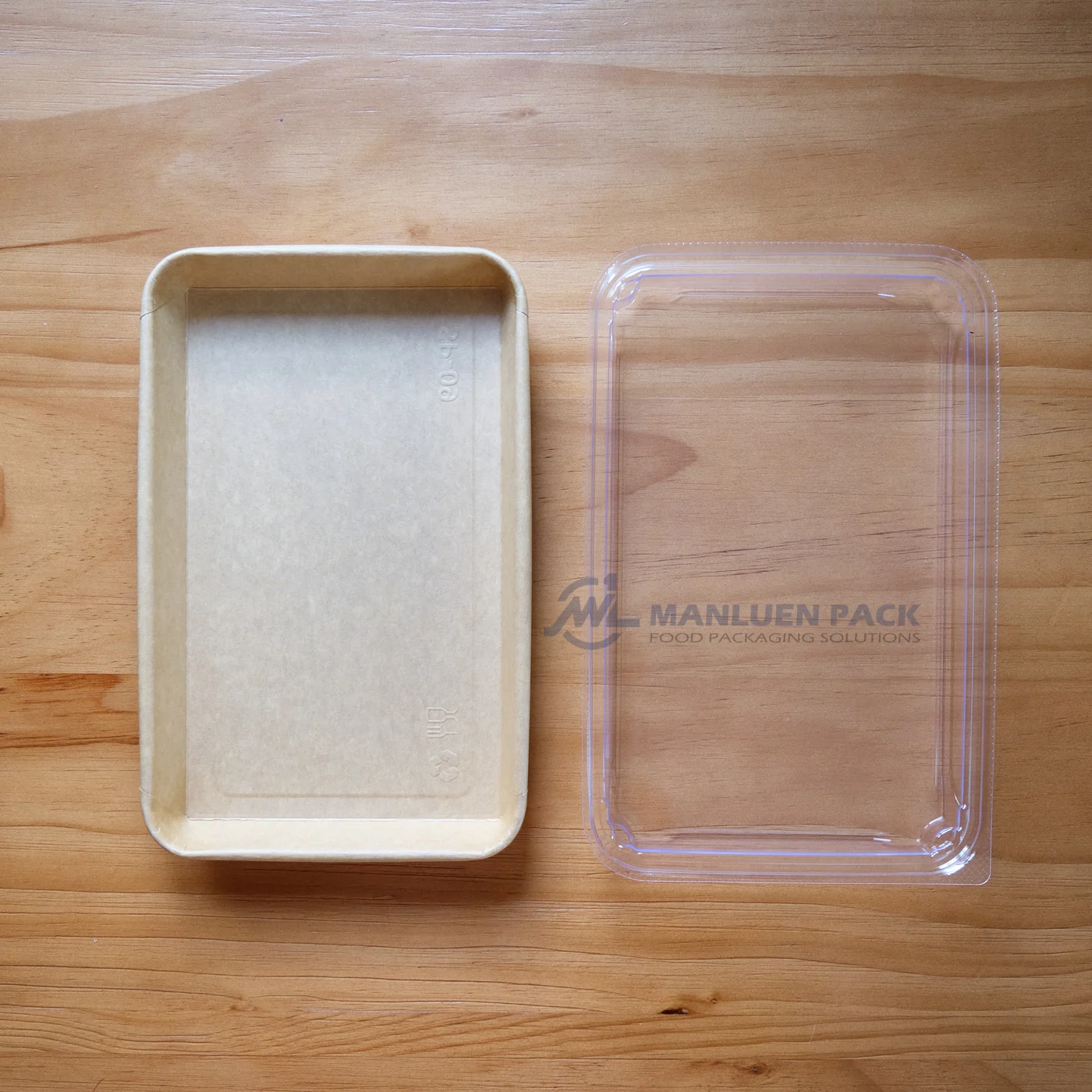
A clear lid helps sell food by keeping it visible. It can also provide more space above the product. However, it may have a different heat limit from the paper base. Instructions should state whether the lid must be removed before reheating.
Closures also need practical testing. Check whether tabs stay locked after the box is filled, stacked and moved. A closure that works on an empty sample may open after steam softens the board.
Vents
Hot fried food and baked products release steam. Without ventilation, condensation can soften the food and the box. Too much ventilation, however, can reduce heat retention. Test hole size and placement with the actual menu item rather than copying another package.
Are Kraft Brown Paper Boxes Microwave-Safe?
Some finished paper containers are suitable for limited microwave reheating. Others are not. Kraft paper itself does not prove microwave suitability.
The coating, adhesive, printing, window, lid and any metal part must all be considered. A clear PET lid should not enter a microwave unless the product instructions specifically allow it. Boxes with foil decoration, metal handles or other conductive parts must stay out.
Request written heating instructions for the exact model. They should state the time, temperature or power conditions and whether the lid must be removed or vented. Do not replace those instructions with a general claim such as “paper is microwave-safe.”
Food-Contact Compliance
Food-contact compliance applies to the finished structure and its intended conditions of use. A certificate for raw paper alone does not cover every coating, ink, adhesive or lid.
United States
Paper and paperboard components used in food-contact articles are addressed in 21 CFR Part 176. Other sections may apply to coatings, adhesives, polymers and production aids.
The FDA states that the regulatory status of a food-contact material depends on each substance that makes up the article. The relevant authorization must cover the substance, specifications and conditions of use. Buyers should therefore ask which regulatory basis applies to each important component.
European Union
Regulation (EC) No 1935/2004 provides the EU’s general framework for food-contact materials. It requires materials to be sufficiently inert so that transfer to food does not endanger health, cause an unacceptable change in composition or harm taste and smell.
Production must also follow Regulation (EC) No 2023/2006 on good manufacturing practice. Market-specific rules may apply to individual materials and substances.
Documents to Request
- the complete material structure, including board, coating, ink, adhesive, window and lid;
- a declaration or letter of compliance for the exact item;
- the regulatory basis for the destination market;
- test reports that match the intended food, temperature and contact time;
- batch or lot traceability; and
- written restrictions for heating, chilling, freezing and storage.
The phrase “FDA approved” is often too broad for food packaging. ManLuen’s guide to what food-grade packaging means explains how component-level authorization and intended use affect a buyer’s document review.
Sustainability Claims Need Specific Evidence
Kraft paper comes from fiber, but that does not make every finished box automatically recyclable, biodegradable or compostable. Coatings, glue, windows, lids and food residue can change the result.
A responsible claim should answer four questions:
- Which part of the package does the claim cover?
- What material or percentage supports the claim?
- Does the box require separation, industrial processing or a special collection program?
- Are suitable facilities available in the market where the package is sold?
The U.S. Federal Trade Commission advises marketers not to make broad, unqualified claims such as “green” or “eco-friendly.” Its Green Guides summary also explains that recyclable and compostable claims may need qualifications based on evidence and facility availability.
Ask for documentation when a supplier claims recycled content, certified fiber sourcing or compostability. For a multi-material pack, explain how the customer should separate the paper base and plastic lid. Clear instructions are more useful than a broad environmental slogan.

Printing and Customization
Custom printing can turn the box into a useful brand surface. A logo, product name, handling instruction or disposal note can be added when the print area allows it.
Before approving artwork, confirm:
- the printable area and number of colors;
- the ink and varnish system;
- whether any print is close to a food-contact surface;
- color tolerance between production batches;
- barcode and regulatory text requirements;
- plate, cylinder or tooling charges; and
- the approval process for proofs and production samples.
Structural customization may include size, board weight, barrier type, compartments, ventilation and lid style. Each change can alter cost, lead time, packing efficiency and compliance documentation. Confirm the final construction before relying on a test report prepared for an older version.

How to Test a Kraft Paper Box Before Ordering
A short product trial can reveal problems that do not appear in a specification sheet.
- Fill the box with the real food. Use the normal portion, oil level, sauce and filling temperature.
- Hold it for the full service time. Include preparation, display, pickup and delivery.
- Stack the packed boxes. Use the highest stack expected in a delivery bag or transport carton.
- Check the base and seams. Look for stains, soft areas, leaks and opened corners.
- Inspect the lid and closure. Confirm that it stays fitted after steam and movement.
- Review food quality. Check condensation, crispness, heat retention and odor transfer.
- Repeat the test. Use several samples rather than relying on one box.
For delivery operations, add a route test. Pack the order as staff normally would, move it through a realistic trip and inspect it on arrival.
How to Choose a Wholesale Supplier
A supplier should be able to answer technical and commercial questions without relying on vague descriptions. Use the following checklist when comparing quotations.
Review the supplier’s production background, quality-control process and experience with the required format. ManLuen provides an overview of its manufacturing business on the About Us page and lists available company documents on its certifications page. Product approval should still be based on documents that match the exact SKU, material structure, market and conditions of use.
| Area | What to confirm |
|---|---|
| Product | Model, internal dimensions, external dimensions, board, coating, lid and closure |
| Intended use | Food type, fill temperature, contact time, storage and reheating instructions |
| Compliance | Applicable market, declaration, test report, restrictions and traceability |
| Quality control | Incoming-material checks, dimensional tolerance, leak or grease tests and batch inspection |
| Customization | Artwork requirements, print tolerance, tooling, sampling and approval steps |
| Packing | Units per bag and carton, carton size, carton volume and pallet plan |
| Commercial terms | MOQ, unit price, tooling cost, lead time, payment terms and defect procedure |
Do not assume a universal MOQ. Stock items, printed orders and custom structures may have different minimums. Send the supplier complete requirements so the quotation reflects the actual project.
Frequently Asked Questions
Are kraft brown paper boxes greaseproof?
Not all of them. Grease performance depends on the paper and barrier system. Test the exact box with the real food and expected holding time.
Are kraft paper boxes suitable for hot food?
Some are designed for hot filling or warm takeaway meals. Ask for the temperature and contact-time limits of the finished box. Hot food can soften an unsuitable coating, seam or base.
Can kraft paper food boxes go in the microwave?
Only when the supplier’s instructions allow it for that exact model. The lid, coating, adhesive, ink and any metal component must also be considered.
Are kraft brown paper boxes plastic-free?
Not always. A box may contain a polymer barrier, plastic window or separate plastic lid. Request the complete material composition before making a plastic-free claim.
Are kraft paper boxes recyclable?
Recyclability depends on the coating, attached components, food contamination and local collection system. Customers may need to remove a plastic lid or window before placing the paper portion in an accepted stream.
What information should I send for a quotation?
Send the food type, portion size, dimensions, temperature, contact time, target market, required quantity, print file and preferred delivery date. You can then request a product-specific quotation from ManLuen.
Conclusion
Kraft brown paper boxes can work well for takeaway, sushi, bakery and retail food. The right choice depends on more than appearance. Buyers need to check the board, barrier, closure, lid, food conditions and compliance documents.
Test the finished box with the real product before placing a large order. Use specific environmental claims, confirm commercial terms in writing and choose a supplier that can explain the complete structure. For further format comparisons, see ManLuen’s guide to choosing kraft paper food containers.
References
U.S. Food and Drug Administration (FDA). Determining the Regulatory Status of Components of a Food Contact Material.
Used to explain why the regulatory status of a finished food-contact article depends on its individual components and intended conditions of use.
U.S. Food and Drug Administration
Electronic Code of Federal Regulations. 21 CFR Part 176—Indirect Food Additives: Paper and Paperboard Components.
Used for the U.S. regulatory category covering paper and paperboard components in food-contact articles.
Electronic Code of Federal Regulations
European Union. Regulation (EC) No 1935/2004 on Materials and Articles Intended to Come into Contact with Food.
Used for the EU’s general safety requirements for food-contact materials and articles.
EUR-Lex
European Union. Regulation (EC) No 2023/2006 on Good Manufacturing Practice for Food-Contact Materials and Articles.
Used for the EU good-manufacturing-practice requirement discussed in the compliance section.
EUR-Lex
U.S. Federal Trade Commission (FTC). Environmental Claims: Summary of the Green Guides.
Used for guidance on broad environmental claims and the evidence or qualifications needed for recyclable, compostable and degradable claims.
Federal Trade Commission

ManLuen Plastic Packaging Company, which is specialized in the production of Plastic Food Packaging for more than 20 years. Our products are made from 100% virgin and BPA-Free PP, PS, and OPS comply with FDA and European Standards.
 EN
 ZH
 FR
 PT
 ES
 KO
 JA