
Introduction
The material behind a sushi tray affects food presentation, lid fit, transport performance, temperature limits, and food-contact compliance. For most disposable plastic sushi packaging, buyers will encounter three main materials: PS, PP, and PET.
None of these plastics is automatically the best choice for every application. PS works well for economical chilled display. PP suits tougher containers and some reheating applications. PET offers high clarity and is widely used for cold retail packaging. The correct choice depends on the food, serving temperature, storage time, distribution route, and the specification of the finished package.
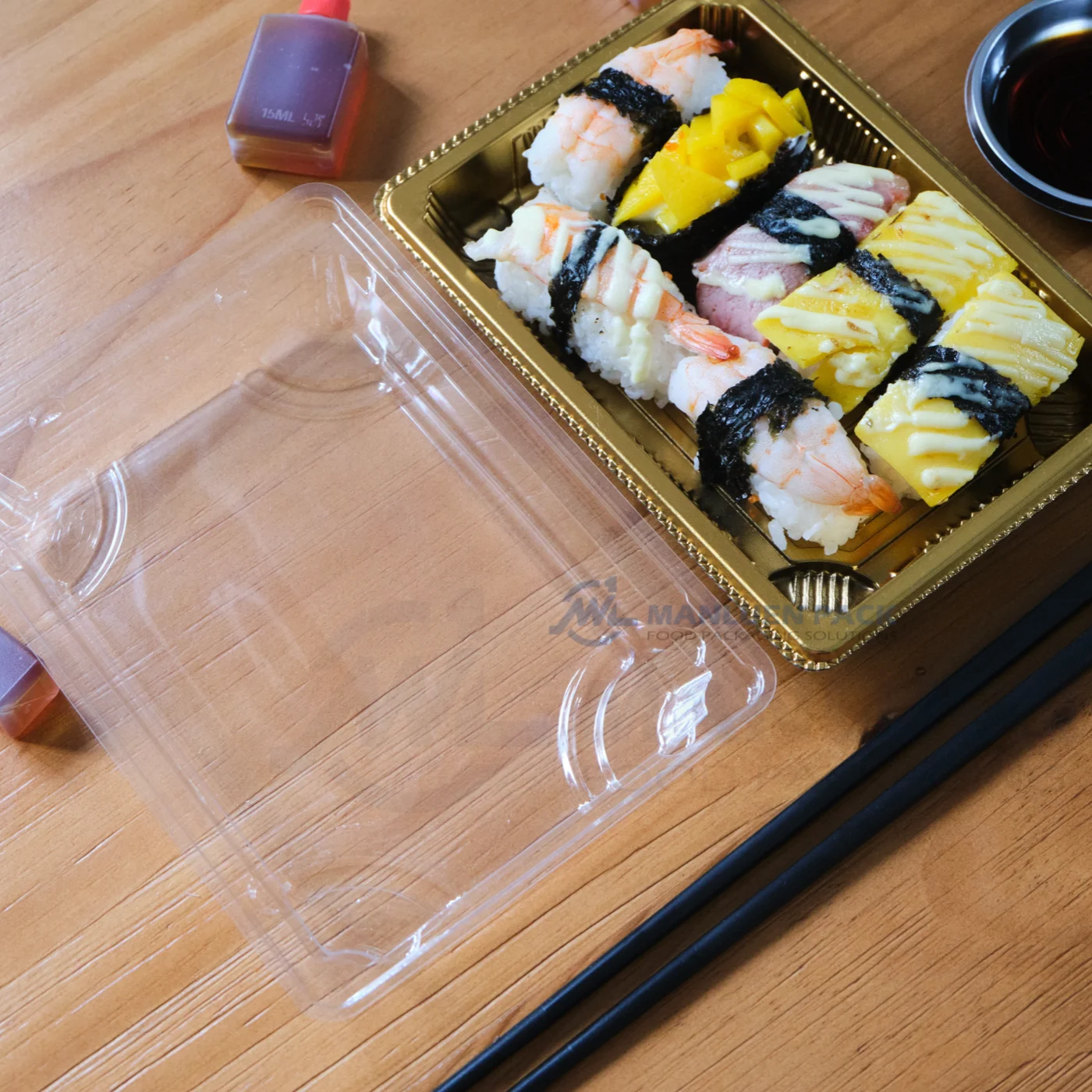
Manluen supplies sushi trays for restaurants, supermarkets, distributors, takeaway operators, and catering businesses. This guide explains how buyers can compare the main plastic materials and verify the finished product before ordering.
Which Plastic Materials Are Used for Sushi Trays?
PS, PP, and PET are common materials for disposable sushi trays and lids. They differ in clarity, stiffness, impact resistance, temperature range, and end-of-life options. Buyers who need a wider comparison can start with our guide to food packaging materials.
| Material | Main Strength | Typical Sushi Use | Main Limitation |
|---|---|---|---|
| PS (polystyrene) | Stiff, economical, easy to form | Cold sushi trays, display bases, party platters | Generally unsuitable for high heat or microwave reheating |
| PP (polypropylene) | Tough, moisture resistant, higher heat tolerance | Takeaway containers, hinged boxes, warm-food combinations | Microwave suitability still depends on the finished container |
| PET (polyethylene terephthalate) | Clear, rigid, strong cold-display performance | Transparent lids, chilled trays, retail display packs | Standard PET should not be assumed to be microwave-safe |
The resin name alone does not prove that a finished package is suitable for a specific food or temperature. Colorants, additives, coatings, recycled content, lid construction, and processing conditions also matter. Our guide to food-grade packaging explains why buyers must assess the complete construction and its intended use.
PS Sushi Trays: Economical Packaging for Chilled Display
Polystyrene is widely used for rigid disposable trays because it forms clean shapes, holds detailed surface patterns, and can provide a cost-effective base for chilled sushi presentation. Black, red, gold, and printed PS bases can create contrast with rice, fish, garnish, and separators.
PS is best treated as a cold- or room-temperature packaging material unless the supplier provides a different product-specific specification. Do not use a generic resin description as permission for oven or microwave heating. Excess heat can deform the tray and move the package outside its tested conditions of use.
In the United States, 21 CFR § 177.1640 sets requirements for polystyrene and rubber-modified polystyrene used in food-contact articles. Compliance still depends on the precise formulation and the conditions under which the finished article contacts food.
PS is often a practical choice for:
- cold nigiri, maki, and sashimi sets;
- same-day supermarket display;
- economical takeaway orders;
- large party trays used for chilled platters.
PP Sushi Containers: Tougher Packaging for Takeaway
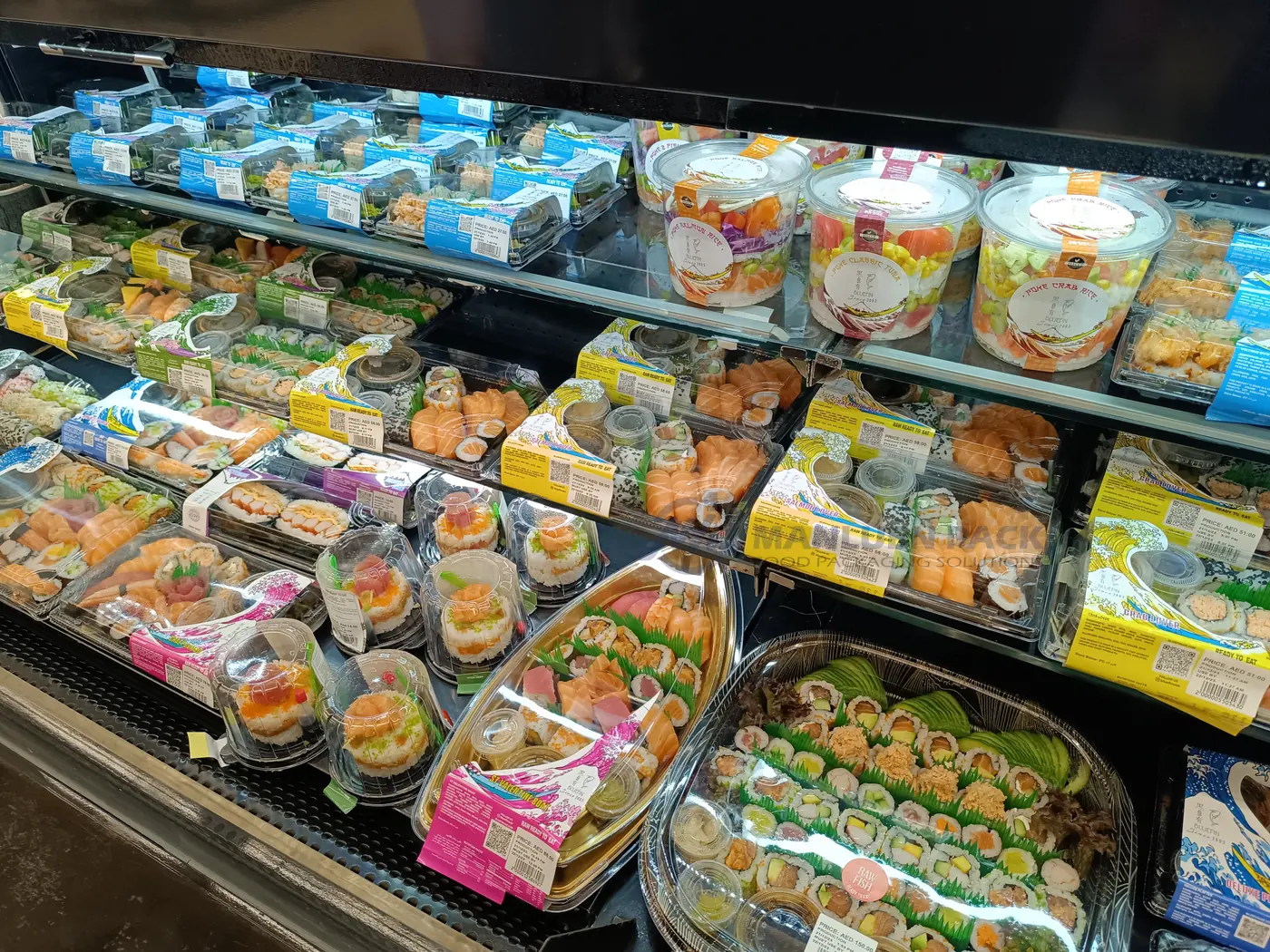
Polypropylene has better impact resistance and higher heat tolerance than standard PS or PET. It works well for takeaway containers that need a secure lid, reliable stacking, and resistance to vinegar, soy sauce, oil, and moisture.
Some PP containers are designed for microwave reheating, but the resin code does not make every PP package microwave-safe. The lid, wall thickness, colorants, food load, heating time, and ventilation design all affect performance. Check the label and the supplier’s written specification. Our plastic-container microwave safety guide explains these checks in more detail.
A restaurant partner reported that a Manluen PP sushi box remained intact after three minutes at 800 W during an internal application test. Treat this as one test condition, not a universal instruction. Buyers should repeat the test with the selected SKU, real food, actual lid, and intended microwave program.
The U.S. provisions covering olefin polymers appear in 21 CFR § 177.1520. Buyers should request the regulatory basis and migration documentation for the actual PP grade rather than accepting a general statement about polypropylene.

PP is also used beyond sushi packaging. Buyers consolidating several container programs can review Manluen’s food storage containers, including the C-16 food-safe 16 oz takeaway container and the C-8 clear 8 oz PP deli container. Each product still requires its own temperature and food-contact review.
PET Sushi Packaging: Clear Presentation for Cold Food
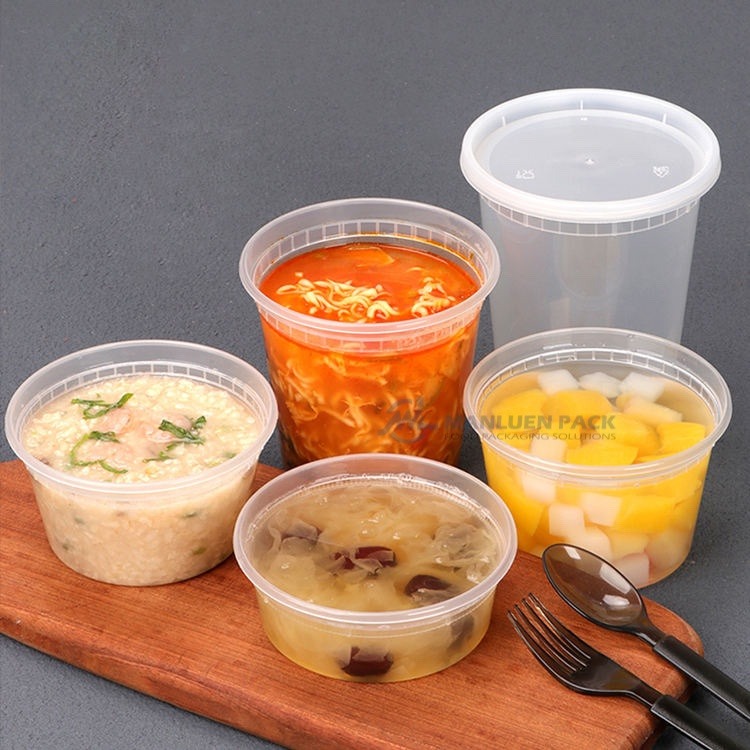
PET provides high clarity and good rigidity. It is commonly used for transparent lids and cold-food containers where customers need to see the sushi without opening the package.
Anti-fog performance is not automatic. It depends on the PET formulation, surface treatment, coating, lid design, storage temperature, and moisture inside the pack. Buyers should test the finished lid under the actual chilled-display and delivery conditions.
Standard PET is normally selected for cold use rather than microwave reheating. The relevant U.S. requirements for polyethylene phthalate polymers appear in 21 CFR § 177.1630. When recycled PET is proposed, confirm the source, recycling process, intended use, and supporting food-contact documentation. The FDA maintains guidance and information on recycled plastics in food packaging.
PET may be recyclable where local collection and processing systems accept the finished pack. Dark colors, multilayer structures, labels, adhesives, food residue, and mixed-material lids can reduce practical recyclability.
Match the Material to the Sushi Application
Chilled supermarket display
PS bases and clear PET lids are common for chilled retail display. The base provides structure and color contrast, while the clear lid helps customers inspect the food. Test condensation, lid retention, stacking, and refrigerator performance before approval.
Takeaway and delivery
PP can be useful when the pack needs more toughness or may hold warm side dishes. PS and PET remain suitable for many cold sushi orders. Select the package by actual temperature and handling conditions rather than by appearance alone.
Large platters and catering
Large formats need a rigid base, dependable lid engagement, and enough clearance to protect presentation. Buyers comparing materials for event orders can read our guide to safe plastic choices for sushi party trays.
Mixed menus
Sushi counters often pack salads, cut fruit, sauces, and side dishes as well as sushi. Related options include fruit boxes and sauce cups. Using compatible formats can simplify case ordering, storage, and service.
Different piece counts
A suitable material will not compensate for the wrong footprint or lid height. Use the sushi tray size and capacity guide to compare formats for 6, 12, 20, 40, and 100 pieces.
Food-Contact Compliance: What Buyers Should Verify
“FDA approved” is too vague for a finished sushi tray. The FDA regulates food-contact substances through specific legal pathways and intended conditions of use. The agency explains that a food-contact substance that is a food additive must be authorized for its intended use before it is marketed in the United States.
For a practical explanation of responsibilities, see what agency approves food packaging. Buyers should also consult the FDA’s official overview of food packaging and food-contact substances.
For the European Union, Regulation (EC) No 1935/2004 provides the general framework for food-contact materials, while Commission Regulation (EU) No 10/2011 contains specific rules for plastic food-contact materials. A supplier should connect its declaration and test report to the actual resin, color, product construction, food type, contact time, and temperature.
Ask for:
- the material identity and resin grade;
- the applicable U.S. regulatory basis or EU declaration of compliance;
- migration testing that matches the intended food and use conditions;
- the permitted temperature and contact-time range;
- statements covering colorants, additives, recycled content, and other requested substances;
- a report or declaration tied to the selected SKU rather than a generic factory document.
Manluen publishes company-level records on its certifications page. Buyers should still request the latest documents for the specific model and destination market.
How Material Choice Can Affect Operating Costs
Material choice can influence breakage, leakage, packing speed, shelf presentation, complaint rates, and the amount of food discarded after delivery. These effects matter more than a small difference in unit price.
Manluen customer feedback has included a reported 15–20% increase in repeat purchases after a packaging upgrade. One sushi-chain customer also reported that delivery losses fell from 7% to 3%, with annual savings above $50,000. These are individual customer reports, not guaranteed results. Menu mix, order volume, delivery distance, staff handling, and the previous package all affect the outcome.
The useful lesson is simpler: test the package against the failure that costs the business money. For some operators, that is a cracked lid. For others, it is condensation, poor stacking, sauce leakage, or a tray that makes the product look smaller than it is.

How to Choose a Plastic Sushi Tray
- Define the food and temperature. Record whether the tray will hold chilled sushi only, warm sides, oily foods, acidic condiments, or a mixed menu.
- Choose the required presentation. Decide whether high clarity, a colored base, a patterned finish, or anti-fog performance matters most.
- Set the portion and lid clearance. Match the tray footprint and lid height to the actual pieces, garnish, separators, and sauce cups.
- Test distribution. Check lid retention, stacking, vibration, refrigeration, condensation, and opening after delivery.
- Verify the documents. Match declarations and test reports to the exact SKU and intended market.
- Compare the full cost. Include rejects, breakage, storage space, carton quantity, labor, and customer complaints.
Our guide to choosing disposable plastic sushi trays covers the main format decisions. Buyers evaluating factories can also use the 2026 sushi tray supplier checklist.
For a closer look at Manluen formats, compare the WL-01 gold sushi box with lid and the WL-01 disposable sushi display tray. Confirm the material, size, color, lid, and intended conditions with the current product specification before ordering.
Frequently Asked Questions
Which plastic is best for sushi trays?
There is no universal best material. PS suits economical chilled presentation. PP provides better toughness and higher heat tolerance. PET offers high clarity for cold display. Choose according to the food, temperature, handling, and target market.
Are plastic sushi trays microwave-safe?
Do not assume so. Some PP containers are designed for microwave reheating, while standard PS and PET sushi trays generally are not. Follow the written instructions for the exact container and lid.
Is PET better than PP for sushi packaging?
PET is often better when clear cold-food presentation is the priority. PP is usually the stronger option when higher heat tolerance and impact resistance matter. The finished package design is as important as the resin.
Can PS sushi trays hold hot food?
PS sushi trays are normally selected for cold or room-temperature food. Do not use them for hot filling or reheating unless the supplier’s product-specific documentation permits that use.
Does a resin code prove food-contact compliance?
No. A resin code identifies the broad material family. It does not prove that the complete tray, lid, colorant, coating, or recycled content complies with the intended food-contact conditions.
What is the minimum order quantity for wholesale sushi trays?
MOQ depends on the model, material, color, printing, carton configuration, and whether new tooling is required. Send the required dimensions, quantity, target market, and use conditions when you request a sample or quotation.
Conclusion
PS, PP, and PET can all be suitable sushi tray materials when the finished package matches its intended use. PS is a practical cold-display option. PP offers greater toughness and can support some reheating applications. PET provides clear presentation for chilled retail packaging.
Before ordering, verify the exact material, lid system, temperature range, food-contact documents, and distribution performance. You can learn more about Manluen’s manufacturing and sourcing support on the About Manluen page or continue with our other food packaging guides.
Sources and Further Reading
U.S. Food and Drug Administration. Food Packaging & Other Substances that Come in Contact with Food.
Used for the definition of food-contact substances, authorization principles, migration review, and recycled-plastic overview.
U.S. Food and Drug Administration
Electronic Code of Federal Regulations. 21 CFR Part 177—Indirect Food Additives: Polymers.
Used for the U.S. regulatory provisions covering polymers used in food-contact articles, including PS, PP, and PET-related sections.
Electronic Code of Federal Regulations
European Union. Commission Regulation (EU) No 10/2011 on Plastic Materials and Articles Intended to Come into Contact with Food.
Used for the EU plastic food-contact framework, declarations of compliance, and migration requirements.
EUR-Lex
U.S. Food and Drug Administration. Recycled Plastics in Food Packaging.
Used for FDA’s current review approach and guidance for recycled polymeric food-contact materials.
U.S. Food and Drug Administration

ManLuen Plastic Packaging Company, which is specialized in the production of Plastic Food Packaging for more than 20 years. Our products are made from 100% virgin and BPA-Free PP, PS, and OPS comply with FDA and European Standards.
 EN
 ZH
 FR
 PT
 ES
 KO
 JA