
Introduction
Kraft paper boxes are common in takeaway, bakery, sushi, catering, and retail food service. They look simple, but the paper color alone tells a buyer very little about safety or performance. The paperboard, coating, ink, adhesive, lid, and finished-box design all affect how the package works with food. Buyers should therefore compare the complete package, not just ask whether it is “food-grade kraft paper.”
A box for dry pastries does not need the same grease barrier as a fried-food box.
A container for chilled sushi has different requirements from one used for hot noodles or soup. This guide explains what to check when buying kraft paper boxes wholesale. It also shows how paper boxes fit into the wider range of food packaging materials and how to match a box to the food, temperature, transport time, and target market.
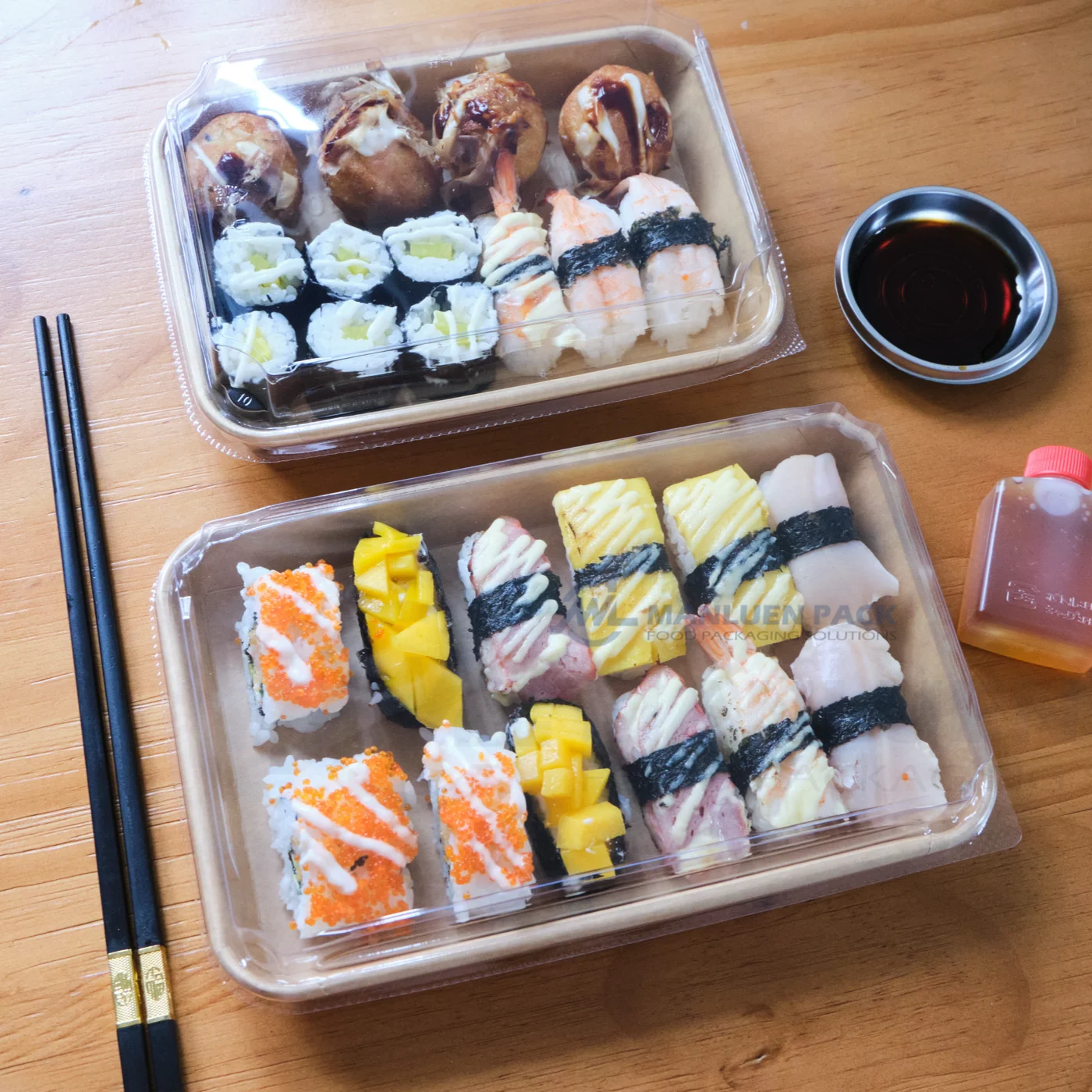
What Makes a Kraft Paper Food Box Safe?
A safe food box starts with suitable raw materials, but safety depends on the finished article and its intended use. Buyers should review four main parts:
- Paperboard: The fiber must be suitable for the intended food-contact application and strong enough for filling, stacking, and transport.
- Barrier coating: A coating may provide oil, moisture, or heat resistance. Common constructions use PE or another functional barrier, but the exact coating must match the food and disposal claim.
- Inks and adhesives: Printing and bonding materials should be controlled so they do not transfer to food under the intended conditions of use.
- Finished construction: Seams, folds, locking tabs, ventilation, and lid fit affect leakage, deformation, and contamination risk.
“Brown,” “natural,” and “kraft” describe appearance or paper type. They do not prove regulatory compliance. Likewise, “FDA approved” is often used too loosely. The better question is whether every food-contact component has a valid regulatory basis for the stated use. Our guide to food-grade packaging explains this distinction in more detail. For a wholesale order, ask the supplier to identify the paper grade, coating type, food-contact side, printing system, adhesive, and recommended conditions of use. The supplier should also link those details to the exact SKU and batch you plan to buy.
Understand the Full Material Structure
Paperboard and fiber
Virgin fiber can provide consistent strength, appearance, and converting performance. Recycled fiber may also be suitable in some constructions, but it needs appropriate controls and, where necessary, a functional barrier. Buyers should not assume that either option is automatically safer. What matters is the specification, the regulatory basis, and the finished-package test result. ManLuen can provide product-specific information for its paper packaging range. Before ordering, ask whether the quoted box uses virgin or recycled fiber and whether the specification permits direct contact with the food you plan to pack.
Oil and moisture barriers
Uncoated paper absorbs oil and water. A takeaway box often needs a barrier to prevent staining, softening, or leakage. PE-coated paper remains common because it offers reliable moisture and grease resistance. Other coatings may support different recycling or composting goals, but their performance varies. The coating changes the package’s regulatory and end-of-life profile. If a paper box includes a plastic layer, the supplier should document that layer as well as the paperboard. A paper-based package is not automatically plastic-free, recyclable, or compostable.
Inks, adhesives, and printing
Custom printing helps restaurants and food brands present a consistent identity. It also adds materials that must be controlled. Keep heavy ink coverage away from direct food-contact surfaces unless the construction and documentation support that use. Ask about low-migration inks, set-off control, curing, and adhesive suitability. If you need printed boxes, send artwork and color requirements early. Printing method, order volume, coating, and box structure can affect color results and lead time.
Food-Contact Rules Buyers Should Check
United States
In the United States, paper and paperboard components used in contact with food are addressed in 21 CFR Part 176. Coatings, adhesives, polymers, colorants, and other components may fall under other provisions or another valid food-contact authorization. This is why a supplier should not present one general certificate as proof for every box. The documentation should cover the actual material structure and intended conditions of use. The FDA’s food-contact substance guidance explains that authorization depends on the substance and its intended use. Buyers who need a wider overview can also read which U.S. agency regulates food packaging.
European Union
For the EU market, food-contact materials must follow the general safety principles in Regulation (EC) No 1935/2004. If the box has a plastic food-contact layer, Regulation (EU) No 10/2011 may also apply to that plastic layer. Do not describe an entire kraft box as “EU 10/2011 certified” without explaining which component was tested. Ask for a declaration or test report that names the SKU, material structure, food simulants, test time, test temperature, and results.
PFAS and grease-resistant paper
Grease resistance needs special attention. In February 2024, the FDA announced that PFAS-containing grease-proofing substances were no longer being sold into the U.S. market for paper food packaging. In January 2025, the agency determined that 35 related food-contact notifications were no longer effective because manufacturers had abandoned those uses. The FDA maintains the current position on its PFAS market phase-out page. Ask for a written PFAS statement for grease-resistant paper boxes, especially if you sell in a market with additional state or local restrictions. Our article on PFAS in food packaging provides further background.
Match the Box to the Food
The safest and most economical box is the one designed for the actual food. Start with the food type, serving temperature, holding time, and delivery method.
| Food or use | Main packaging need | What to check |
|---|---|---|
| Dry bakery items | Shape protection and clean presentation | Board stiffness, food-contact surface, window material, folding strength |
| Fried or oily foods | Grease resistance without excessive condensation | Barrier type, venting, seam leakage, PFAS statement |
| Hot takeaway meals | Heat resistance, secure closure, stack strength | Maximum fill temperature, holding time, coating, lid fit |
| Soup or high-liquid foods | Leak resistance | Use a purpose-designed bowl or container; test seams and lid under transport |
| Cold sushi and deli food | Visibility, moisture control, secure transport | Base stiffness, lid clarity, condensation, food presentation |
Do not assume that every coated paper box is microwave-safe. Microwave suitability depends on the complete construction, including coatings, adhesives, inks, lids, and any metal parts. Only make that claim when the supplier gives written instructions for the exact SKU. If you are comparing several formats, use our guide on how to choose the right food packaging to narrow the options before requesting samples. 
Kraft Paper Box Types for Food Businesses
Sushi and cold-food boxes
Kraft bases paired with clear lids can present sushi, desserts, and chilled deli food while protecting the contents during handling. Buyers can compare the disposable kraft paper sushi box and the mini kraft paper sushi takeaway container, then review the wider sushi tray range for other shapes and materials.
Bento and takeaway boxes
Takeaway boxes need reliable locks, strong corners, and enough headspace to protect the meal. Compartments can separate sauces or side dishes, but each divider also needs to withstand movement and moisture. Compare kraft formats with ManLuen’s broader bento box range before choosing a structure.
Cake and bakery boxes
Cake packaging needs a stable base and enough clearance for decoration. Grease marks, window fogging, and crushed corners can weaken presentation. The cake container range shows alternative structures for retail display and transport.
Bowls and liquid-food containers
Paper bowls can work for rice, salads, noodles, and some soups when their coating and lid match the use. High-liquid foods require a purpose-designed seam and lid. Buyers should compare samples from the food bowl range rather than treating a folded paper box as a universal container.
General food storage and prepared meals
For meal prep, deli counters, and refrigerated display, compare paper constructions with the food storage container range. The right choice depends on visibility, temperature, stacking, sealing, and local recovery systems. For more examples, see ManLuen’s guides to safe wholesale kraft paper boxes, kraft paper food packaging, and kraft paper boxes with lids.
Wholesale Buyer Checklist
Before placing a bulk order, ask the supplier for information tied to the exact product. A useful approval file should include:
- Product specification: Dimensions, capacity, board weight, coating, lid material, color, and tolerances.
- Intended-use statement: Food types, maximum fill temperature, holding time, refrigeration or freezing limits, and microwave or oven restrictions.
- Food-contact documents: Regulatory basis, declaration, and relevant migration or composition reports for the destination market.
- PFAS statement: Especially for grease-resistant paper and paperboard.
- Sample evaluation: Test the box with the actual meal, sauce, temperature, delivery time, stacking load, and transport route.
- Quality control: Confirm incoming-material checks, in-process inspection, finished-goods inspection, traceability, and complaint handling.
- Commercial details: MOQ, carton quantity, printing MOQ, tooling charge, sample cost, production lead time, shipping terms, and payment terms.
ManLuen lists company-level documents on its certifications page. A buyer should still request the report for the exact SKU and target market. General certificates and management-system audits do not replace product-specific food-contact evidence.
How Kraft Paper Boxes Can Support Profitability
Packaging affects more than unit cost. A stronger box may reduce leaks, crushed food, refunds, and repacking time. A box that stacks well can also improve storage and delivery efficiency. Printing can support brand recognition, but excessive customization may raise MOQ and slow replenishment. Compare total packed-meal cost rather than buying on container price alone. Include lids, labels, assembly time, packing speed, damage, storage space, freight, and waste. Run a small trial before changing the whole packaging system. ManLuen has received internal customer feedback reporting a reduction of up to 91% in complaints described as delivery contamination or packaging-related soiling after a suitable container change. This is not a guaranteed result. Food type, closure, staff handling, transport time, and delivery conditions all affect performance. Buyers should validate results in their own operations. For a broader view of material and supplier trade-offs, see sustainable food packaging trends and supplier selection. 
Use Environmental Claims Carefully
Paper packaging can support lower-plastic or fiber-based packaging goals, but buyers should avoid broad claims such as “100% eco-friendly,” “fully biodegradable,” or “degrades in 34 days” without evidence for the complete package and the stated disposal conditions. The U.S. Federal Trade Commission’s Green Guides say environmental claims should be clear, qualified, and supported. A coating, adhesive, window, or plastic lid can change whether the finished package is recyclable or compostable. Local collection and processing also matter. Ask these questions before publishing an environmental claim:
- Does the claim cover the complete package or only the paperboard?
- Does a recognized test method support it?
- Does the claim require industrial composting?
- Can local recycling facilities process the coating and food residue?
- Should the lid, window, or liner be separated before disposal?
Clear disposal instructions are more useful than vague green language.
Frequently Asked Questions
Are kraft paper food boxes safe?
They can be safe when every food-contact component is suitable for the intended food and conditions of use. Check the paperboard, coating, ink, adhesive, lid, and finished-box test documents. The brown color alone does not prove safety.
Are kraft paper boxes microwave-safe?
Some products may be suitable for limited microwave reheating, but this is not a general property of kraft paper boxes. Use only the time, temperature, and venting instructions supplied for the exact SKU. Never microwave a package with metal components or an unsuitable lid.
Are kraft paper boxes recyclable?
It depends on the coating, food residue, package design, and local recycling system. Clean, lightly coated fiber may be accepted in some programs, while heavily soiled or multi-material packaging may not be. Ask the supplier for the material structure and check local rules before making a recyclability claim.
What is the usual MOQ for wholesale paper boxes?
MOQ depends on box size, stock availability, printing, coating, and custom tooling. Standard items usually have lower minimums than custom-printed or custom-shaped boxes. Send the dimensions, quantity, artwork, food type, and target market when requesting a quote.
What documents should I request?
Request the product specification, material declaration, intended-use statement, relevant food-contact reports, PFAS statement where applicable, and quality-control information. Confirm that the product code on each document matches the item you are buying.
Conclusion
Good kraft paper packaging starts with a clear use case. Define the food, temperature, holding time, transport conditions, target market, and disposal claim. Then compare the complete material structure and test the finished box with the real meal. ManLuen supplies paper and plastic food packaging for restaurants, distributors, retailers, and catering businesses. Learn more about ManLuen, browse the packaging knowledge center, or request samples and a wholesale quote with your product requirements.
Sources and Further Reading
- Electronic Code of Federal Regulations — 21 CFR Part 176: Paper and Paperboard Components
- U.S. Food and Drug Administration — Food Packaging and Food Contact Substances
- U.S. Food and Drug Administration — Market Phase-Out of PFAS Grease-Proofing Substances
- EUR-Lex — Regulation (EC) No 1935/2004 on Food-Contact Materials
- EUR-Lex — Regulation (EU) No 10/2011 on Plastic Materials and Articles
- Federal Trade Commission — Environmental Claims: Summary of the Green Guides

ManLuen Plastic Packaging Company, which is specialized in the production of Plastic Food Packaging for more than 20 years. Our products are made from 100% virgin and BPA-Free PP, PS, and OPS comply with FDA and European Standards.
 EN
 ZH
 FR
 PT
 ES
 KO
 JA