
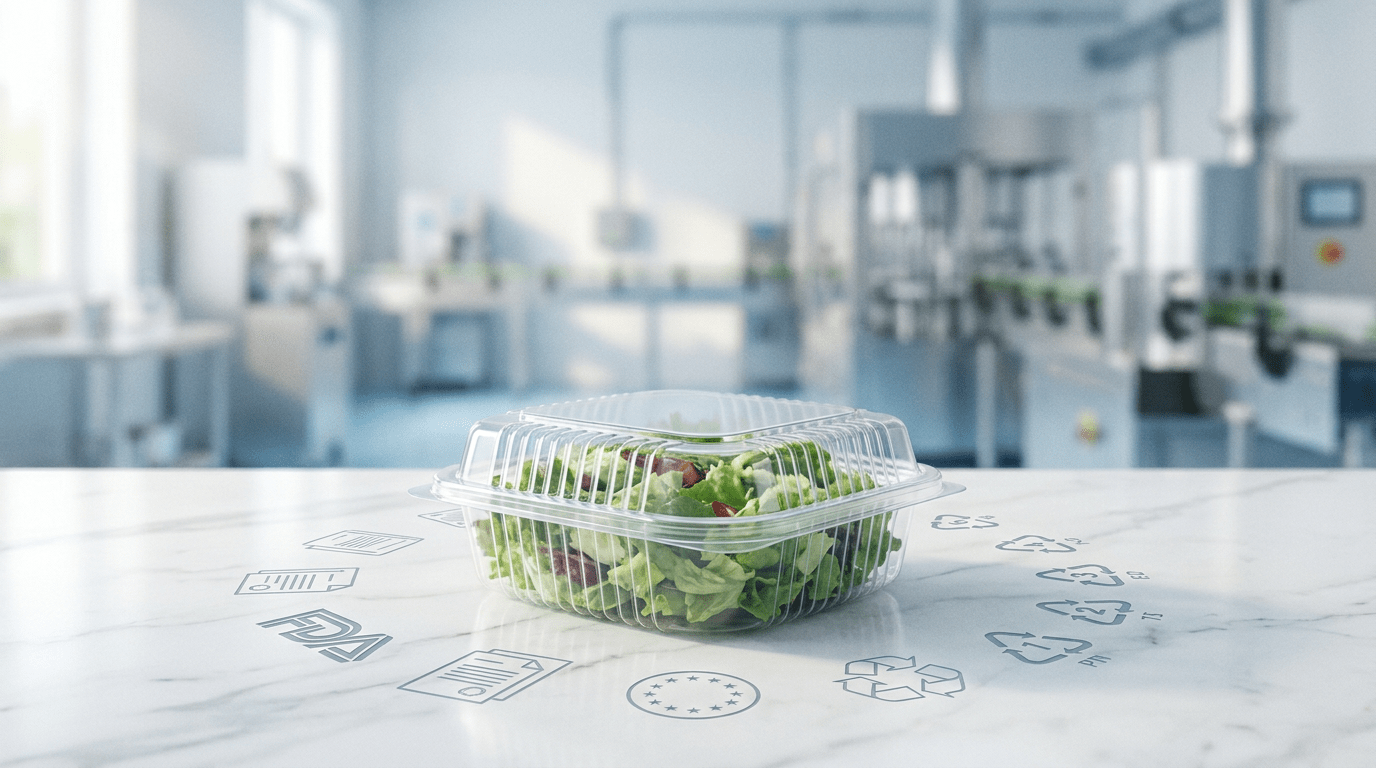
Key Market Insights for Plastic Food Packaging Compliance 2026
| 📊 Metric | Value | 📈 Trend |
|---|---|---|
| Global plastic food packaging market (2024) | USD 392B | +4.2% CAGR |
| EU packaging recyclable target (2030) | ≥ 70% | Mandatory |
| PFAS individual substance limit | ≤ 25 ppb | Tightened |
| Sustainable packaging CAGR (2025-2030) | +10.3% | Strong |
| Major plastic food packaging compliance 2026 deadline | 2026-08-12 | Cliff edge |
Why 2026 Reshapes Plastic Food Packaging Compliance
Plastic food packaging compliance 2026 is the most disruptive year the industry has faced in a decade. Three forces are converging. A PET clamshell that is fully compliant for U.S. retail can still be rejected at an EU port if it carries PFAS residues, lacks a recyclability grade, or misses a producer registration number.
If you buy, specify, or manufacture plastic food packaging, the next twelve months will reset your compliance playbook. This plastic food packaging compliance 2026 guide breaks down what brands, converters, and packaging manufacturers must do, with dates, thresholds, and a practical checklist you can apply before the August 2026 cliff edge.
The Regulatory Landscape
Governments on both sides of the Atlantic are tightening the rules that govern plastic food packaging compliance 2026. The four pieces of legislation that matter most:
- United States phase-out of grease-proofing substances containing PFAS — final deadline already passed
- U.S. Pharmacopeia (USP) new chapter on plastic components — mandatory May 1, 2026
- EU Packaging and Packaging Waste Regulation — fully applicable August 12, 2026
- U.S. state-level recycled content mandates — California AB 793 and successors
Each rule changes a different lever: chemistry, traceability, recyclability, and recycled content. Together, they force plastic food packaging compliance 2026 to overhaul supplier qualification processes.
How to Make Plastic Food Packaging PFAS-Free in 2026
The single biggest shift in plastic food packaging compliance 2026 is the simultaneous enforcement of PFAS limits on both sides of the Atlantic. Any plastic food packaging that previously relied on PFAS-containing coatings or additives must switch to fluorine-free alternatives.
What the Numbers Mean for Plastic Food Packaging Buyers
| Threshold | Limit | Applies to |
|---|---|---|
| Individual PFAS (targeted analysis) | ≤ 25 ppb | All plastic food packaging in the EU from Aug 12, 2026 |
| Sum of all PFAS (targeted analysis) | ≤ 250 ppb | Same |
| Total PFAS including polymeric (total fluorine) | ≤ 50 ppm | Same |
The EU testing pathway is a three-step process. Start with total fluorine (TF) screening. If TF ≤ 50 ppm, the sample is automatically compliant. If TF > 50 ppm, pyrolysis-GC/MS distinguishes organic from inorganic fluorine, with TOP assay as the final confirmation.
Plastic Food Packaging Buyer Checklist
- Audit every active plastic food packaging SKU. Document the polymer, additives, inks, adhesives, and coatings
- Identify every plastic food packaging SKU exposed to PFAS in any layer, including legacy multi-layer structures
- Commission third-party TF screening for each plastic food packaging SKU intended for the EU market
- For TF > 50 ppm samples, run pyrolysis-GC/MS or TOP assay to confirm compliance
PCR Content: From Sustainability Story to Procurement Mandate
Post-consumer recycled (PCR) content is no longer a sustainability story. It is a regulatory and procurement requirement for plastic food packaging compliance 2026.
2030 and 2040 PCR Targets for Plastic Food Packaging
| Plastic food packaging type | 2030 minimum PCR | 2040 minimum PCR |
|---|---|---|
| Single-use plastic beverage bottles | 30% | 65% |
| PET food contact plastic food packaging (non-bottle) | 30% | 50% |
| Non-PET food contact plastic food packaging (non-bottle) | 10% | 25% |
| Other plastic food packaging | 35% | 65% |
Why Mono-Material Wins in Plastic Food Packaging Compliance 2026
Mono-PET, mono-PP, and mono-PE structures simplify recyclability grading, reduce PFAS exposure points, and streamline migration testing. For plastic food packaging buyers, mono-material is the default specification for new SKU development.
Request the recycling process No-Objection Letter (NOL) number from every PCR supplier. Verify that the intended use matches your product. A PCR grade approved for dry food cannot be used for hot-fill beverages without a separate NOL.
Where Plastic Food Packaging Is Sold: Channels and Applications
Compliance requirements for plastic food packaging compliance 2026 vary by channel. A plastic food packaging SKU that works for supermarket retail may fail in catering or hospitality applications.
- Supermarket retail — AB 793 minimum 25% PCR in rigid plastic food packaging in California. EU EPR registration in every member state of sale
- Hospitality and catering — Microwave-safe, leak-resistant plastic food packaging for transport. Food-grade Declaration of Conformity (DoC) required
- Quick-service restaurants and takeout — PFAS-free grease-resistant plastic food packaging. Mono-material preferred
- Event catering and bulk distribution — Stackable plastic food packaging with documented mono-material structure for downstream recyclability
The common thread: every channel demands a refreshed DoC per (EU) 10/2011 with the 2026 amendments, plus U.S. compliance statements traceable to specific manufacturing batches.
Eco-Material and Recyclability Trends
The 2026 regulatory wave accelerates the shift toward plastic food packaging designs that are simultaneously compliant and recyclable.
Recyclability Grading Timeline for Plastic Food Packaging
| Date | Requirement | Impact on plastic food packaging |
|---|---|---|
| January 1, 2030 | All plastic food packaging must achieve ≥ 70% recyclability (Grade C or above) | Mono-material plastic food packaging becomes the default |
| January 1, 2038 | Only Grade A (≥ 95%) and Grade B (≥ 80%) plastic food packaging allowed | Multi-material plastic food packaging designs exit the market |
From Recyclable to Truly Recycled
Design for recycling is no longer enough. Plastic food packaging buyers must also verify that recycling infrastructure exists to actually process the package. The recyclability assessment is performed at the component level. A multi-material plastic food packaging can pass only if each separable component meets the grade.
A 90-Day Plastic Food Packaging Compliance 2026 Checklist
Use this checklist to bring your portfolio into compliance before the August 12, 2026 EU cliff.
Days 1-30: Audit Your Plastic Food Packaging
- Pull every active plastic food packaging SKU. Document the polymer, additives, inks, adhesives, and coatings
- Request from each supplier: U.S. 21 CFR compliance statement, current EU DoC per (EU) 10/2011, and PCR recycling-process NOL number
- Identify every plastic food packaging SKU exposed to PFAS in any layer, including legacy multi-layer structures
Days 31-60: Test Your Plastic Food Packaging
- Commission third-party total fluorine (TF) screening for each plastic food packaging SKU intended for the EU market
- For TF > 50 ppm samples, run pyrolysis-GC/MS or TOP assay to confirm compliance
- Verify heavy metal content (Pb, Cd, Hg, Cr⁶⁺) for every plastic food packaging SKU at an ISO 17025-accredited lab
Days 61-90: Remediate and Register Your Plastic Food Packaging
- Reformulate or replace any non-compliant plastic food packaging. Prefer single-polymer structures (mono-PET, mono-PP, mono-PE) for the 2030 recyclability grades
- Complete Extended Producer Responsibility (EPR) registration in each EU member state of sale. Appoint an EU authorized representative if you are a non-EU exporter
- Update your technical files, issue a refreshed DoC for each plastic food packaging SKU, and brief your customs broker on the new Harmonized System documentation
Plastic Food Packaging Compliance 2026: FAQ
What is the single most urgent deadline for plastic food packaging compliance 2026?
The EU Packaging and Packaging Waste Regulation enforcement on August 12, 2026. After that date, non-compliant plastic food packaging cannot be placed on the EU market, with no inventory sell-off.
Are PFAS now banned in all plastic food packaging?
In the U.S., PFAS-based grease-proofing agents in food contact materials are no longer authorized. In the EU, all food contact plastic food packaging must meet the numerical PFAS thresholds (25 ppb / 250 ppb / 50 ppm total fluorine) from August 12, 2026. Multi-layer structures that historically used PFAS for oil resistance need to be reformulated.
Does mono-material plastic food packaging really have a compliance advantage?
Yes. Mono-PET, mono-PP, and mono-PE structures simplify recyclability grading, reduce PFAS exposure points, and streamline migration testing. They are the default specification for new plastic food packaging SKU development.
Do I need to redo my DoC because of the 2026 amendments?
Yes, any plastic food packaging SKU affected by the updated positive list or the revised BPA restriction should have a refreshed DoC. Ask your supplier for an updated version referencing the new amendment numbers.
What about PCR for plastic food packaging?
The U.S. regulatory body maintains a public list of recycling processes that have received a No-Objection Letter. For any plastic food packaging containing PCR, confirm that your supplier’s recycling process is on the list and that the food type and conditions of use match your product.
Sources and Further Reading
- U.S. Federal Register, January 6, 2025: PFAS used as grease-proofing agents in food packaging no longer being sold in the U.S.
- European Commission, Regulation (EU) 2025/40 (PPWR), published January 22, 2025, fully applicable August 12, 2026
- European Commission, Regulation (EU) 2026/245 and 2026/250, February 2, 2026
- European Commission, PPWR Implementation Guidelines and FAQ, March 30, 2026
- California AB 793, Plastic Beverage Container Recycling Act
- ASTM D3475-2024, Standard Specification for Child-Resistant Packaging
- Sabert, 2026 Food Packaging Trends Report
- The Business Research Company, Sustainable Packaging Global Market Report 2026
Related Reading on Our Site
- How to Choose PET Clamshell Containers for Food Service
- Mono-Material Plastic Trays: The PPWR Compliance Shortcut
- Recycled Content Mandates: What Brand Owners Need to Know
- FDA Food Contact Compliance Checklist for Plastic Packaging
- PCR Plastic Sourcing: Reading the FDA No-Objection Letter List
- Manluen Pack Product Catalog
This guide is part of our commitment to helping plastic food packaging buyers and brand owners navigate the most disruptive compliance year the industry has faced in a decade.
How We Can Help with Plastic Food Packaging Compliance 2026
If you are auditing your plastic food packaging portfolio ahead of the August 12, 2026 deadline, we can ship a free compliance sample pack with technical data sheets, third-party test reports, and a one-page roadmap for your specific food category. PFAS-free, mono-material, and PCR-ready plastic food packaging is in stock now and ready to ship.


ManLuen Plastic Packaging Company, which is specialized in the production of Plastic Food Packaging for more than 20 years. Our products are made from 100% virgin and BPA-Free PP, PS, and OPS comply with FDA and European Standards.
 EN
EN  ZH
ZH  FR
FR  PT
PT  ES
ES  KO
KO  JA
JA