
Introducción
Kraft paper food boxes are widely used for takeaway meals, bakery items, sushi and prepared-food displays. Their natural brown surface gives food a simple, practical presentation, while the paperboard base is light and easy to print.
However, the words “kraft paper” do not tell you everything about a box. A finished package may also contain a grease-resistant coating, adhesive, ink, window or plastic lid. Those parts affect food-contact compliance, heat resistance, leak performance and end-of-life options.
This guide explains how to compare kraft paper boxes before ordering. It covers materials, food fit, coatings, compliance documents, sustainability claims and wholesale specifications. Buyers who are still comparing material families can also read ManLuen’s guide to food packaging materials. For current products, browse the sushi tray range, including kraft paper bases with clear lids.

What Is a Kraft Paper Food Box?
A kraft paper food box is a paperboard container made for packing, displaying or transporting food. The board may have a natural brown finish or a printed surface. Depending on the product, it may be folded, glued, pressed or paired with a separate lid.
Kraft paper boxes come in many forms:
- folding takeaway cartons for dry or moderately greasy foods;
- sushi trays with a kraft paper base and clear plastic lid;
- bakery boxes with or without a viewing window;
- paper bowls and tubs with a moisture-resistant inner layer;
- compartment boxes for set meals; and
- vented cartons for foods that release steam.
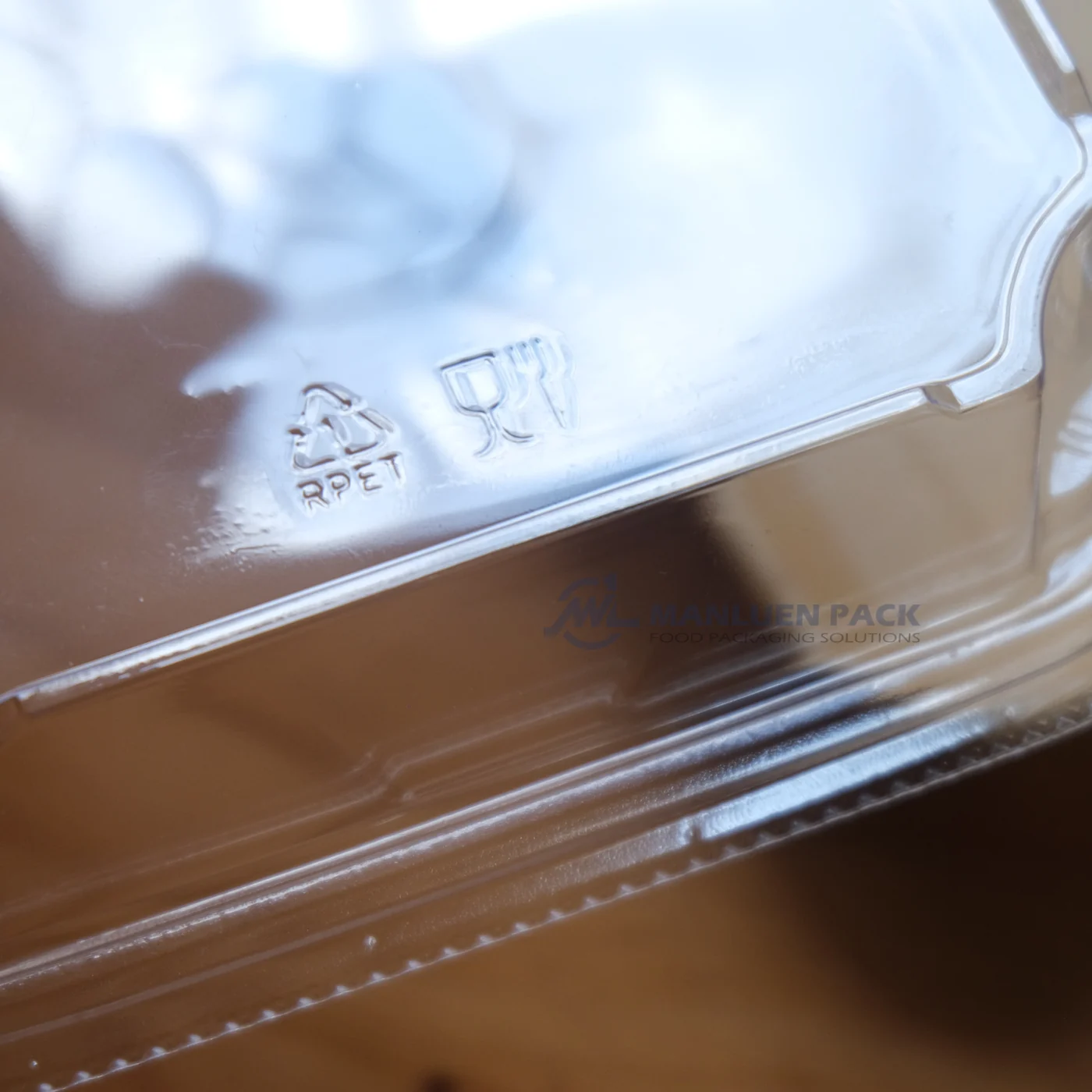
The package should be assessed as a complete item. A paper base with a PET lid, for example, is a multi-material package. The lid improves visibility and protects the food, but it also changes the package’s temperature limits and recycling instructions.
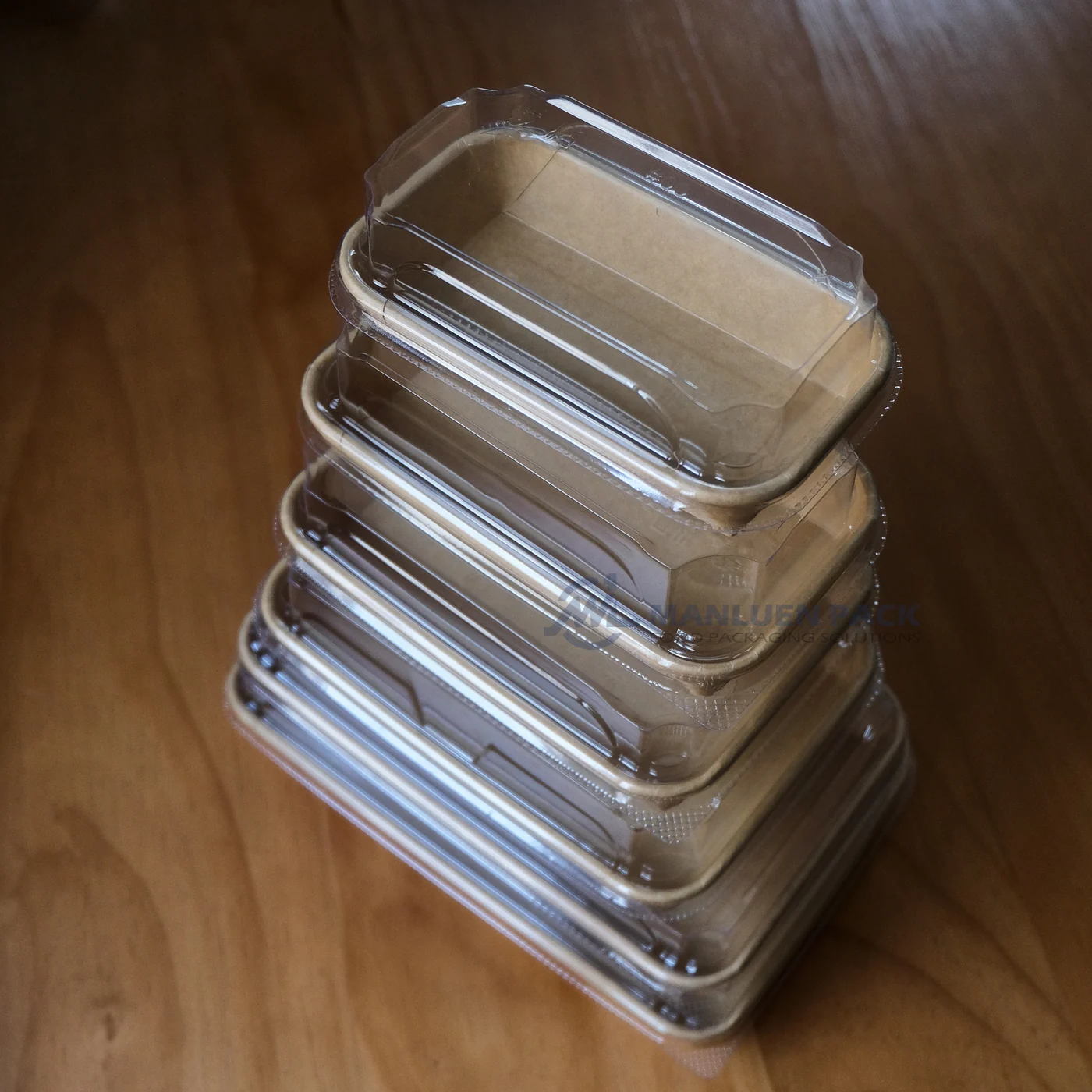
Real Product Examples: Kraft Paper Sushi Boxes
ManLuen currently lists kraft paper sushi trays in several sizes. The following two examples show why buyers should order by exact model and dimensions instead of relying on a broad name such as “small paper box.”
| Modelo | Base size | Lid size | Materials | Carton quantity |
|---|---|---|---|---|
| 0# Kraft Paper Sushi Tray | 138 × 78 × 24 mm | 143 × 80 × 32 mm | Kraft paper base and clear PET lid | 600 juegos |
| 3# Kraft Paper Sushi Box | 165 × 113 × 24 mm | 166 × 115 × 32 mm | Kraft paper base and clear PET lid | 300 juegos |
Both products use a natural kraft base to present sushi and prepared foods. Their clear lids keep the contents visible during display and short-distance handling. These specifications are model-specific. They should not be applied to every kraft paper box in a supplier’s range.
The Board Is Only One Part of the Package
Plain paperboard absorbs oil and water. A food box may therefore need a barrier layer to hold greasy, moist or saucy food. The exact structure depends on the intended use.
Paperboard
Board thickness and stiffness affect stacking strength, folding performance and how well the box holds its shape. A heavier board is not automatically better. It must still form clean corners, close securely and fit the packing line.
Coatings and Liners
A coating can improve resistance to grease or moisture. Common solutions include polymer coatings and water-based barrier systems. Each option has different performance and disposal implications. Ask the supplier to identify the coating instead of accepting the vague description “food-grade paper.”
Adhesives and Inks
Glue, printing ink and varnish are also part of the finished article. Printing should stay away from direct food contact unless the system is intended and documented for that use. Buyers should also consider set-off, which can occur when a printed surface touches the food-contact side of another box during stacking or storage.
Lids and Windows
A transparent PET lid or window improves product visibility. It may be useful for sushi, cold desserts and retail displays. It does not make the entire pack suitable for heating. The lid and base may also need to be separated before recycling.
How to Match the Box to the Food
Start with the food, not the color of the box. Oil, water, acidity, temperature and contact time all affect packaging performance.
| Food or use | Main packaging need | What to verify |
|---|---|---|
| Bread, cookies and dry pastries | Shape protection and clean presentation | Board stiffness, closure, window material and carton size |
| Sushi and chilled prepared foods | Visibility and secure covered display | Base dimensions, lid fit, chilled-use suitability and condensation |
| Fried or oily food | Grease resistance and ventilation | Barrier type, stain resistance, venting and hold time |
| Rice, pasta and warm meals | Moisture resistance and structural strength | Maximum fill temperature, contact time, closure and leak test |
| Sauces, soups and very wet dishes | Leak control | Whether the exact box is designed for liquids; do not assume it is leakproof |
| Frozen food | Low-temperature strength and moisture control | Freezer rating, condensation performance and thawing instructions |
Run a pack test with the real recipe. Fill the box at the normal serving temperature, close it, stack it and hold it for the longest expected delivery time. Check the base, seams, lid and outer carton for softening, staining, leaks and deformation.
Are Kraft Paper Boxes Microwave-Safe?
Some finished paper containers are designed for microwave reheating, but kraft paper is not automatically microwave-safe. The answer depends on the coating, adhesive, ink, lid and structure of the exact SKU.
A clear PET lid should not be treated as a microwave lid unless its instructions explicitly allow that use. Metal handles, foil details and some window materials must also stay out of the microwave.
Before making a microwave claim, ask the supplier for the product specification and test evidence for the intended time and temperature. State whether the lid must be removed or vented. If the supplier cannot support the claim for that model, use the box only under its documented conditions.
Food-Contact Compliance: What Buyers Should Check
There is no single blanket approval for every kraft paper box. Compliance depends on the substances used and the conditions of use.
United States
The U.S. rules for paper and paperboard components appear in 21 CFR Part 176. Other parts may apply to adhesives, coatings, polymers and production aids.
The FDA explains that the regulatory status of a food-contact material depends on the status of each substance in the finished article. A substance expected to migrate to food must have a suitable regulatory basis, such as an applicable regulation, a prior sanction, a threshold exemption, GRAS status or an effective Food Contact Notification. The authorization must also cover the intended food type and conditions of use.
European Union
Regulation (EC) No 1935/2004 sets the general safety framework for food-contact materials in the EU. It requires materials to be sufficiently inert so they do not transfer substances to food at levels that could endanger health, unacceptably change the food or harm its taste and smell. Manufacturing must also follow the requirements of Regulation (EC) No 2023/2006 on good manufacturing practice.
Documents to Request
- a complete material description for the board, coating, ink, adhesive, lid and window;
- the regulatory basis for the target market;
- a declaration or letter of compliance that identifies the exact product;
- test reports that match the intended food, temperature and contact time;
- traceability details, including model, batch and supplier; and
- written use limits for heating, chilling, freezing and storage.
Do not accept a certificate for raw paper as proof that the complete printed and coated box is suitable for every food. ManLuen’s food-grade packaging guide explains how buyers can check a finished package and its component-level documentation. Available company documents can be reviewed on the página de certificaciones, but buyers should still request the report that applies to their chosen SKU and target market.

Are Kraft Paper Boxes Recyclable or Compostable?
Sometimes, but not in every case. The answer depends on the complete package and the collection system where it is sold.
Clean paperboard may be accepted by a local paper-recycling program. Heavy food residue, a barrier coating, a plastic window or a bonded liner can change that result. A PET lid may need to be removed and placed in a separate recycling stream where local facilities accept it.
Compostability also requires evidence for the finished item. A plain paper fiber may break down, but the coating, adhesive and ink must be considered too. “Biodegradable” and “compostable” are not interchangeable claims.
The U.S. Federal Trade Commission advises businesses not to make broad, unqualified claims such as “green” or “eco-friendly.” Its Green Guides summary also explains when recyclable, compostable and degradable claims need evidence or qualification.
Use specific language. For example, identify the percentage of paper content, name the coating, explain whether parts should be separated and tell customers to check local collection rules. ManLuen’s 2026 sustainable food packaging guide covers the wider sourcing and regulatory questions behind environmental claims.
Printing and Customization
Kraft paper can support simple branding, handling instructions and product information. Before approving artwork, confirm the printable area, number of colors, color tolerance, ink system and whether the print sits near a food-contact surface.
Customization may include dimensions, board weight, barrier structure, lid type, venting, compartments and outer-carton configuration. Each change can affect performance, tooling, order quantity, lead time and compliance documents. Ask the supplier to confirm these points in writing after the final structure is approved.
Wholesale Buying Checklist
Send a clear request for quotation. It reduces revisions and makes supplier comparisons more useful.
- Describe the food. Include oil, moisture, acidity and any sauce.
- State the temperature. Give the filling, holding, delivery, chilling or freezing conditions.
- Set the contact time. A 20-minute takeaway order differs from a two-day retail pack.
- Confirm dimensions. Provide the usable internal size, portion weight and required headspace.
- Define the structure. Ask for the board, coating, lid, window, adhesive and ink details.
- Request samples. Test the real food, closure, stacking and transport route.
- Check compliance. Match the documents to the exact SKU, market and use conditions.
- Confirm packing data. Record units per carton, carton dimensions, carton volume and pallet requirements.
- Confirm commercial terms. Ask for the MOQ, lead time, tooling cost, print tolerance and replacement terms in the quotation.
For a broader view of how the package will move from direct food contact to transport cartons, see the guide to the three levels of food packaging.
Preguntas frecuentes
Are all kraft paper food boxes grease-resistant?
No. Grease resistance depends on the paper structure and barrier treatment. Ask for a specification and test the finished box with the actual food and hold time.
Can a kraft paper box hold soup or sauce?
Only if the exact container is designed and tested for that use. A folded paper carton made for pastries or sushi may not be leakproof. Wet foods usually need a suitable barrier and secure seam or rim design.
Can I microwave a kraft paper box?
Follow the instructions for the exact box. Do not assume that natural paper, a coating or a clear lid is microwave-safe. Remove any component that the supplier says must not be heated.
Is a kraft paper box plastic-free?
Not necessarily. Some boxes use polymer coatings, plastic windows or clear plastic lids. Request the full material composition if a plastic-free claim matters to your business.
Is kraft paper packaging better for the environment?
It can reduce the amount of conventional plastic in some applications, but the result depends on material use, food waste, transport, coatings and local recovery systems. Use specific, supported claims instead of assuming that every brown paper package is automatically sustainable.
What is the minimum order quantity?
MOQ depends on the model, printing, tooling and packing requirements. Stock products and custom structures may have different minimums. Send the product size, quantity, target market and artwork requirements when you request a quotation from ManLuen.
Conclusión
A kraft paper box can be a practical choice for takeaway, bakery and prepared-food packaging. The brown surface is only the visible part of the decision. Buyers still need to verify the board, barrier, lid, food fit, temperature limits and compliance documents.
Choose by exact SKU and intended use. Test the finished package with the real food. Then use clear, qualified language for recyclability, compostability and other environmental claims. This approach produces a box that works in service and gives buyers a more reliable basis for approval.
References
U.S. Food and Drug Administration (FDA). Determining the Regulatory Status of Components of a Food Contact Material.
Used to explain why every relevant component of a finished food-contact article needs an appropriate regulatory basis and must comply with its conditions of use.
Administración de Alimentos y Medicamentos de España
Electronic Code of Federal Regulations. 21 CFR Part 176—Indirect Food Additives: Paper and Paperboard Components.
Used for the U.S. regulatory category covering paper and paperboard components in food-contact articles.
Electronic Code of Federal Regulations
European Union. Regulation (EC) No 1935/2004 on Materials and Articles Intended to Come into Contact with Food.
Used for the EU’s general safety requirements for food-contact materials and articles.
EUR-Lex
European Union. Regulation (EC) No 2023/2006 on Good Manufacturing Practice for Food-Contact Materials and Articles.
Used for the EU good-manufacturing-practice requirement discussed in the compliance section.
EUR-Lex
U.S. Federal Trade Commission (FTC). Environmental Claims: Summary of the Green Guides.
Used for guidance on broad environmental claims and the evidence or qualifications needed for recyclable, compostable and degradable claims.
Federal Trade Commission

ManLuen Plastic Packaging Company, especializada en la producción de embalaje de alimentos de plástico durante más de 20 años. Nuestros productos están hechos de PP virgen y libre de BPA, cumpliendo con las normas de la FDA y europeas.
 ES
 EN
 ZH
 FR
 PT
 KO
 JA