
引言
高品质的寿司容器可以改善产品展示,减少损坏,支持更快的包装,并使库存管理更容易。这些操作上的提升可以保护利润,但包装必须与食品、销售渠道和搬运条件相匹配。.
目标不是购买最昂贵的托盘,而是选择一种能保持寿司排列整齐、易于观察的容器,同时不增加不必要的材料、运费、存储或人工成本。.
本指南解释了餐厅、寿司店、超市、配送企业和分销商如何比较 寿司容器和托盘. 。它关注直接影响成本和性能的因素:尺寸、材料、盖子贴合度、堆叠性、纸箱效率、合规性和供应商一致性。.

寿司容器如何影响运营成本
包装成本不仅仅是底座和盖子的价格。易裂开、开启或让食物移动的托盘可能导致重做、退款、原料浪费和客户投诉。过大的托盘会增加材料使用、纸箱体积、存储需求和运费。.
总成本包括:
- 容器和盖子购买价格
- 运费和进口成本
- 仓库及后勤存储
- 员工包装时间
- 损坏、泄漏和重做
- 标签和防篡改封条
- 由不良贴合或保护不足引起的产品浪费
- 合规检测和文件
使用这个简单的比较:
总包装成本 = 采购成本 + 物流成本 + 人工成本 + 预期故障成本 + 合规成本。.
这种方法使比较不同单价托盘变得更容易。如果容器包装速度更快、堆叠更好或减少损坏订单,价格略高的容器可能整体成本更低。.

在比较价格之前选择合适的尺寸
正确的托盘尺寸取决于件数、寿司类型、排列方式、配菜和盖子间隙。用实际食物测量预期布局。包括姜、芥末、装饰、酱料容器和标签。.
过大的托盘可能会使份量看起来稀疏,并导致寿司块移动。过小的托盘可能会挤压配料或使包装难以关闭。 寿司托盘尺寸与容量指南 说明如何匹配容器以适应6、12、20、40和100件的组合。.
对于中等份量,WL-05型号提供一个基础尺寸约为184×128×20毫米,配有大约188×132×31毫米的配套盖子。Manluen同时提供 WL-05 黑樱花寿司容器 和 WL-05 金色寿司托盘 以适应不同的展示风格。.
不要仅凭外部尺寸批准尺寸。要求提供可用的内部空间,并测试实际布局。.
材料选择必须符合应用需求
寿司容器可以使用PS、PP、PET、OPS、甘蔗渣、牛皮纸或混合结构。这些材料在透明度、刚性、抗冲击性、温度限制和生命周期处理方面各有不同。.
"(《世界人权宣言》) 食品包装材料指南 详细比较主要选项。对于寿司包装,买家应关注冷藏性能、盖子可见性、底座刚性、封口性和本地法规。.
| 材料 | 寿司包装中的常用材料 | 需要核实的内容 |
|---|---|---|
| PET | 透明盖子和冷藏展示容器 | 透明度、回收利用基础和温度限制 |
| OPS | 清洁盖子和展示包装 | 冷冲击强度、开裂以及目标市场限制 |
| PS | 轻量化托盘底座 | 脆性、耐热限制和本地规则 |
| 聚丙烯 | 坚韧的底座和一些预制食品容器 | 刚性、透明度以及产品特定的使用条件 |
| 甘蔗渣 | 模塑纤维托盘底座 | 耐油脂、PFAS状态、盖子贴合度和堆肥通道 |
不要将整个寿司托盘系列标记为微波炉安全. 底座和盖子可能使用不同材料,许多透明盖子仅用于冷藏展示。微波炉适用性需提供具体成品包装的相关文件。.

使用包装提升展示效果
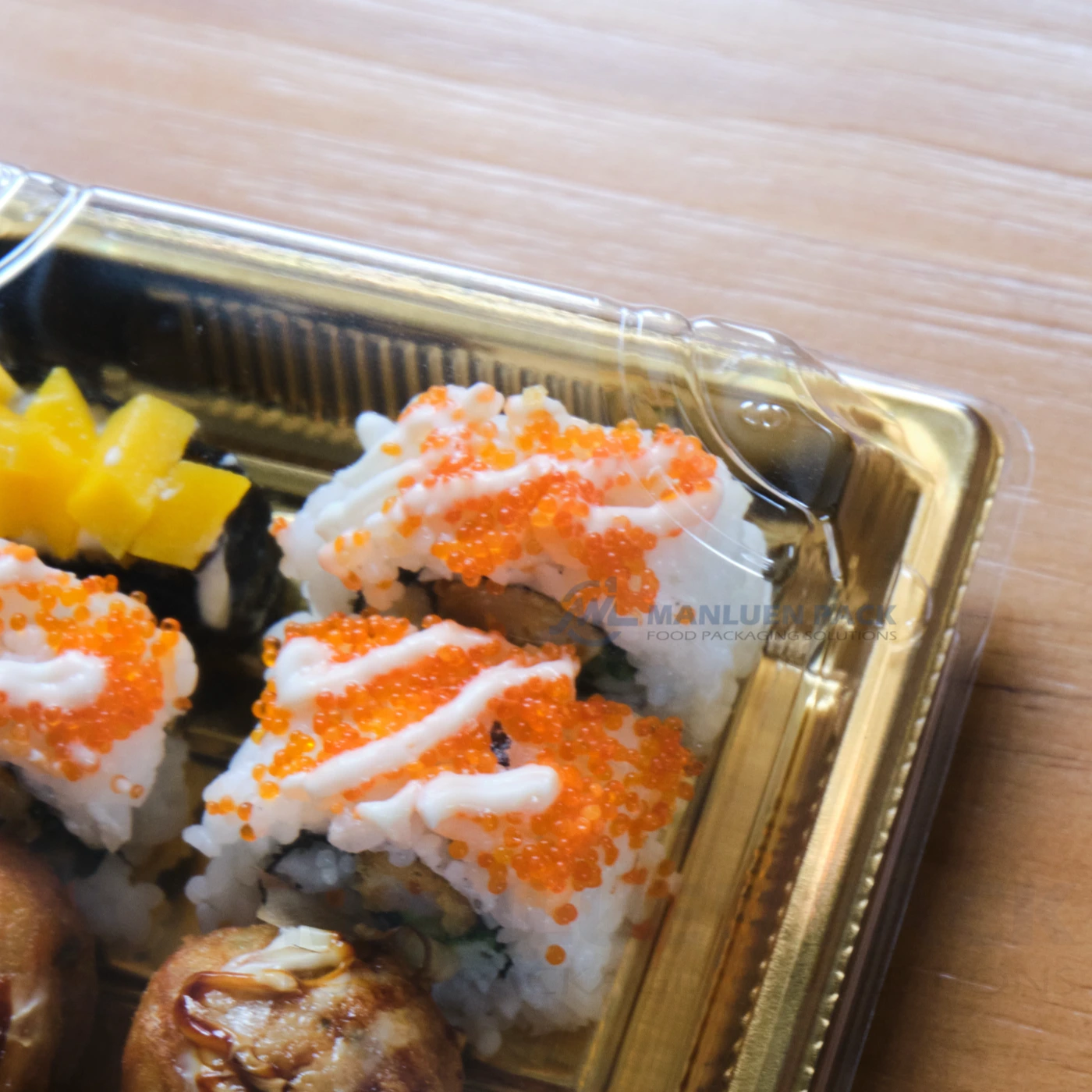
寿司是视觉产品。托盘颜色、盖子透明度、底座图案和摆放方式影响顾客对产品的评价。.
Use packaging to create a consistent presentation:
- Choose a base color that provides contrast with the food.
- Keep enough space between pieces to show the arrangement clearly.
- Use a clear lid that does not distort the product.
- Place labels where they do not cover the main display area.
- Use the same tray family across related portion sizes.
Decorative designs can help distinguish premium assortments, but they should not distract from the food. Test the filled package under the store’s actual lighting and after refrigeration.
The guide on improving supermarket food packaging with sushi trays provides more detail on retail presentation and prepared-food displays.
Match the Container to the Sales Channel
Restaurant takeaway
Restaurant takeaway packaging should close quickly, remain secure in a bag, and be easy for customers to open. Test the tray with sauce containers, chopsticks, napkins, and other order components.
If staff apply a security label, make sure it provides visible evidence of opening without weakening the lid. The guide to tamper-evident packaging explains the main options.
Delivery
Delivery adds vibration, tilting, stacking, and time inside an insulated bag. Test the container after the normal delivery period. Check whether pieces move, the lid loosens, condensation builds up, or labels peel away.
Pack several containers in the actual delivery bag. A strong individual tray can still fail if different package sizes stack poorly.
Supermarket and deli display
Retail containers need clear visibility, a stable shelf footprint, efficient stacking, and space for compliant labels. Test lid fogging and product movement after the complete display period.
The package should help staff rotate stock and identify sizes quickly. Similar tray dimensions with clear model codes can reduce picking errors and simplify reordering.
Catering and event trays
Large assortments require stronger bases and lids. Check lifting, stacking, and transport with the full food weight. The tray must remain stable when customers remove pieces from one side.

Test Before You Buy in Volume
Use the real food and workflow. An empty tray cannot show condensation, food movement, lid pressure, or label performance.
Run these checks:
- Measure the intended arrangement and fill weight.
- Pack the food at the normal preparation temperature.
- Close the lid using the normal staff procedure.
- Apply labels and seals.
- Refrigerate for the expected holding time.
- Stack and transport the package.
- Inspect fogging, cracking, lid fit, and food movement.
- Record staff time and any packaging failures.
Compare at least two sizes or constructions under the same conditions. This produces more useful purchasing evidence than a visual comparison of empty samples.
Manage Wholesale Purchasing and Inventory
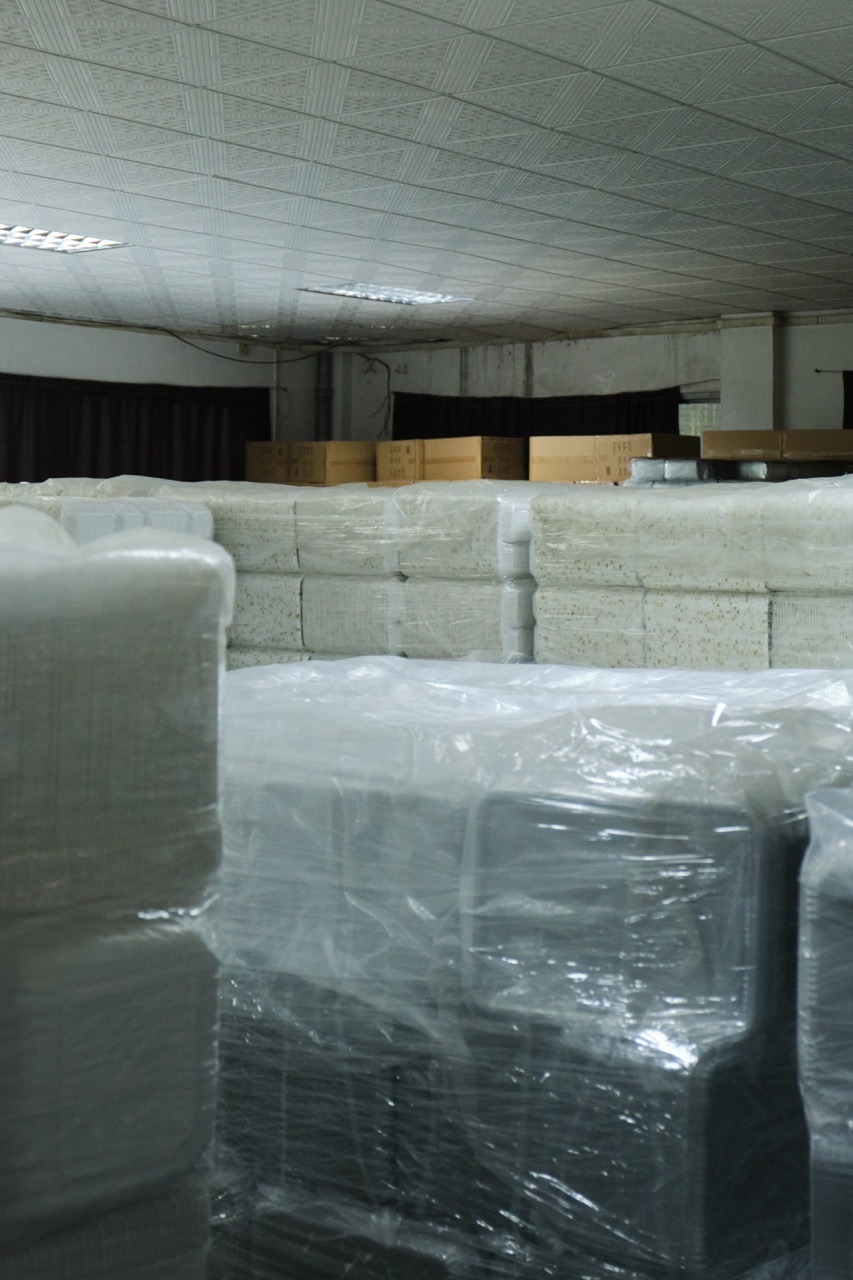
Bulk purchasing can reduce unit cost, but a large order also ties up storage space and cash. Before ordering, confirm:
- Units per carton
- Carton dimensions and volume
- Minimum order quantity
- Production and shipping lead time
- Monthly usage by tray size
- Safety stock requirement
- Custom-color or printing commitments
- Material and tooling change notification
Use sales data to set reorder points. Separate individual, medium, and family-size formats so slow-moving trays do not create excess inventory.
Customization can help brand recognition, but standard colors and sizes usually allow more flexibility. Confirm tooling, print setup, approval samples, and repeat-order conditions in writing.
Verify Food-Contact Compliance
A color, model number, or resin code does not prove that a finished package suits every use. The base and lid may use different materials. Inks, pigments, recycled content, and labels can add further considerations.
The FDA regulates food-contact substances according to their identity and intended conditions of use. Ask the supplier for documentation that identifies the exact product and material construction. Manluen’s guide to food-grade packaging explains the documents buyers should request.
For US and EU projects, the food packaging compliance guide covers regulatory basis, migration testing, PFAS, recycled content, and supplier declarations.
A basic file may include:
- A product-specific compliance statement
- Base and lid material specifications
- Applicable CFR, FCN, or other regulatory basis
- Migration testing where relevant
- PFAS, heavy-metal, and recycled-content statements when applicable
- Lot traceability and change-control records
Consider Sustainability Without Reducing Food Protection
Material reduction, recycled content, recyclable designs, and fiber-based trays can all play a role. The best option depends on the food, local waste system, and complete package.
"(《世界人权宣言》) WL-05 bagasse sushi tray offers a molded-fiber base for buyers comparing alternatives to conventional plastic bases. It still requires evaluation of the lid, grease performance, PFAS status, certification, and local composting access.
Do not treat “plant-based,” “recyclable,” or “compostable” as a complete environmental assessment. The guide to sustainable food packaging trends explains how to compare material claims, food protection, and local infrastructure.

常见问题
Can a better sushi container improve profit?
It can protect profit by reducing damage, remakes, packing delays, and poor presentation. The result depends on the actual failure rate, labor, sales channel, and price difference. Track these costs during a controlled trial rather than assuming a fixed percentage improvement.
Are WL-05 sushi containers microwave-safe?
Do not assume the entire WL-05 range is microwave-safe. Material options can vary between the base and lid. Use a container in a microwave only when the supplier documents that exact construction for the intended heating conditions.
How many sushi container sizes should a business stock?
Stock enough sizes to cover the main portion groups without creating slow-moving inventory. Many businesses can organize the range around individual, medium combination, and large sharing portions, then add a specialty size only when sales justify it.
Should I choose plastic or bagasse sushi trays?
Plastic may provide stronger clarity, low weight, and familiar chilled-display performance. Bagasse offers a fiber-based appearance and may suit certain sustainability goals. Compare the complete base-and-lid package, food protection, certifications, local collection, and cost.
What information should I send when requesting a quote?
Provide the model or required dimensions, sushi piece count, base and lid material, color, monthly or annual quantity, destination market, customization needs, and required compliance documents. Submit these details through Manluen’s request-a-quote form.
结论
A high-quality sushi container can protect food, improve display, support faster packing, and reduce avoidable failures. Profit improves when the complete packaging system costs less to operate—not simply when the unit price is lowest.
Choose the tray by testing the real food, portion, lid, label, refrigeration, stacking, and delivery conditions. Compare total cost, verify food-contact documents, and confirm wholesale terms before committing to a large order.
References
U.S. Food and Drug Administration (FDA). Packaging & Food Contact Substances.
Used for the US regulatory framework covering substances that contact food and their intended conditions of use.
U.S. Food and Drug Administration
U.S. Environmental Protection Agency (EPA). Recycling Basics and Benefits.
Used for the role of local collection and processing systems when evaluating packaging recovery.
U.S. Environmental Protection Agency

万联塑料包装公司专业生产塑料食品包装已有 20 多年的历史。我们的产品由 100% 原生和不含双酚 A 的 PP、PS 和 OPS 制成,符合 FDA 和欧洲标准。
 ZH
 EN
 FR
 PT
 ES
 KO
 JA