
Introduction
L'emballage en verre est-il durable ? Cela peut l'être—surtout lorsqu'un contenant contient une quantité importante de verre recyclé, est collecté via un flux de recyclage propre, ou est réutilisé plusieurs fois dans un système local de retour bien géré. Cependant, le verre n'est pas automatiquement le matériau d'emballage à impact le plus faible. Sa fabrication nécessite des températures très élevées dans le four, et son poids peut augmenter les émissions de transport par rapport à des alternatives plus légères.
La réponse la plus défendable est donc conditionnelle : l'emballage en verre est le plus durable lorsque le système complet maintient le contenant ou son matériau en circulation tout en contrôlant le poids, la casse, le lavage et le transport. Une bouteille rechargeable retournée localement constitue une proposition environnementale différente d'un pot jetable lourd expédié sur une longue distance et jeté après une seule utilisation.
Ce guide explique les avantages et inconvénients du verre, comment le recyclage et la réutilisation modifient le résultat, comment le verre se compare-t-il au plastique, à l'aluminium, et au papier, et ce que les acheteurs d'emballages alimentaires doivent examiner avant de faire une déclaration environnementale.
L'emballage en verre est-il durable ? La réponse courte
Oui, l'emballage en verre peut être durable, mais seulement dans les bonnes conditions. Ses principaux avantages sont que le verre d'emballage peut être recyclé en nouvelles bouteilles et bocaux, que le calcin recyclé peut remplacer les matières premières vierges, et que les contenants rechargeables peuvent répartir les impacts de fabrication sur plusieurs utilisations. Ses principaux inconvénients sont la fusion énergivore, le poids élevé de l'emballage, et le risque que la casse ou une collecte insuffisante empêchent le système circulaire prévu de fonctionner.
| Question | Réponse pratique |
|---|---|
| Le verre est-il recyclable ? | Oui. Le verre en bouteille correctement trié peut être transformé en calcin et utilisé dans de nouveaux contenants en verre. La récupération réelle dépend de la collecte locale, de la qualité du tri, des exigences de couleur et de l'accès au marché final. |
| Le verre recyclé a-t-il un impact moindre ? | Généralement. Le calcin remplace les minéraux vierges et fond à une demande d'énergie inférieure à celle d'un lot entièrement vierge. |
| Le verre réutilisable est-il toujours meilleur ? | Non. Il fonctionne mieux avec des taux de retour élevés, suffisamment de cycles de réutilisation, un lavage efficace, peu de casse et des itinéraires de logistique inverse courts ou optimisés. |
| Le verre est-il plus écologique que le plastique ? | Pas dans toutes les applications. Le verre peut être plus robuste pour la réutilisation et le recyclage en boucle fermée, tandis que le plastique léger peut réduire la charge matérielle et de transport et peut mieux protéger certains aliments. |
Pourquoi l'emballage en verre peut être durable
1. Le verre en bouteille peut soutenir le recyclage en boucle fermée
Les bouteilles et bocaux collectés en bon état peuvent être broyés en calcin, nettoyés, triés et refondus en nouveaux contenants. C'est un avantage majeur par rapport aux structures d'emballage qui sont techniquement recyclables mais rarement réutilisées dans la même application. Le verre n'a pas besoin d'être dévalorisé par définition ; le matériau peut rester dans une boucle bouteille-à-bouteille ou bocal-à-bocal lorsque l'infrastructure de collecte et de traitement le permet.
Cette distinction est importante. “ Recyclable ” décrit une capacité du matériau, tandis que “ recyclé ” décrit ce qui s'est réellement passé. Une évaluation de durabilité doit donc demander non seulement si l'emballage peut être recyclé, mais aussi si les programmes locaux l'acceptent, si le verre récupéré est suffisamment propre pour la production de contenants, et si un marché final à proximité l'utilisera.
2. Le calcin réduit la demande en matériaux vierges
Le verre d'emballage conventionnel est principalement fabriqué à partir de sable de silice, de soude et de calcaire. L'utilisation de calcin récupéré remplace une partie de cette fournée vierge et réduit la besoin d'extraire, de traiter et de transporter de nouveaux minéraux. Elle détourne également le verre approprié de l'élimination.
La séparation par couleur peut influencer la quantité de calcin qu'un fabricant peut utiliser. Le verre clair, ambré et vert a des exigences différentes en termes de qualité et de couleur, donc une collecte mixte ou contaminée peut être moins précieuse qu'un matériau propre et contrôlé en couleur.
3. Le verre recyclé peut réduire l'énergie de fusion
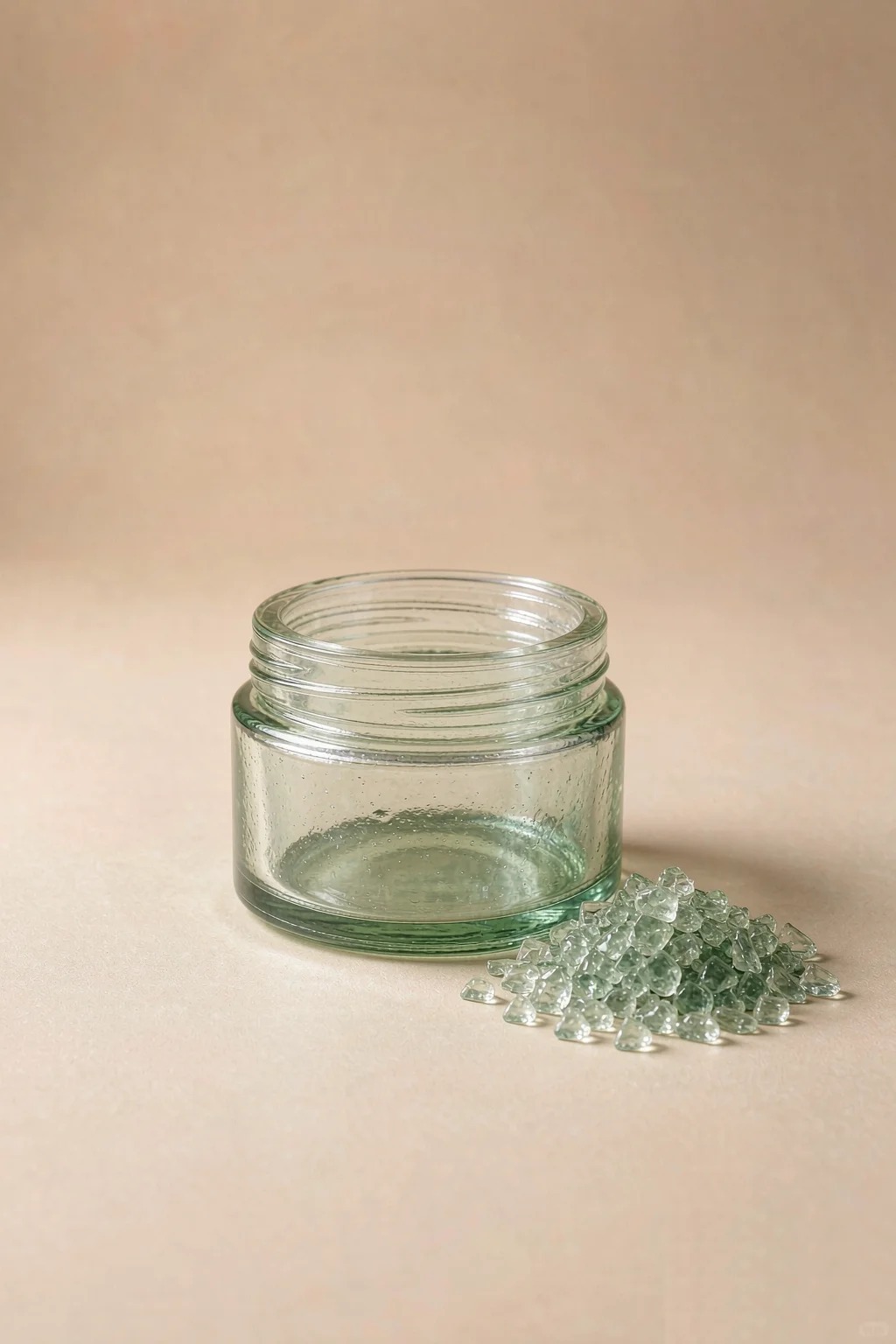
Le calcin nécessite moins d'énergie pour fondre qu'un lot entièrement composé de matières premières vierges. L' Institut du Packaging en Verre FEVE a constaté qu’un scénario de rebuts 100% utilisait 25,4% d’énergie de fusion en moins qu’un scénario de matériaux vierges 100%.
Ces chiffres décrivent les avantages en fabrication, non une garantie que chaque emballage en verre a le même empreinte écologique. Le combustible du four, la source d’électricité, la teneur en recyclé, le poids du contenant, l’efficacité de l’usine et la distance de transport modifient toujours le résultat.
4. Le verre rechargeable peut répartir les impacts de la production sur plusieurs trajets
Une bouteille ou un bocal en verre durable peut être collecté, inspecté, lavé et rechargé. Lorsqu’il effectue suffisamment de rotations, sa charge de fabrication est répartie sur plusieurs utilisations au lieu d’être attribuée à un seul remplissage. C’est le principal argument en faveur de la durabilité du verre, mais le contenant seul ne crée pas cet avantage. C’est le système de retour qui le fait.
Quels sont les inconvénients environnementaux de l’emballage en verre ?
Production à haute température
Les fours à verre fonctionnent à des températures très élevées. L’énergie utilisée pour la fusion et les émissions associées à la combustion du carburant et aux réactions des matières premières peuvent rendre cette étape de production significative. Une utilisation accrue de rebuts, des contenants plus légers, des fours plus efficaces, une énergie à faible émission de carbone et une meilleure récupération de la chaleur peuvent réduire cette charge, mais ne la font pas disparaître.
Poids du transport
Pour le même volume de produit, un emballage en verre à usage unique est souvent plus lourd qu’une bouteille en plastique, un sac, un carton enduit ou une canette en aluminium. Une masse d’emballage plus importante peut réduire l’efficacité de la charge utile et augmenter la consommation de carburant, en particulier sur de longues routes de distribution. Une comparaison qui ignore le transport des conteneurs entrants, la distribution du produit rempli et le retour des contenants vides peut surestimer l’avantage du verre.
Bris et perte de produit
Glass provides a rigid barrier but can break during filling, transport, retail handling, consumer use, or return logistics. Breakage increases packaging loss and may also cause product loss. Because producing the food or beverage can carry more environmental impact than producing its package, preventing spoilage and damage is often more important than minimizing package impact in isolation.
Collection does not guarantee closed-loop recycling
Broken ceramics, heat-resistant cookware, stones, metals, and mixed colors can contaminate recovered glass. Very small fragments can also be difficult to sort in mixed-material facilities. Some collected material becomes aggregate or is discarded rather than returning to new containers. Buyers should avoid treating a recycling symbol or a general claim of recyclability as proof of local bottle-to-bottle recycling.
Single-Use Glass vs Reusable Glass
The distinction between single-use and reusable packaging is more important than the word “glass” alone.
- Single-use glass is manufactured, filled, distributed, used once, and then recycled or discarded. Its performance depends heavily on lightweighting, recycled content, collection, and transport distance.
- Reusable glass adds collection, reverse transport, sorting, washing, inspection, and refilling. Those extra operations create impacts, but successful reuse can avoid manufacturing a new container for each sale.
Lifecycle research consistently shows that the outcome is system-specific. A 2025 peer-reviewed study of wine bottles in Germany found reusable glass favorable in four of five evaluated impact categories under its modeled conditions, while also identifying washing and reverse transport as important burdens. Another beverage-packaging study found strong potential for returnable glass at high return rates but poor carbon performance for disposable glass in the system assessed.
These studies should not be converted into a universal “break-even number.” A refill system’s result changes with bottle design, trip distance, vehicle loading, wash temperature, energy source, loss rate, and the number of successful rotations.
Five questions that determine whether reuse works
- What percentage of containers comes back? Low return rates force the operator to manufacture replacements.
- How many successful rotations are achieved? Theoretical durability is less useful than documented average trips.
- How far do empties travel? Local pooling and efficient backhauls can reduce the penalty of moving heavy empty containers.
- How efficient is washing? Water, heat, detergent, drying, and wastewater treatment belong in the calculation.
- How much breakage and rejection occurs? Damaged, scuffed, or contaminated containers shorten system life.
How Sustainable Is Glass Recycling in Practice?
Recycling performance varies greatly by market. The latest comprehensive U.S. municipal-solid-waste dataset published by the U.S. Environmental Protection Agency covers 2018: approximately 3.1 million tons of glass containers were recycled, equal to a 31.3% recycling rate, while 7.6 million tons of glass were landfilled. The year matters; these figures should not be presented as a 2024 or 2026 national rate.
European industry data reported by FEVE indicates a 79% collection-for-recycling rate across the European glass value chain. That figure is not directly comparable with the U.S. EPA number because geographic scope, reporting methods, and waste systems differ, but it demonstrates how infrastructure and policy can change real-world recovery.
Collection quality is as important as collection quantity. According to the L', deposit-return systems produce substantially more clean, furnace-ready cullet than commingled curbside collection. The organization reports that ten U.S. states currently operate beverage-container deposit programs. Source-separated bins, deposit returns, careful color sorting, and stable local end markets can all improve the chance that a glass container becomes another container.
Is Glass More Sustainable Than Plastic, Aluminum, or Paper?
No packaging material wins every comparison. The correct unit is the complete package delivering the required amount of product—not one gram of material considered by itself. Shelf life, leakage, closures, secondary packaging, transport, recovery, and reuse must all be included.
| Matériau | Potential strengths | Important limitations | Often a good fit when |
|---|---|---|---|
| Glass | Rigid; strong product barrier; can support container-to-container recycling and refill systems | Heavy; breakable; energy-intensive melting; recovery varies by location | Recycled content is high, routes are short, or a high-return reuse system exists |
| Plastique | Lightweight; versatile; good barrier and seal performance with little material | Recovery varies by resin and format; films, dark colors, and multilayers can be difficult to recycle | Low weight, clarity, impact resistance, leak prevention, or cold-chain performance is essential |
| Aluminum | Lightweight; strong barrier; valuable recycling stream | Primary aluminum production is energy intensive; coatings and format affect suitability | A lightweight, high-barrier package with established metal recovery is needed |
| Paper or carton | Renewable fiber; low weight; efficient shipping and printing | Moisture or oxygen barriers may require coatings and layers that complicate recovery | A simple fiber structure provides enough protection and clean paper recycling is available |
For a wider overview of material properties, see ManLuen’s guide to matériaux d'emballage alimentaire. Buyers comparing practical formats can also review the company’s food storage container range.
Is Glass Packaging Sustainable for Food?
Glass is well suited to many sauces, preserves, beverages, condiments, and shelf-stable foods because it is rigid, can provide an effective barrier, and allows product visibility. Yet sustainability depends on the entire pack and process.
A food package may include a metal or plastic closure, liner, label, adhesive, tamper-evident component, sleeve, and transport case. These parts affect sealing, separation, recycling, and total material use. A jar body being recyclable does not mean every component follows the same route.
Operational fit also matters. Buyers should validate filling temperature, pasteurization or sterilization conditions, thermal shock, impact resistance, closure compatibility, headspace, line speed, and distribution hazards. A package that fails during processing or allows food loss is not a sustainable choice.
For takeaway soup, compare disposable hot-soup bowls and lid options against the same serving volume and delivery conditions when evaluating alternatives to glass; material choice and sustainability need separate checks.
ManLuen’s guide on how to choose the right food packaging explains how product, process, and distribution requirements should shape material selection.
What Do Current U.S. Packaging Rules Mean for Glass?
Environmental regulation should be checked by market, package format, and effective date. For example, California’s packaging extended-producer-responsibility program under SB 54 covers a broad range of single-use packaging. CalRecycle states that permanent regulations took effect on May 1, 2026. Producers of covered material generally must participate in an approved producer-responsibility organization plan by January 1, 2027, unless a valid alternative applies.
This does not make every glass format automatically compliant or exempt. Businesses should confirm whether they are a regulated producer, how the specific package is categorized, what reporting or fee obligations apply, and whether recycled-content, labeling, deposit, or local collection rules also affect the product. Food-contact compliance is a separate issue from environmental claims; the relevant material, intended conditions of use, supplier documentation, and applicable jurisdiction must be reviewed. For a U.S.-focused starting point, see what agency regulates food packaging.
How to Make Glass Packaging More Sustainable
Increase verified recycled content
Specify a practical cullet target with the supplier and ask how it is measured. Consider color and appearance tolerances, because demanding perfect clarity or unusual colors can restrict recovered-content options.
Lightweight without compromising performance
Reducing glass mass can lower raw-material use and transport burdens. Lightweighting should be tested against filling pressure, thermal shock, top load, impact, line handling, pallet stability, and consumer use. A fragile package that increases breakage can cancel the material savings.
Design the full pack for recovery
Use closures, labels, inks, adhesives, and decoration that do not unnecessarily disrupt local sorting and remelting. Provide disposal instructions that match the actual destination market rather than using a generic global statement.
Shorten and optimize distribution routes
Source close to filling operations when feasible, maximize pallet and truck utilization, reduce empty space, and use return trips efficiently. Transport planning is especially important for heavy packaging and reusable systems.
Build reuse around measured performance
Track return rate, average rotations, wash energy, water use, breakage, rejection, replacement purchases, and reverse-logistics distance. Claims should be based on the system’s observed performance, not merely on the fact that a bottle is physically refillable.
Support better collection
Where volumes justify it, source-separated collection, deposit arrangements, retail take-back, or direct partnerships with processors can produce cleaner cullet than mixed collection. Confirm that the recovered material has an end market before describing the system as closed loop.
Buyer Checklist: Is Glass the Right Sustainable Package?
- Product protection: Does glass protect shelf life and prevent leakage or contamination under the intended conditions?
- Process compatibility: Has the complete package been tested for filling, heating, cooling, capping, handling, and distribution?
- Container weight: Can the design be lightweighted safely, and how does its filled-pack weight compare with alternatives?
- Recycled content: What verified cullet percentage does the supplier use for this color, plant, and production run?
- Local recovery: Is container glass accepted and actually processed in each sales market?
- Reuse feasibility: What return rate, rotation count, washing efficiency, and breakage rate can the system realistically achieve?
- Closures and labels: Can components be separated or managed by the intended recovery route?
- Transport: What are the supplier-to-filler, distribution, and return distances, and are loads efficiently utilized?
- Evidence: Are environmental claims supported by current, product-specific data rather than broad material assumptions?
- Regulatory scope: Have food-contact rules, labeling requirements, deposit laws, and packaging EPR obligations been checked for the destination market?
Questions fréquemment posées
Is glass packaging 100% sustainable?
No material is impact-free. Glass can be recycled and reused, but it still requires raw materials, high-temperature manufacturing, transport, and an effective recovery system. “100% sustainable” is too broad to substantiate.
Can glass be recycled indefinitely?
Container glass can undergo repeated remelting without the inherent polymer degradation associated with some plastics. In practice, repeated recycling depends on collection, contamination control, color specifications, processing yield, and demand from glass manufacturers.
Does recycled glass save energy?
Yes. Cullet melts more efficiently than an all-virgin batch. GPI reports an approximately 2%–3% energy-cost reduction for every 10% cullet used, while FEVE’s European lifecycle study modeled a 25.4% melting-energy saving for 100% cullet versus 100% virgin raw materials.
Is glass better than plastic for the environment?
Sometimes, but not universally. Refillable glass with high return rates and short routes may perform well, while heavy disposable glass shipped long distances can have a larger climate burden than a lightweight plastic package. Product protection, recycled content, recovery, and transport must be compared for the actual application.
Is reusable glass always the best option?
No. It needs a high return rate, enough successful rotations, efficient washing, low loss, and optimized reverse logistics. Without those conditions, the additional transport and cleaning burdens may outweigh the avoided production.
Why is glass recycling different from one location to another?
Programs differ in collection method, sorting equipment, acceptable colors and formats, contamination, hauling distance, and access to glass manufacturers or other end markets. Buyers should check local guidance instead of assuming that acceptance is universal.
What is the most important sustainability metric for glass packaging?
There is no single universal metric. For single-use glass, container weight, recycled content, transport, and actual recycling rate are central. For reusable glass, return rate and completed rotations should be added, along with washing and reverse logistics. A lifecycle assessment is the best tool for comparing meaningful alternatives on an equivalent product-delivery basis.
Conclusion
Glass packaging is sustainable when its circular advantages work in the real world. High cullet content, lightweight design, clean collection, efficient local transport, and successful reuse can make glass a strong choice. Heavy single-use containers, long routes, low recycling rates, and poorly managed returns can produce the opposite result.
The purchasing question should not be “Is glass good or bad?” It should be: Which complete packaging system protects this product with the lowest credible lifecycle impact in the markets where it will be sold? Compare function first, then container weight, recycled content, reuse performance, logistics, and the actual end-of-life route. That approach produces a defensible decision—and a sustainability claim buyers and customers can trust.
Sources et lectures complémentaires
- U.S. EPA: Glass—Material-Specific Data
- Glass Packaging Institute: Environmental Benefits of Glass Recycling
- Glass Packaging Institute: How Deposit Return Impacts Glass Recycling
- FEVE: Container Glass Life Cycle Assessment
- CalRecycle: Packaging Extended Producer Responsibility
- Cleaner Environmental Systems: Reusable and Single-Use Wine Bottle Life Cycle Study

ManLuen Plastic Packaging Company, spécialisée dans la production d'emballages alimentaires en plastique depuis plus de 20 ans. Nos produits sont fabriqués à partir de PP, PS et OPS vierges et sans BPA, conformes aux normes de la FDA et aux normes européennes.
 FR
 EN
 ZH
 PT
 ES
 KO
 JA