
For buyers comparing packaging across several chilled-food lines, the same material, closure, and handling checks also apply to disposable sushi trays used by supermarkets, restaurants, and takeaway counters.
Introduction
Clamshell food containers combine a base, hinged lid, and closure in one piece. Restaurants and retailers use them for takeaway meals, bakery products, produce, salads, and prepared foods because the lid stays attached during filling and service.
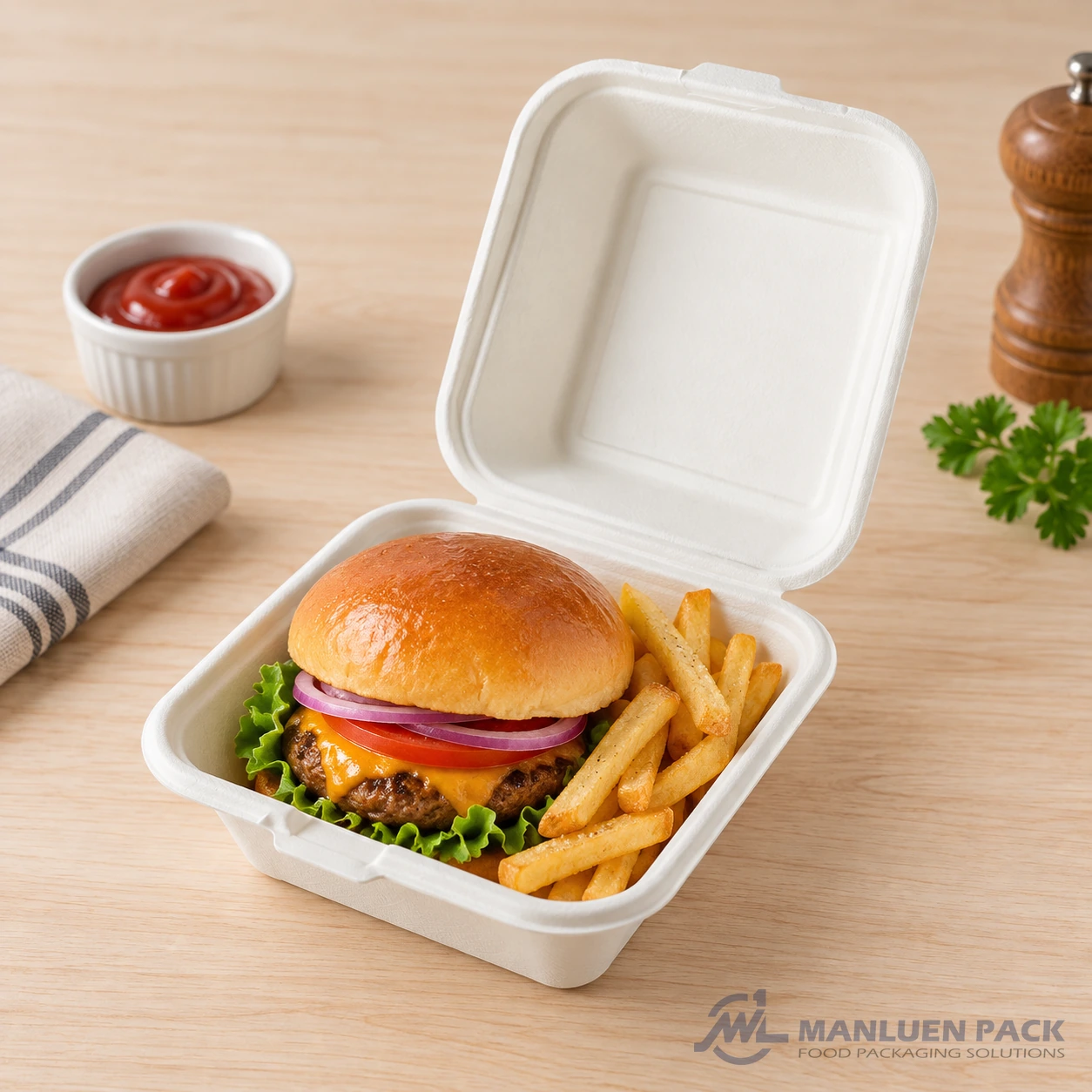
The format is useful, but no single clamshell works for every food.
A hot meal needs different material and ventilation from chilled berries or decorated pastries. Buyers must check the food, temperature, storage time, transport method, and disposal system before choosing a container.
ManLuen’s clamshell container range includes plastic and fiber-based formats for different foodservice uses. This guide explains how the structure works, where it helps, how materials differ, and what to verify before ordering wholesale.

What Is a Clamshell Food Container?
A clamshell container has two connected sections joined by an integrated hinge. One section holds the food. The other closes over it as a lid. Snap tabs, friction-fit edges, or another closure keep the package shut during normal handling.
The connected design separates a clamshell from a tray with a loose lid. It can simplify filling because staff do not need to match two separate components. The hinge also keeps the lid aligned with the base.
A standard snap closure is not automatically tamper-evident or leakproof. Those functions need specific features and must be tested on the finished container. Readers who need a complete structural definition can use the guide to what clamshell packaging is and how it works.
Why Food Businesses Use Clamshell Containers
Product Protection
Rigid walls help protect food from crushing and accidental contact. The level of protection depends on the material, wall thickness, geometry, closure, and how much empty space remains around the food. A clamshell cannot compensate for rough handling, but a well-fitted design can reduce movement and surface damage.
Fast Filling and Closing
The attached lid can speed up counter service. Staff can fill, close, label, and stack the container without searching for a separate lid. This is useful during busy takeaway and catering periods.

Product Visibility
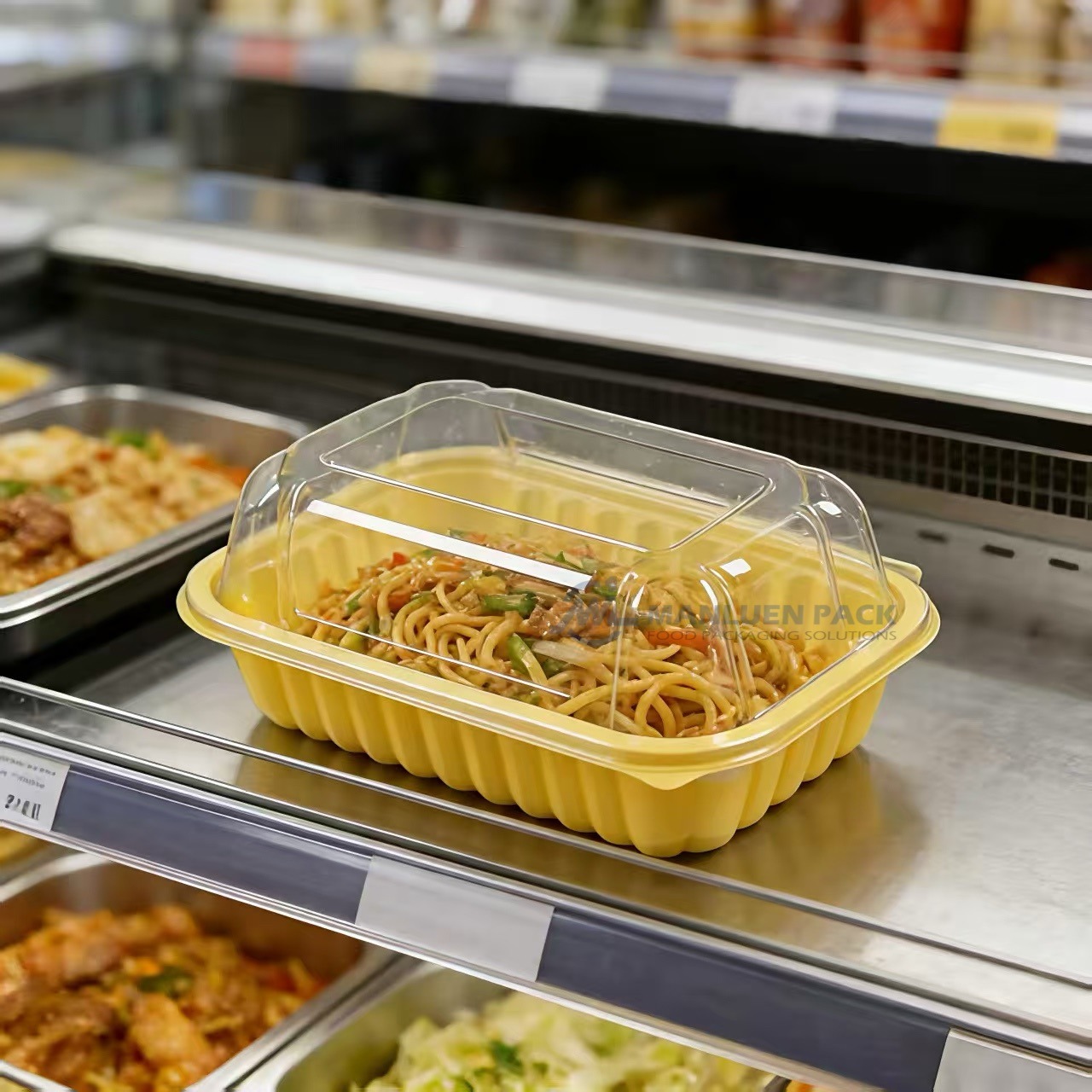
Clear containers let customers inspect produce, pastries, salads, sushi, and other display foods without opening the package. Visibility can support retail presentation, but chilled products should be tested for condensation and fogging.
Stacking and Storage
Many empty clamshells nest together to reduce storage space. Filled containers may use flat lid and base features for stacking. Buyers should test both conditions because a container that nests well when empty may not stack securely when filled.
Common Foodservice Uses
Takeaway Meals
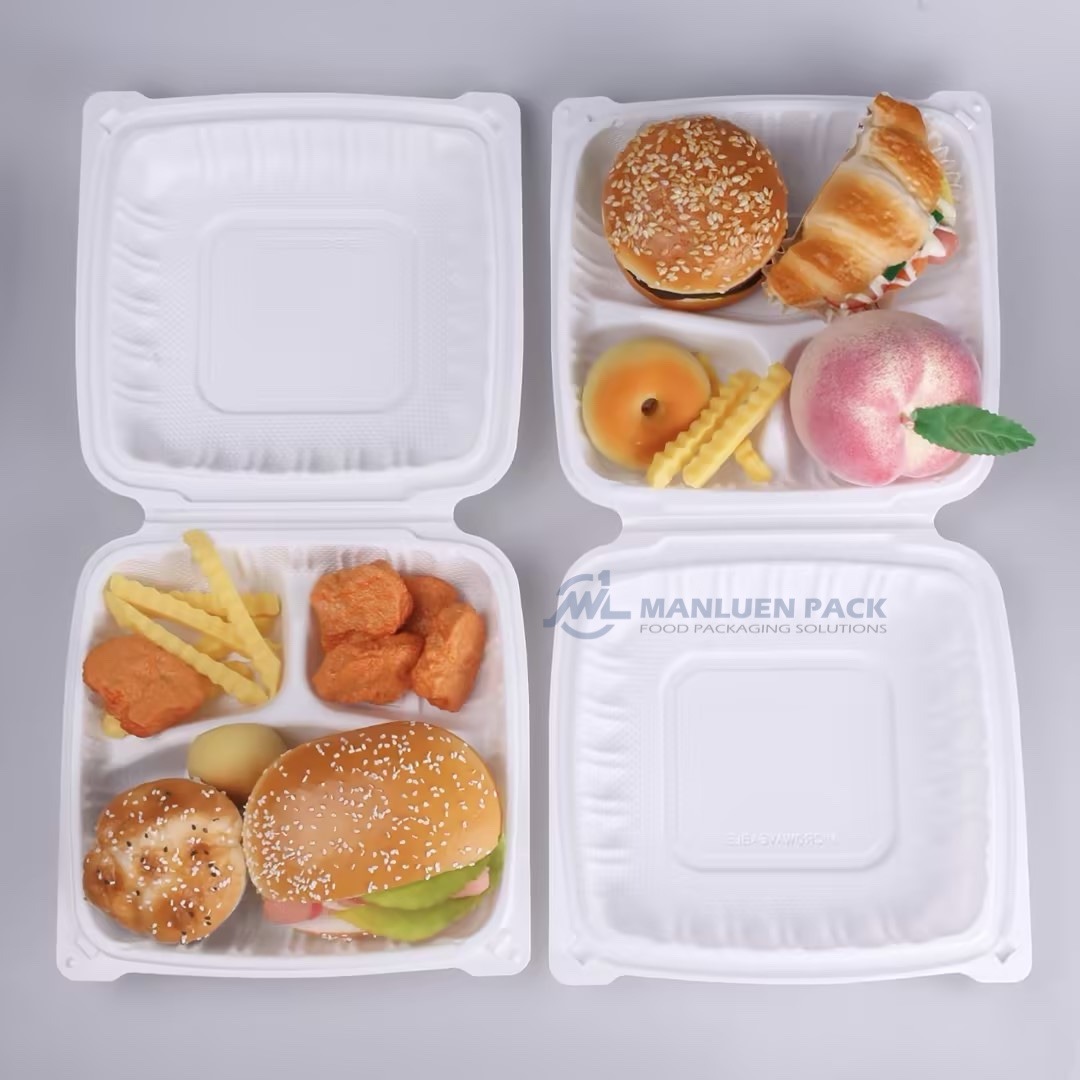
Restaurants use hinged containers for rice dishes, pasta, fried foods, sandwiches, and combination meals. Hot or moist foods may need vents to release steam. Sauces and oily foods need a closure and material that can resist leakage and deformation under the intended conditions.
The WL-P96 9×6-inch clamshell takeaway container is one example of a large plastic format. Buyers should confirm its exact material, compartment layout, dimensions, and heating instructions for their order.
Bakery and Desserts
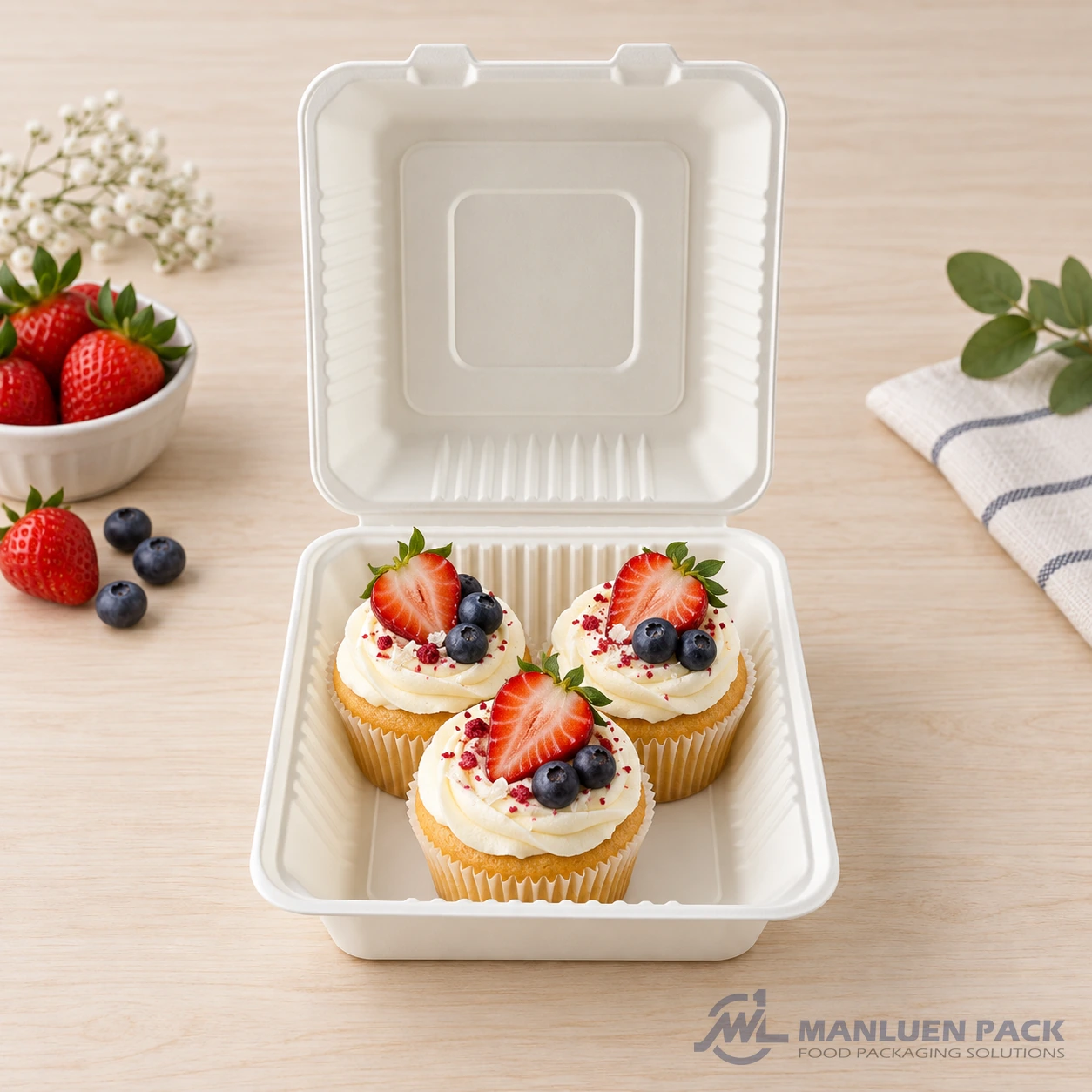
Clear clamshells are used for cakes, cupcakes, cookies, pastries, and other products whose appearance affects the purchase decision. Dome height, base rigidity, and clearance around frosting matter more than nominal capacity.
Fresh Produce
Berries, grapes, cut fruit, and vegetables often use clear ventilated clamshells. Vent size and placement affect airflow and moisture. The design should also protect delicate produce from compression during packing and display.
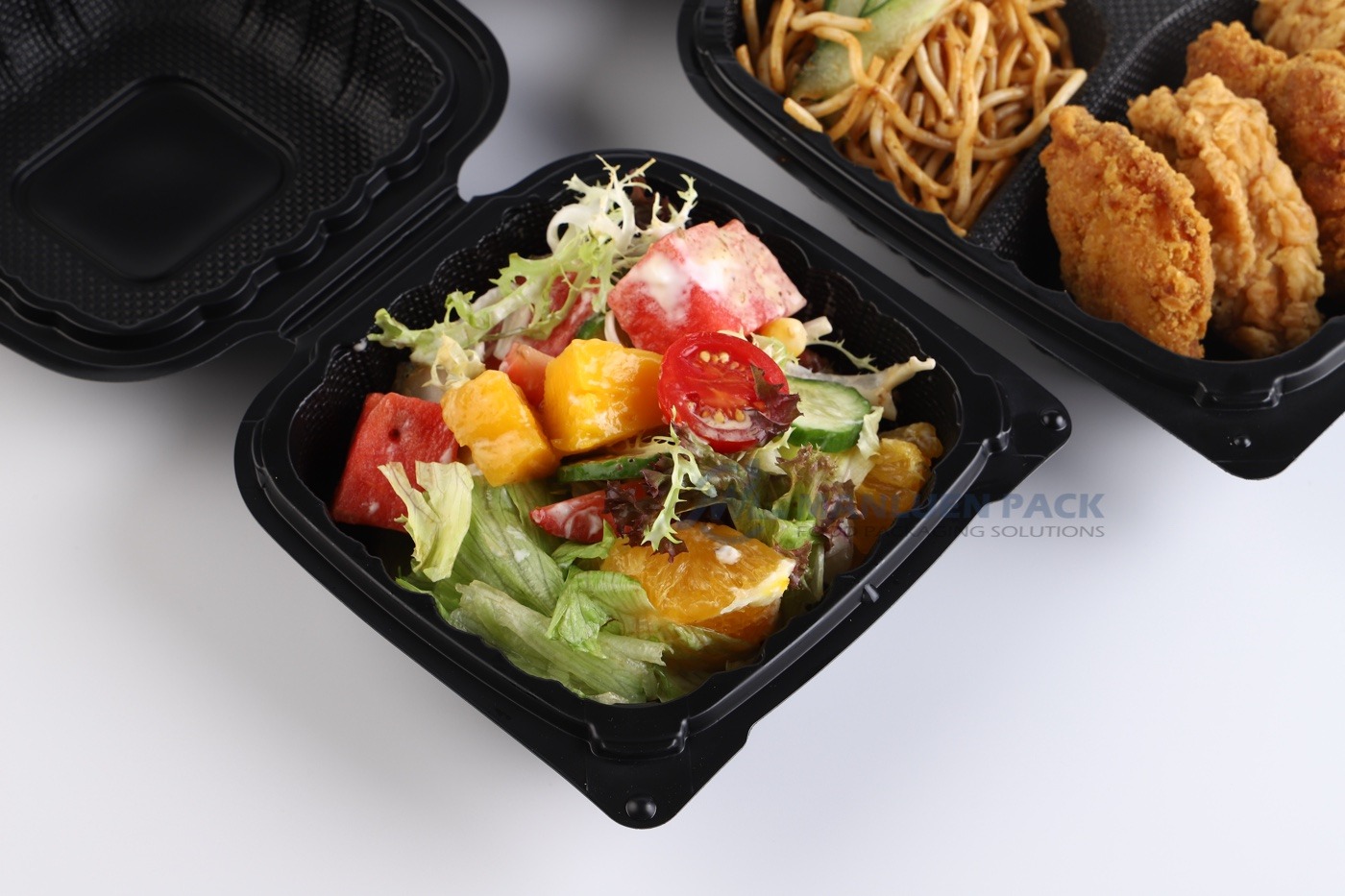
Salads, Sushi, and Chilled Foods
Chilled foods need secure closure, clear presentation, and resistance to condensation. The container should be tested at the actual storage temperature and holding time. Anti-fog performance, labels, dressings, and oily ingredients can all affect the result.
Catering and Events
Caterers may use clamshells for individual portions, boxed meals, desserts, or leftovers. A consistent footprint can simplify stacking in transport boxes. The clamshell catering guide covers this use in more detail.
Clamshell Materials: PP Is Only One Option
Clamshell food containers can be made from PP, PET, rPET, PS, OPS, PLA, bagasse, molded fiber, or paperboard. Each material has different strengths and limits. The food packaging materials guide provides a broader comparison.
| Material | Typical role | What buyers should verify |
|---|---|---|
| PP | Prepared meals and takeaway applications that may need greater flexibility or heat performance | Exact resin grade, finished-container temperature instructions, microwave claim, closure, and food-contact basis |
| PET or rPET | Clear refrigerated display, produce, bakery goods, and salads | Clarity, recycled-content evidence where claimed, temperature limits, and local recycling acceptance |
| PS or OPS | Lightweight cold-food and display packaging | Brittleness, impact resistance, temperature limits, and local collection or restrictions |
| PLA | Some cold-food applications using a bio-based plastic | Heat sensitivity, certified compostability claim, correct disposal route, and local facility access |
| Bagasse or molded fiber | Takeaway meals and fiber-based foodservice packaging | Oil and moisture resistance, coating, PFAS statement, temperature instructions, and compostability certification |
PP is not automatically the “best” clamshell material. It may suit some prepared meals, while clear PET may better serve cold retail display and bagasse may fit another purchasing brief. Start with the food and distribution conditions, then choose the material.
The biodegradable clamshell packaging guide compares fiber-based options, and ManLuen’s WL-BG81 8×8-inch bagasse clamshell shows one molded-fiber format.
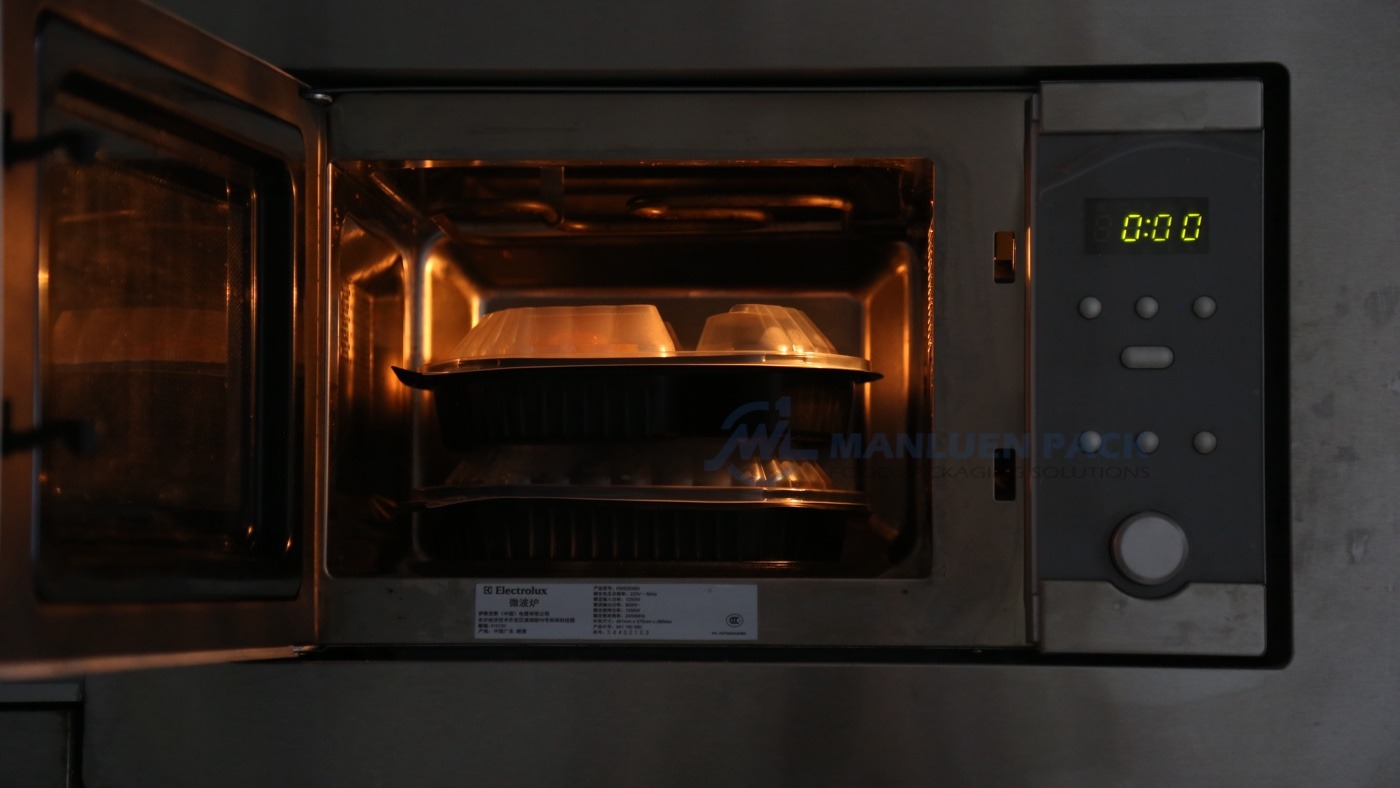
Are PP Clamshell Containers Microwave-Safe?
Some PP containers are designed for reheating, but the resin name or recycling code does not prove that every PP clamshell is microwave-safe. Additives, pigments, thickness, hinge design, lid material, food type, heating time, and temperature all affect performance.
Use a container in the microwave only when the manufacturer provides instructions for that exact SKU and the lid. Check whether the lid should remain attached, be vented, or be removed. Replace damaged or distorted containers, and do not use a cold-display PET, OPS, or PS clamshell for heating unless its instructions expressly allow it.
The FDA separates food-contact uses by food type and condition of use. Its tables distinguish room-temperature storage, refrigerated storage, reheating, hot filling, and cooking. This is why a general claim such as “complies with 21 CFR Part 177” is not enough to establish microwave suitability for a finished container.
Food-Contact Compliance: What Buyers Should Request
In the United States, the FDA regulates food-contact substances according to their authorization and intended use. It does not issue a universal approval for every finished clamshell. A supplier should identify the regulatory basis for each material and explain how the intended food and temperature conditions are covered. The article on which agency regulates food packaging explains this process.
For the European Union, plastic food-contact materials are covered by the general framework and Regulation (EU) No 10/2011. The European Commission explains that migration testing uses standardized time and temperature conditions representative of the intended food use. A Declaration of Compliance must be supported by appropriate documentation.
Ask for:
- A specification naming the exact material, color, dimensions, unit weight, and intended use
- The U.S. regulatory basis or EU Declaration of Compliance for the supplied material and product
- Migration or laboratory reports that identify the tested sample and test conditions
- Heating instructions for the exact base and lid when microwave use is claimed
- Batch traceability and production records
- Evidence supporting BPA-free, recycled-content, recyclable, or compostable claims
Check that the company, factory, material, color, and SKU on the reports match the quotation. A generic certificate for another product does not establish compliance. ManLuen buyers can consult the certification information and request current documents for the selected model. For basic terminology, see what food-grade packaging means.
Recyclable and Compostable Claims Need Context
A plastic container may use a technically recyclable resin, but actual recycling also requires local collection, sorting, a viable processor, and a reasonably clean item. Shape, color, labels, food residue, and mixed materials can affect acceptance. Do not promise customers that every PP or PET clamshell will be recycled.
Compostable packaging also needs evidence and a suitable disposal route. A bagasse container may include coatings or additives that change its end-of-life claim. Ask for the applicable test standard, certification scope, and exact product covered. Industrial compostability does not necessarily mean the item will break down in a home compost pile.
Environmental decisions should consider material use, food protection, transport, and the recovery system available in the destination market. “Eco-friendly” alone is not a useful purchasing specification.

How to Choose the Right Clamshell Container
- Define the food. Record whether it is hot, chilled, frozen, oily, acidic, moist, crisp, or delicate.
- Measure the portion. Check usable internal dimensions, not only nominal capacity or outside size.
- Set the temperature conditions. Include filling temperature, storage, reheating, and expected contact time.
- Choose the closure. Decide whether you need a standard snap, stronger lock, seal, or visible tamper evidence.
- Check ventilation. Steam vents can help some hot foods, while produce may need airflow and chilled display may need anti-fog performance.
- Test delivery. Fill, close, stack, tilt, and transport samples along the real route.
- Verify documents. Match the compliance file to the exact product, material, and intended market.
- Review disposal claims. Confirm what local recycling or composting system actually accepts.
The everyday clamshell container guide provides additional help with common food applications.
How to Open, Close, and Store Clamshell Packaging
To close a snap-lock clamshell, align the lid and base before pressing around the closure points. Do not force a misaligned corner. If one side repeatedly opens, check for food on the rim, a deformed hinge, or damage to the locking tab.
To open it, hold the base on a stable surface and release the tabs at the designed opening points. Avoid pulling hard on the hinge or squeezing the food cavity. Tamper-evident designs may require breaking a seal or tab; follow the product instructions.
Store empty containers in their original cartons, away from dust, strong odors, direct sunlight, and heat. Do not overload nested stacks or place heavy cartons on top unless the supplier’s packing plan allows it. First-in, first-out stock rotation also helps buyers use older cartons before newer deliveries.
Buying Clamshell Containers Wholesale
Compare suppliers against one written specification. The quotation should state:
- Model number and whether the item is standard or custom
- Material, color, dimensions, usable capacity, and unit weight
- Pieces per sleeve and carton, carton dimensions, net weight, and gross weight
- Minimum order quantity and price breaks
- Sample cost and courier terms
- Tooling, color, printing, labeling, and customization charges
- Production lead time and payment terms
- Named Incoterm location
- Available food-contact and environmental documents
MOQ, price, and lead time vary by model, material, color, order quantity, and factory schedule. Ask for current written figures instead of relying on a universal number. Approve a filled sample and written specification before mass production. Define lid-fit failures, cracks, contamination, dimensions, unit weight, carton packing, and inspection method.
Buying in bulk can reduce unit and handling costs, but only when the chosen format fits the menu. A single large clamshell will not suit every product. Fewer well-chosen formats often make inventory easier to manage than a wide range of overlapping sizes.
Frequently Asked Questions
What does clamshell food container mean?
It means a food container with two connected sections joined by a hinge. The upper section folds over the base and closes through tabs, friction-fit edges, or another integrated closure.
What foods can go in a clamshell container?
Clamshells are used for takeaway meals, produce, bakery products, salads, sushi, sandwiches, desserts, and prepared foods. The correct material and design depend on temperature, moisture, grease, storage, transport, and display requirements.
Are all clamshell containers made from PP?
No. Common materials include PP, PET, rPET, PS, OPS, PLA, bagasse, molded fiber, and paperboard. Confirm the exact material for the model being purchased.
Can every PP clamshell go in the microwave?
No. Use it for reheating only when the exact container and lid are designed, tested, and labelled for the intended microwave conditions.
Are clamshell containers leakproof?
Not automatically. Standard snap closures may hold solid foods but still leak sauces or liquids. Test the filled container while tilted and transported. Use a sealed or specially designed leak-resistant format when required.
Are clamshell containers tamper-evident?
A normal hinged lid is not necessarily tamper-evident. The container needs a feature that gives visible evidence of opening, such as a breakaway tab, seal, label, or band. The guide to tamper-evident packaging explains the distinction.
How do I request a wholesale quote?
Send the food type, portion dimensions, temperature conditions, material preference, quantity, destination market, required documents, customization, and delivery location. ManLuen can then match the request to available models through the quotation page.
Conclusion
Clamshell food containers can protect food, simplify filling, and support product display. Their performance depends on the complete package, not the word “clamshell” or the resin code alone.
Choose the container around the food and its real journey. Confirm material, size, closure, ventilation, temperature instructions, and compliance documents. Then test a filled sample through storage and delivery before placing a wholesale order.
References
U.S. Food and Drug Administration. Food Packaging & Other Substances that Come in Contact with Food. Used for the U.S. food-contact substance and intended-use framework.
U.S. Food and Drug Administration
U.S. Food and Drug Administration. Food Types & Conditions of Use for Food Contact Substances. Used to distinguish refrigerated storage, reheating, hot filling, and cooking conditions.
U.S. Food and Drug Administration
Electronic Code of Federal Regulations. 21 CFR Part 177—Indirect Food Additives: Polymers. Used as the U.S. regulatory reference for food-contact polymers.
Electronic Code of Federal Regulations
European Commission. Food Contact Materials Legislation. Used for migration testing, supporting documentation, and Declaration of Compliance requirements for plastic food-contact materials.
European Commission
European Union. Commission Regulation (EU) No 10/2011 on plastic materials and articles intended to come into contact with food.
EUR-Lex

ManLuen Plastic Packaging Company, which is specialized in the production of Plastic Food Packaging for more than 20 years. Our products are made from 100% virgin and BPA-Free PP, PS, and OPS comply with FDA and European Standards.
 EN
 ZH
 FR
 PT
 ES
 KO
 JA