
Introduction
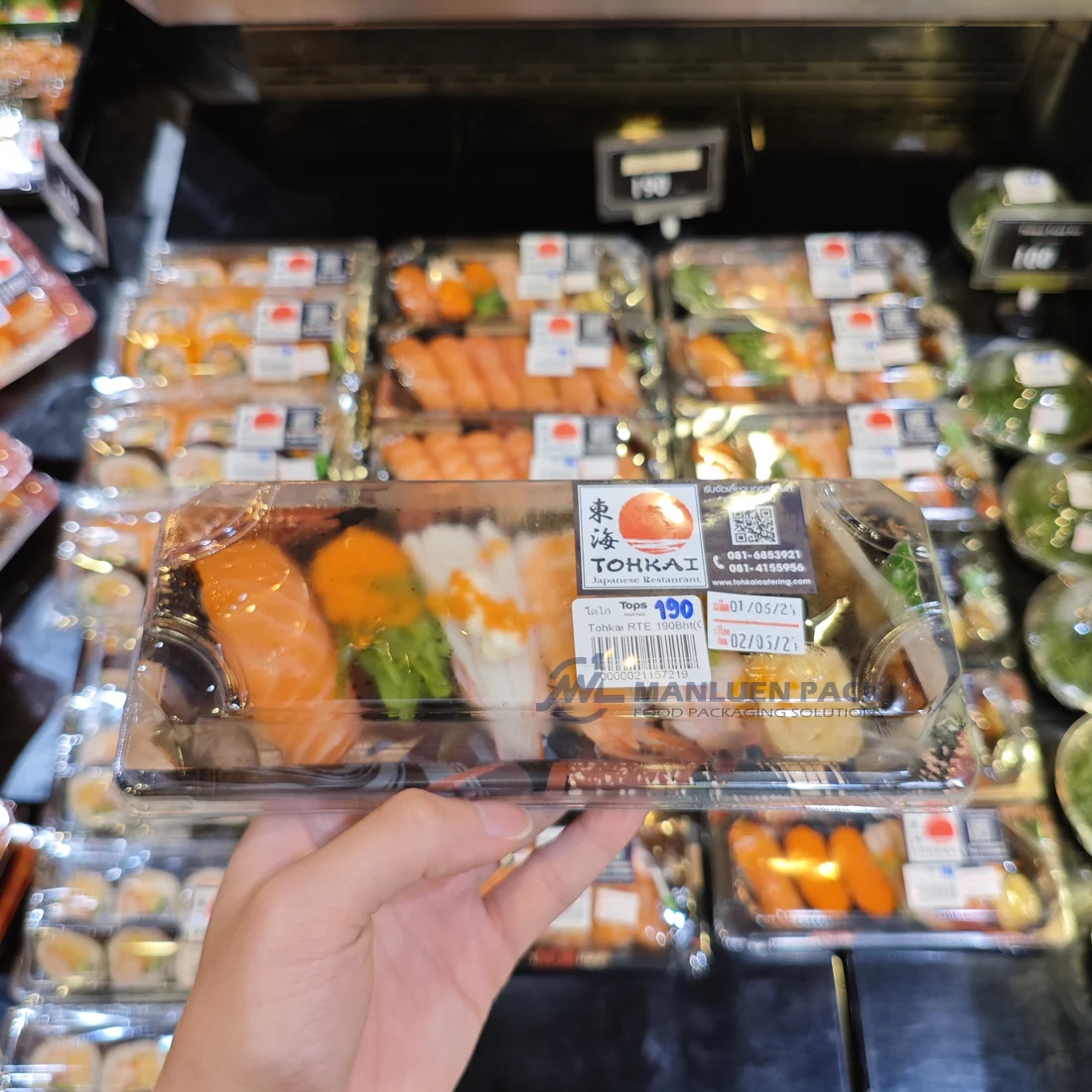
Walk through a supermarket deli, sushi counter, bakery, or quick-service kitchen and you will see many different food packaging materials. A sushi tray may use an opaque base with a clear lid, a microwave meal may use polypropylene, a cake may sit inside a transparent PET dome, and a ready meal may be packed in an aluminum tray that can move from frozen storage to an oven.
The material determines much of the package’s performance: whether it tolerates heat or cold, blocks moisture and oxygen, protects the food during transport, displays the product clearly, and fits available recycling or composting systems.
Food packaging is also a large and evolving market. One industry estimate projects the global food packaging market to reach USD 598.98 billion by 2033. For foodservice buyers, however, the most important question is not market size. It is whether a specific material is suitable for the food, the intended conditions of use, the destination market, and the complete package design.
This 2026 buyer’s guide explains the major materials used for food packaging, including plastics, paper and cardboard, compostable fibers, metal, glass, and multilayer structures. It also compares common polymers such as PET, PP, PE, PS, OPS, HIPS, and PLA; maps materials to food applications; explains US food-contact requirements; and provides a practical supplier checklist.
What Materials Are Used for Food Packaging? The Quick Answer
Food packaging materials include plastics, paper and cardboard, bio-based or compostable materials, metals, glass, and multilayer structures. No material is best for every application.
The right option depends on:
- The food’s temperature, moisture, oil, acidity, and shelf life
- Required protection from oxygen, light, contamination, and physical damage
- Refrigeration, freezing, hot filling, reheating, or oven use
- Retail display, takeaway, delivery, storage, and transportation conditions
- Food-contact regulations in the destination market
- Package weight, cost, manufacturing method, and customization needs
- Local recycling, reuse, or composting infrastructure
For example, PET is commonly used for clear chilled-food packaging, while PP is frequently used for hot-food and microwave-rated containers. Paperboard is useful for printed cartons and dry foods but may require a barrier for grease or moisture.
Aluminum and steel provide excellent protection for shelf-stable or high-temperature foods. Glass offers chemical stability and a premium presentation but adds weight and breakage risk. Bagasse and PLA can support compostable packaging programs when the complete package is certified and an appropriate collection system exists.
The Six Main Categories of Food Packaging Materials
Most food packages belong to one of six broad material categories or combine several of them. The table below provides a practical overview.
| Material Category | Common Examples | Typical Applications | Main Strength | Main Limitation |
|---|---|---|---|---|
| プラスチック | PET, PP, PE, PS, OPS, HIPS | Trays, containers, bottles, cups, lids, films, and pouches | Lightweight, formable, and available in many performance grades | Recycling access and performance vary by resin and package design |
| Paper and cardboard | Kraft paper, paperboard, corrugated board | Bakery bags, cartons, sleeves, food boxes, and shipping cases | Printable, lightweight, and widely recognized by consumers | Untreated fiber has limited grease and moisture resistance |
| Bio-based or compostable | Bagasse, molded fiber, PLA, palm leaf | Takeaway boxes, plates, bowls, cold cups, and food trays | Can reduce reliance on conventional fossil-based materials | Claims depend on certification and available composting systems |
| Metal | Aluminum, steel, tinplate | Cans, foil trays, ready meals, and shelf-stable foods | Excellent barrier and strong heat-processing performance | No product visibility; coatings and appliance compatibility require review |
| Glass | Bottles, jars, and reusable food containers | Beverages, sauces, baby food, dairy, and premium products | Chemical stability, transparency, and strong barrier performance | Heavy and breakable during handling and transport |
| Multilayer materials | Plastic laminates, foil laminates, coated paper, composite cartons | Coffee, snacks, powdered foods, pouches, and long-shelf-life products | Combines sealing, strength, printability, and high barrier | Bonded layers can be difficult to separate and recycle |
The category name alone does not determine performance. A package’s thickness, geometry, additives, coatings, seals, and manufacturing method can change how it behaves. Buyers should evaluate the finished article rather than relying only on the material name.
Plastic Food Packaging Materials
Plastic is widely used in food packaging because it combines low weight, moisture resistance, manufacturing flexibility, and a broad range of optical and temperature properties. It can be thermoformed, injection molded, blow molded, extruded into film, or combined with other materials.
Plastic food packaging includes rigid trays, hinged clamshells, cups, tubs, lids, bottles, flexible films, and pouches. The main foodservice plastics include PET, PP, PE, PS, OPS, and HIPS. PLA has plastic-like performance but is usually discussed separately because it is bio-based and may be industrially compostable when certified.
| プラスチック | Resin Code | Appearance | Common Food Uses | Typical Service Role | End-of-Life Consideration |
|---|---|---|---|---|---|
| PET | #1 | Clear and rigid | Sushi trays, salad containers, bottles, fruit cups, and cake domes | Cold and ambient display | Established recycling streams exist, but acceptance depends on format and locality |
| PP | #5 | Translucent to opaque | Bento boxes, soup tubs, deli cups, sauce cups, and meal trays | Hot food and specifically rated reheating applications | Collection is expanding but varies by community |
| HDPE and LDPE | #2 and #4 | Opaque to translucent | Bottles, bags, wraps, liners, freezer film, and squeeze containers | Moisture-resistant rigid or flexible packaging | HDPE bottles often have better access than films and flexible PE |
| PS | #6 | Clear, colored, or foamed | Trays, cups, lids, and some bakery or dairy packaging | Cost-focused rigid or foamed applications | Collection is limited and regional restrictions may apply |
| OPS | #6 | Clear, glossy, and stiff | Sushi lids, cookie trays, and bakery clamshells | Cold display and presentation | Shares many end-of-life limitations with PS |
| HIPS | #6 | Usually opaque | Rigid food trays, cups, and clamshell bases | Impact-resistant, cost-sensitive applications | Regional acceptance and restrictions must be checked |
| PLA | #7 | Often clear | Cold cups, salad containers, lids, and compostable serviceware | Controlled cold-food applications | Requires an appropriate composting pathway and should not enter conventional PET recycling |
Temperature figures published for a polymer are only general screening values. A resin melting point is not the same as the safe service temperature of a thin-walled container. Always confirm the finished package’s tested conditions of use, including the food type, contact time, fill temperature, microwave instructions, and lid material.
PET food packaging
Polyethylene terephthalate, or PET, is valued for clarity, stiffness, strength, and moisture resistance. It is commonly used when the customer needs to see the product before purchase.
Typical applications include:
- Sushi and sashimi display trays
- Chilled salad and fruit containers
- Beverage bottles
- Ready-to-eat cold foods
- Cake domes and bakery clamshells
- Clear lids for refrigerated trays
PET can protect the food while providing a strong merchandising window. This makes it useful for supermarket sushi, cakes, salads, and other products where color, freshness, arrangement, or portion size influence the purchase decision.
Conventional APET packaging is generally selected for cold or ambient use rather than microwave reheating or hot filling. Specialized PET structures, such as CPET, have different properties, which is why buyers should specify the exact material instead of treating every PET package as identical.
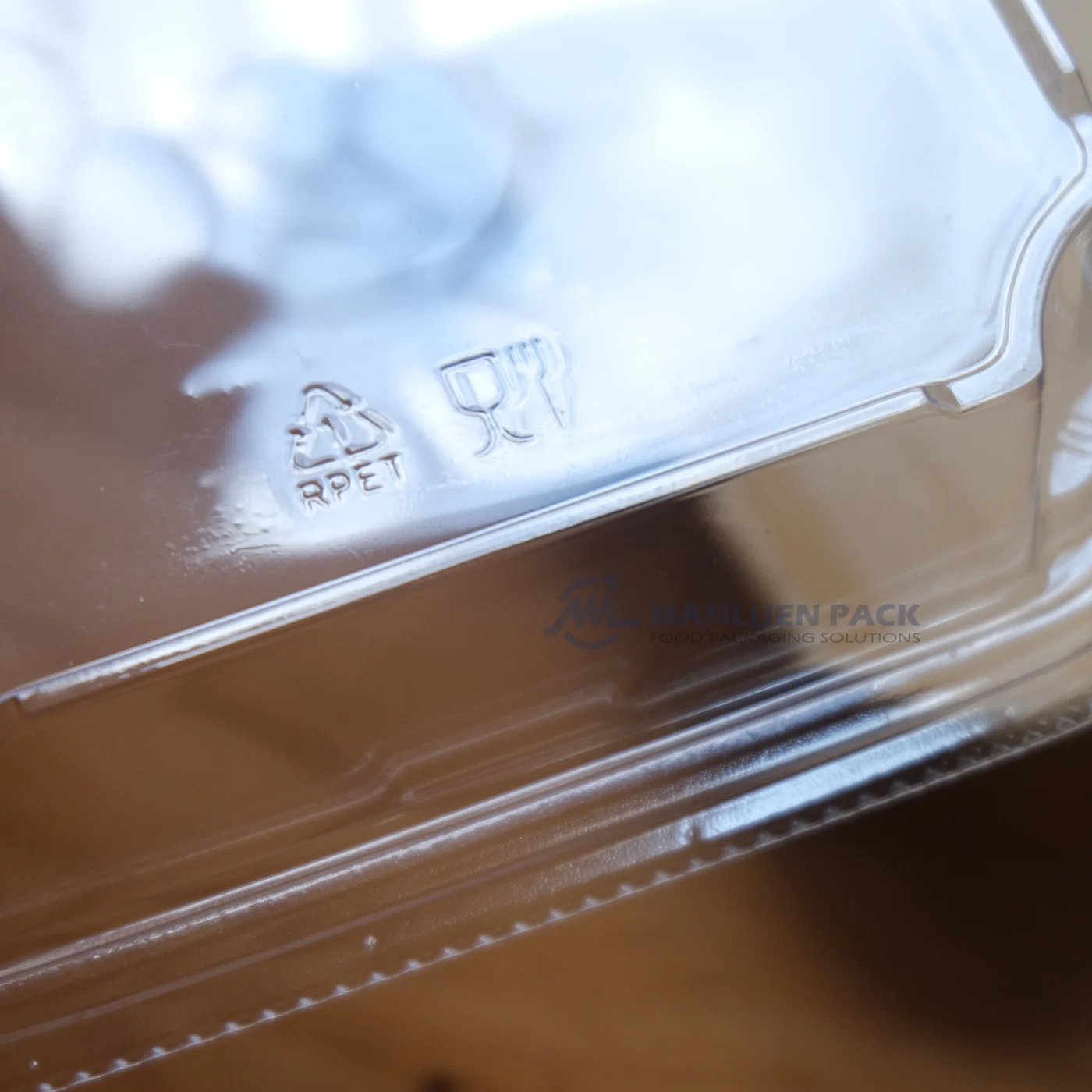
rPET contains recycled PET. A credible rPET specification should state the recycled-content percentage, food-contact basis, color and clarity expectations, source controls, and traceability. “Made with recycled plastic” does not by itself explain the amount or suitability of the recycled content.
PP food packaging
Polypropylene, or PP, is commonly used for food packaging that needs toughness, oil resistance, and better heat performance than many clear display plastics.
Common applications include:
- Takeaway and bento containers
- Microwave-rated meal trays
- Soup and deli tubs
- Yogurt and portion-control cups
- Sauce and condiment cups
- Reusable food-storage containers
PP is often the practical choice for hot prepared foods and packages intended for microwave reheating. However, a #5 resin code does not automatically make a container microwave-safe. Wall thickness, formulation, lid construction, venting, food composition, and intended heating time all matter.
Buyers should require clear use instructions and documentation for the finished container. A thin PP tub designed for refrigerated food may not have the same performance as a purpose-built microwave meal tray.
PE food packaging
Polyethylene is used in both rigid and flexible food packaging. High-density polyethylene, or HDPE, appears in bottles, jugs, tubs, and closures. Low-density polyethylene, or LDPE, and related PE grades are widely used in bags, wraps, liners, sealant layers, freezer packaging, and flexible pouches.
PE is useful because it provides flexibility, moisture resistance, toughness, and reliable heat-sealing performance. Flexible PE packaging can use less material and shipping space than a rigid container when the food does not require structural protection.
Common PE applications include:
- Bread and produce bags
- Frozen-food bags and liners
- Cling and protective films
- Squeeze bottles and closures
- Sealant layers inside multilayer pouches
Film recycling differs from bottle recycling. A package made primarily from PE may still be difficult to recover if it is very small, heavily contaminated, laminated to another material, or not accepted by local collection programs.
PS, OPS, and HIPS food packaging
Polystyrene appears in several food-packaging forms. General-purpose PS may be rigid and clear or colored. Expanded PS uses a foamed structure. OPS is oriented polystyrene that provides improved stiffness and clear presentation. HIPS modifies polystyrene to improve impact performance and is usually opaque.
These materials are used for:
- Sushi tray bases and clear lids
- Bakery display trays and clamshells
- Dessert and dairy cups
- Rigid food trays
- Opaque clamshell bases
- Cold-food display packaging
OPS works well where a glossy, clear lid supports product presentation. HIPS is useful where an opaque, rigid structure needs more impact resistance than general-purpose PS.
PS-family materials generally have limited curbside collection and may be affected by state or local restrictions, especially in foamed foodservice formats. They should not be assumed microwave-safe. Buyers should review destination-market rules and compare PS with PP for hot applications or PET for clear cold-display applications.
Advantages and limitations of plastic food packaging
Plastic remains important because it offers:
- Low package weight and efficient transportation
- Moisture, oil, and leakage resistance
- Clear options for food display
- Rigid and flexible package formats
- High-volume manufacturing efficiency
- Compatibility with closures, compartments, and tamper-evident features
Its limitations include:
- Recycling availability that varies by resin, format, and locality
- Small, dark, multilayer, or contaminated items that may not be recovered
- Different temperature limits across resin grades and finished packages
- State and local restrictions on certain single-use formats
- Potential confusion between resin codes and actual recyclability
The goal is not simply to replace every plastic. It is to use the minimum appropriate material while preserving food safety, shelf life, transport performance, and customer usability.
Paper and Cardboard Food Packaging Materials
Paper and cardboard are widely used because they are lightweight, printable, easy to fold, and supported by established recycling systems for many clean, uncoated formats. They are common in bakery, dry-food, takeaway, beverage, retail, and transportation packaging.
The main paper-based materials include:
- Kraft paper: strong paper with a natural appearance, commonly used for bags, wraps, and dry foods.
- Paperboard: thicker material used for folding cartons, sleeves, trays, bakery boxes, and beverage packaging.
- Corrugated cardboard: layered board used mainly for cases, shipping boxes, cushioning, and distribution.
- Coated paper and board: fiber structures with added barriers for moisture, grease, oxygen, sealing, or heat resistance.
Kraft paper packaging
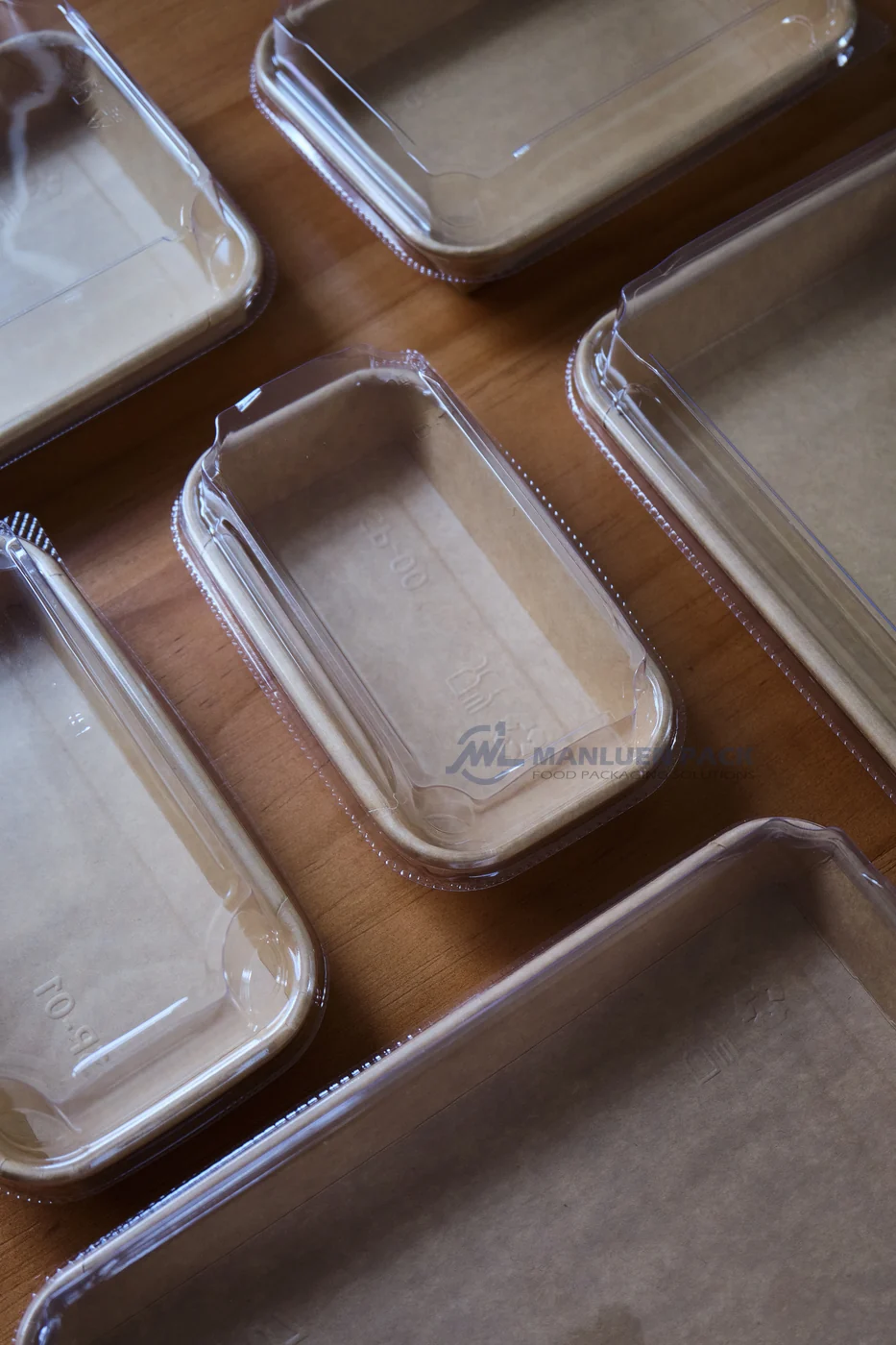
Kraft paper is produced from wood pulp and is known for strength and a natural brown appearance. It is often selected for bakery bags, grocery bags, food wraps, and dry-food packaging.
Untreated kraft paper has limited resistance to water, oil, and sauces. Direct-contact packages for greasy or moist food may need a coating, liner, wax, or separate film. That additional layer changes the package’s food-contact documentation and may also change whether the package can be recycled or composted.
Paperboard and corrugated packaging
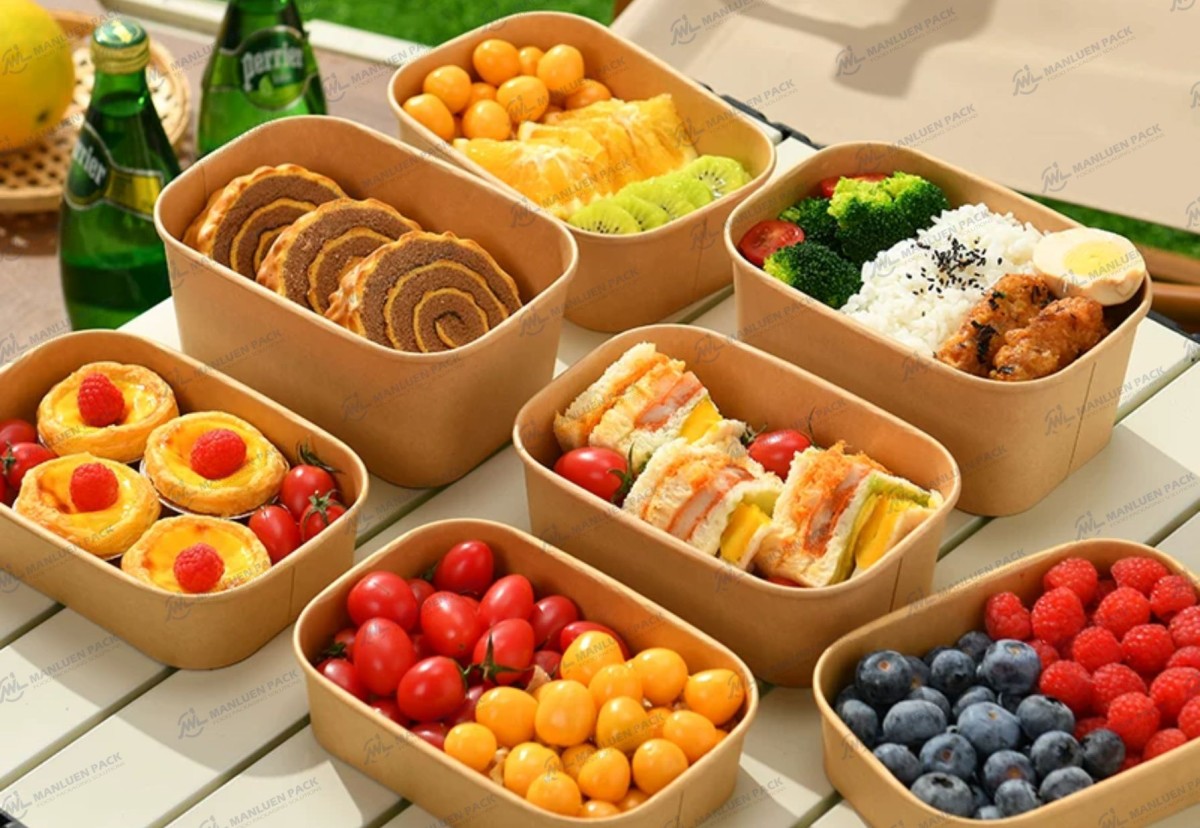
Paperboard provides more stiffness than ordinary paper and can be cut, folded, printed, and formed into cartons or trays. It is used for cereal boxes, bakery cartons, frozen-food cartons, sleeves, and beverage carriers.
Corrugated board adds fluted layers for compression strength and cushioning. It is primarily a transportation material used for master cartons, produce boxes, and foodservice distribution cases rather than as an unprotected direct-contact surface.
Paper and cardboard offer good printability and efficient flat storage, but performance depends on humidity, food contact, coating, and structural design. Buyers should test stacking strength after refrigeration or freezing because fiber can behave differently after absorbing moisture.
Why paper packaging is often a hybrid
Many paper food packages are not made from fiber alone. A takeaway cup may use a polymer lining, a frozen-food carton may use a moisture barrier, and a grease-resistant tray may include a coating or treatment.
Hybrid construction is not automatically a problem; it may be necessary to protect food. However, buyers should identify every layer and ask:
- Is the coating suitable for the intended food and temperature?
- Does the complete package meet applicable food-contact requirements?
- Is the package accepted by paper recyclers in the destination market?
- Can the coating or liner separate during pulping?
- Does a compostable claim cover the coating, adhesive, ink, and label?
- Is there a written statement addressing intentionally added PFAS?
Compostable and Bio-Based Food Packaging Materials
Bio-based materials are made partly or entirely from biological feedstocks. Compostable materials are designed and tested to break down under defined composting conditions. These terms describe different attributes: a material can be bio-based without being compostable, and a compostable polymer can contain fossil-derived components.
Common options include bagasse, molded fiber, PLA, and palm leaf. Their environmental value depends on food protection, material efficiency, certification, collection, and the facility that receives the package after use.
Bagasse and molded-fiber packaging
Bagasse is the fibrous residue left after sugarcane juice extraction. It can be processed into molded trays, bowls, plates, clamshells, and meal containers.
Bagasse packaging is used for:
- Takeaway meals
- Hot and prepared foods
- Sushi and catering trays
- Plates and bowls
- Compartment food containers
Its advantages include a plant-based feedstock, a natural appearance, and useful stiffness. Actual grease resistance, liquid resistance, heat tolerance, lid fit, and compostability depend on the formulation and design.
Do not assume that every molded-fiber package is PFAS-free or compostable. Request the applicable certification, ingredient or treatment in
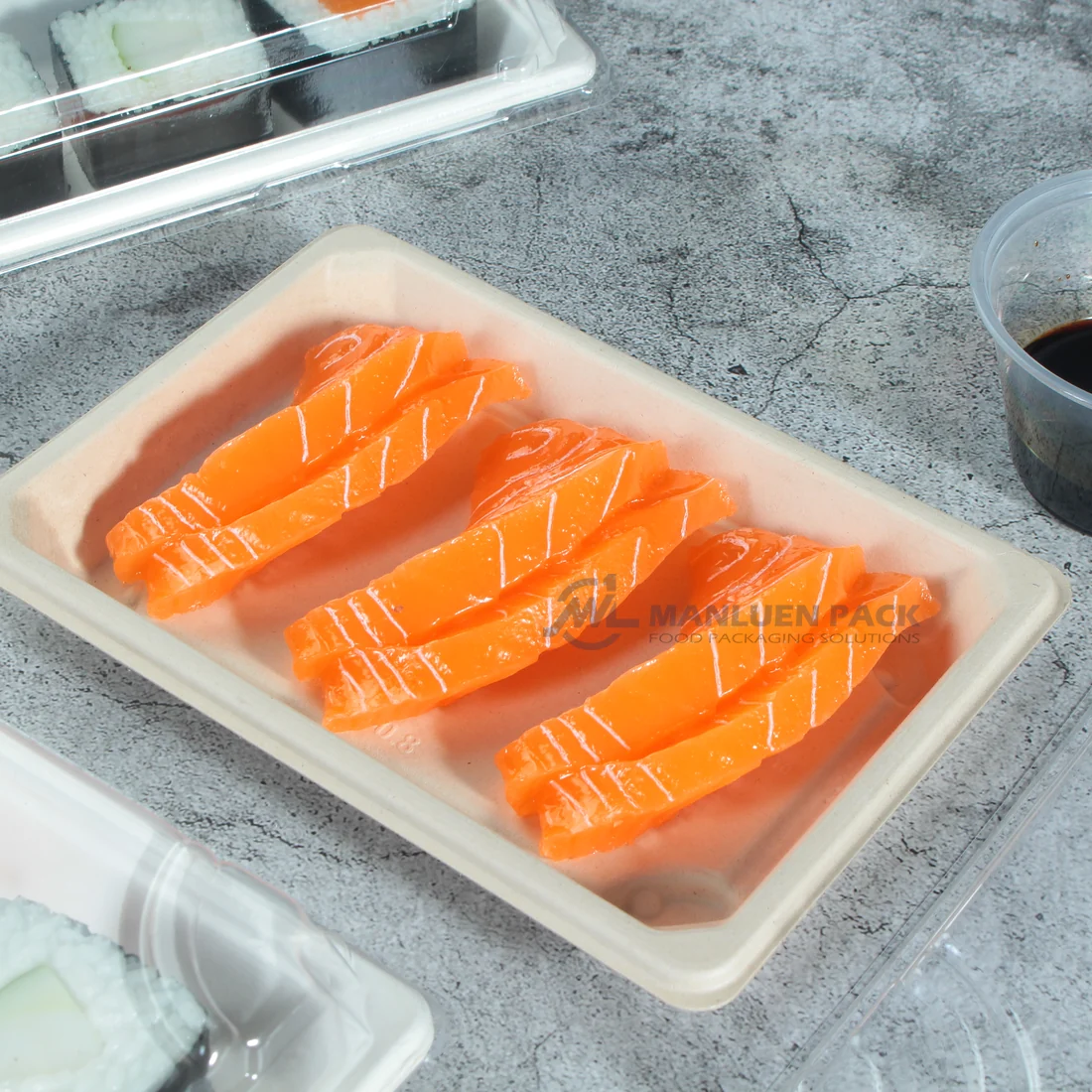
formation, food-contact documentation, and a written PFAS statement for the finished package.
PLA and other bioplastics
Polylactic acid, or PLA, is commonly produced from fermented plant sugars. It can provide a clear, plastic-like structure for cold cups, salad containers, bakery packaging, lids, and serviceware.
PLA usually has lower heat resistance than PP and should not be treated as a direct substitute for hot-food or microwave packaging. Certified PLA products are generally designed for industrial composting conditions, not uncontrolled littering, ordinary recycling, or automatic breakdown in a landfill.
PLA can also contaminate conventional PET recycling if the two clear materials are mixed. Buyers should plan labeling, collection, and disposal before choosing PLA—not after the package launches.
Biodegradable is not the same as compostable
“Biodegradable” and “compostable” should not be used as interchangeable marketing terms. Under the US Federal Trade Commission’s Green Guides, environmental claims should be truthful, supported, and qualified when necessary.
A compostable claim should be supported by competent and reliable evidence that the complete product or package will break down safely and in a timely manner under the claimed conditions. If the package requires a municipal or industrial facility and appropriate facilities are not widely available, the claim should explain that limitation.
Before purchasing compostable food packaging, confirm:
- The certification standard and certifying organization
- Whether the complete package or only one component is certified
- Required industrial or home-composting conditions
- Acceptance by local collection and processing programs
- Instructions for labels, lids, films, and food residue
Metal Food Packaging Materials
Metal packaging is used when food needs strong physical protection, excellent barrier performance, heat processing, or long shelf life. Aluminum and steel are the main food-packaging metals.
Metal blocks light and provides an effective barrier against oxygen and moisture when the container and closure remain intact. The food-contact surface may include a coating or lacquer, so buyers should review the complete construction rather than the metal alone.
Aluminum food packaging
Aluminum is used in beverage cans, foil wraps, trays, lids, and flexible laminates. It combines relatively low weight with heat performance and strong barrier properties.
Common applications include:
- Roast chicken and barbecue trays
- Bakery and catering pans
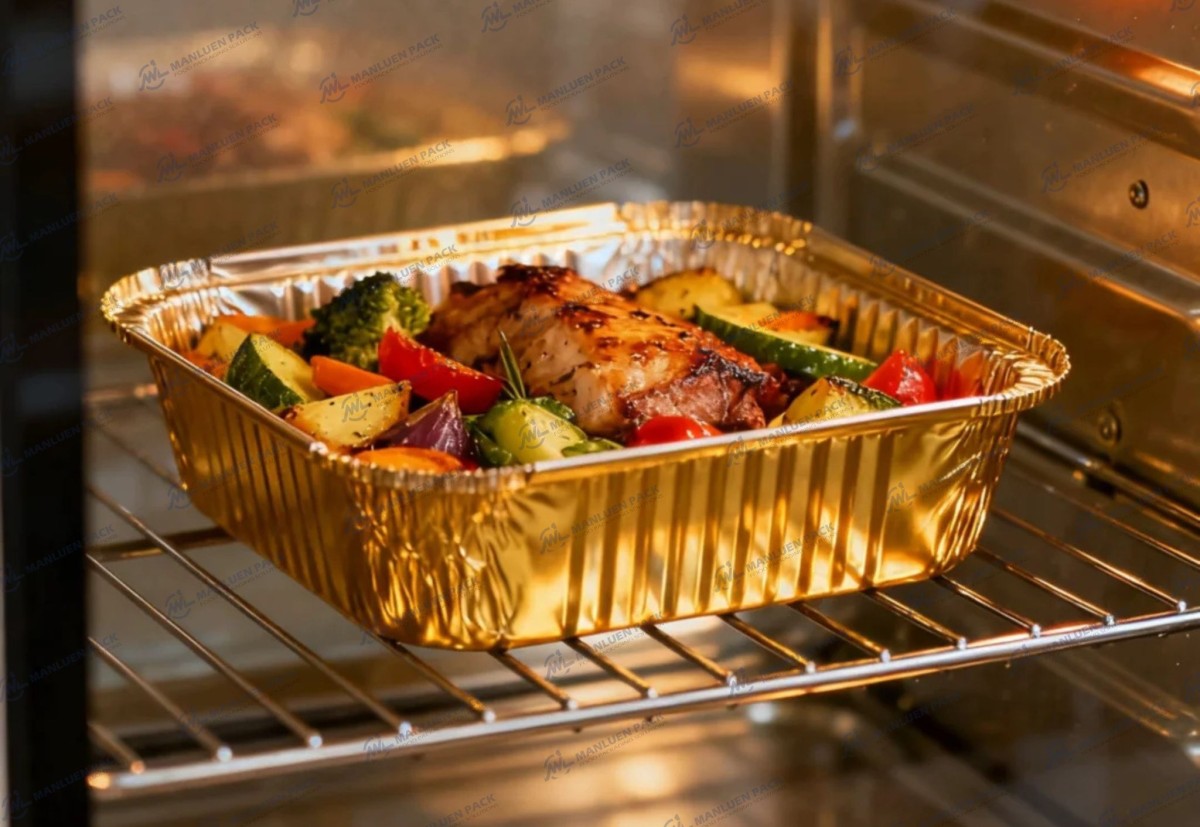
- Ready-meal and freezer-to-oven trays
- Beverage cans
- Foil lids and high-barrier laminate layers
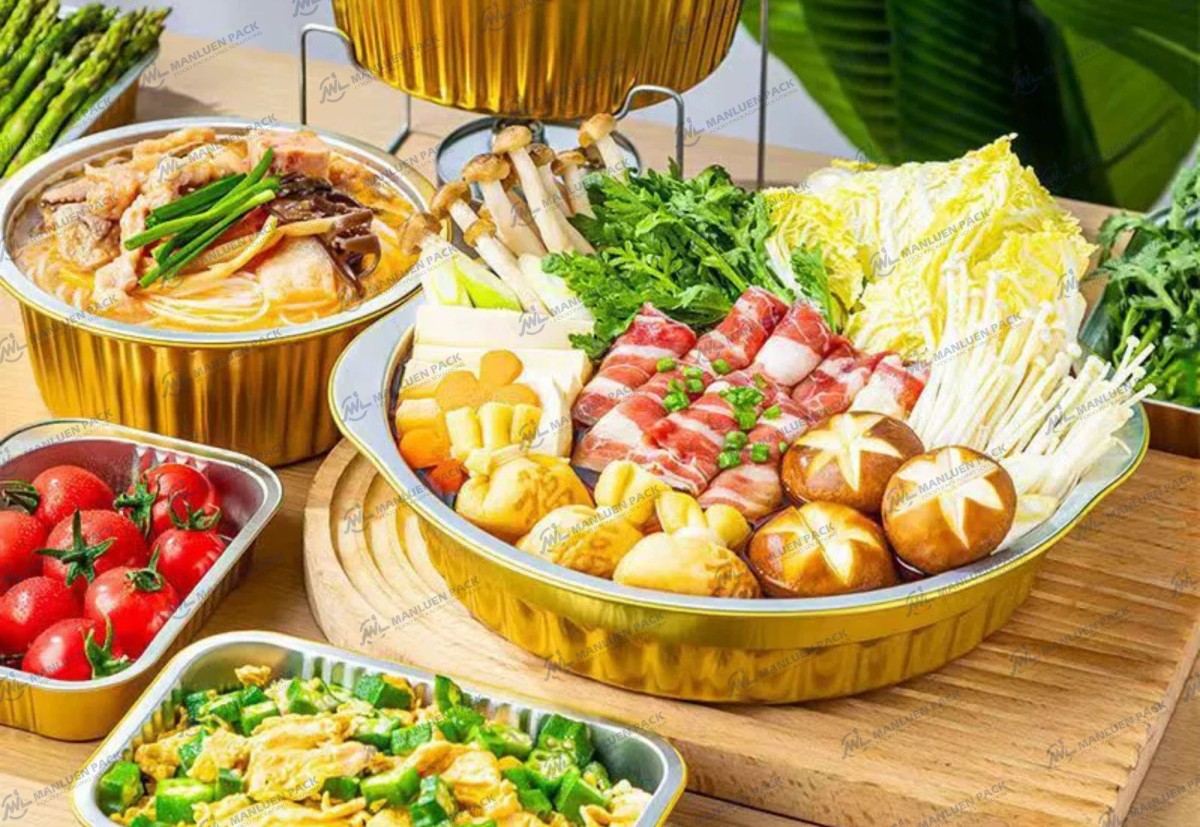
Aluminum trays can work well for conventional oven applications, but appliance compatibility must be explicit. Metal should not be placed in an ordinary microwave unless both the package instructions and appliance manufacturer allow it.
Aluminum is recyclable, but actual recovery depends on collection, contamination, size, and whether it is bonded to plastic or paper. A clean rigid tray is different from a thin foil layer inside a multilayer pouch.
Steel and tinplate food packaging
Steel and tinplate are used for canned vegetables, soups, meat, pet food, and other shelf-stable products. They provide strength for thermal processing, stacking, transportation, and long storage.
Can linings, seams, and closures are part of the food-contact system. Buyers should obtain documentation for coatings and other components, particularly when the food is acidic, fatty, or processed at high temperature.
Glass Food Packaging Materials
Glass is one of the oldest food-packaging materials and remains important for beverages, sauces, condiments, baby food, dairy, preserves, and premium products.
Its main advantages include:
- Strong barrier performance
- Chemical stability and low interaction with many foods
- Transparency for product display
- Suitability for reuse when the container is designed and managed for it
- Recyclability without the same polymer degradation concerns as many plastics
Glass does not remove every food-contact consideration. Closures, cap liners, gaskets, coatings, decorations, and thermal shock still require evaluation.
Its main disadvantages are weight and breakage.
Heavier packages increase handling and transportation demands, while broken glass creates safety and product-loss risks. For fresh prepared foods, lightweight plastic or fiber containers may be easier to handle and distribute.

Multilayer Food Packaging Materials
Multilayer packaging combines materials so that each layer performs a different function. A structure may use plastic for sealing, aluminum for oxygen and light protection, and paper for stiffness and printability.
Common applications include:
- Coffee and snack pouches
- Powdered foods
- Sauces and retort products
- Ready meals
- High-barrier films
- Composite beverage cartons
The primary advantage is performance. A multilayer structure can provide better oxygen, moisture, aroma, grease, puncture, or light protection than one material alone. This can extend shelf life and reduce food loss.
The main limitation is end-of-life recovery. Bonded layers may be difficult to separate in conventional facilities. The package may require specialized recycling or may not have a practical recovery pathway in the destination market.
Packaging developers are therefore exploring mono-material structures that maintain barrier and sealing performance while improving sorting and recycling compatibility. A mono-material claim should still be evaluated at the complete-package level, including coatings, inks, adhesives, valves, zippers, and labels.
Which Food Packaging Material Fits Which Application?
Buyers usually start with a food, not a polymer. The following application map converts common foodservice requirements into a practical shortlist.
| Food or Application | Common Material Options | Manluen Related Product Category | Why They Are Used | What to Verify |
|---|---|---|---|---|
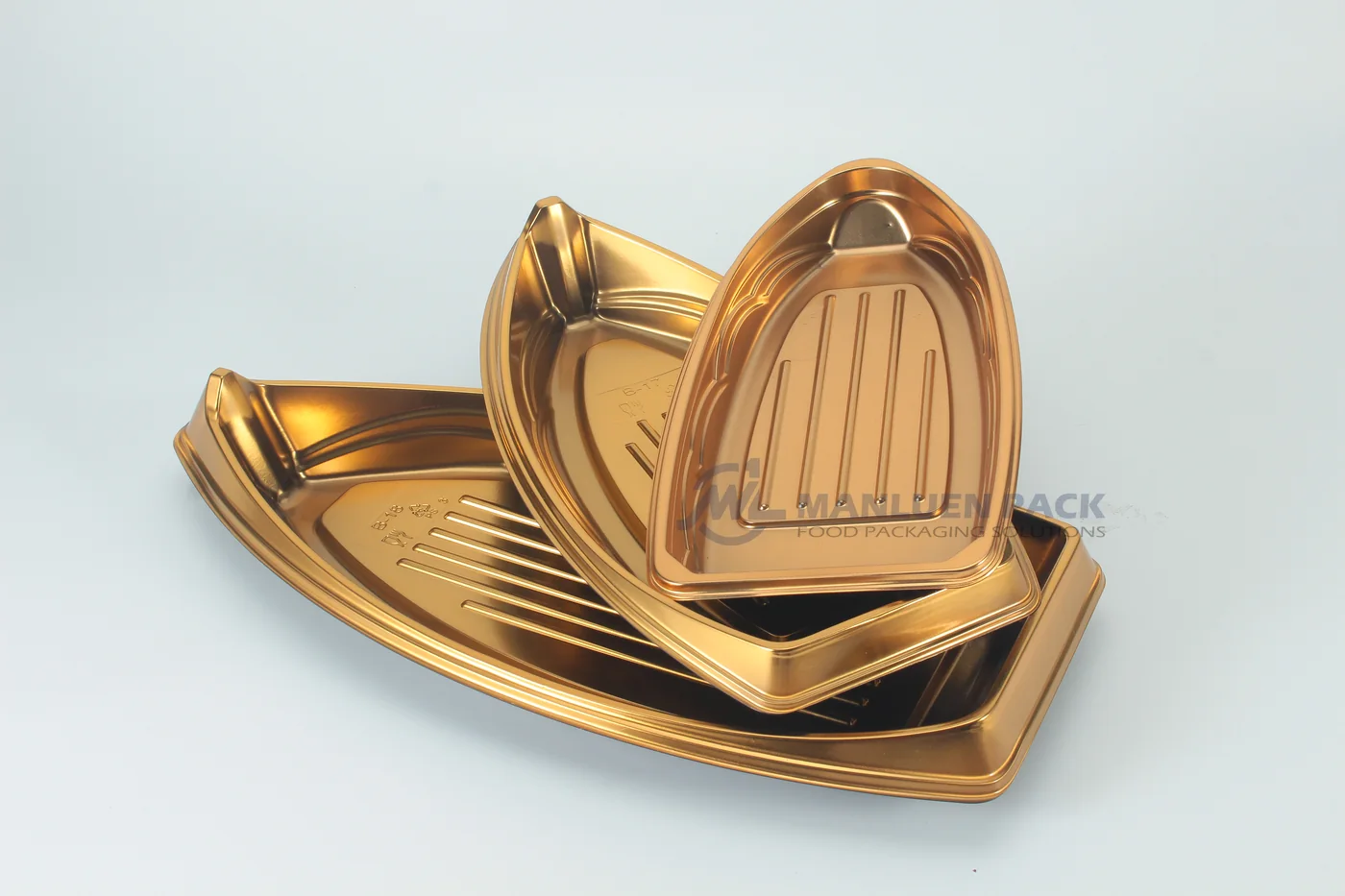
| Sushi and sashimi | PET, OPS, PS base with a clear lid, or bagasse | Sushi Trays / パーティートレイ | Cold-display visibility, arrangement, or a fiber-based presentation | Condensation, lid fit, refrigeration, leakage, local recovery, and heat restrictions |
| Bento and hot takeaway meals | PP or suitable molded fiber | Bento Boxes / Microwave Containers | Heat, oil, compartments, closure, and delivery performance | Microwave instructions, venting, lid material, grease resistance, and delivery time |
| Cakes and pastries | PET, rPET, OPS, PS, paperboard, or hybrid structures | パーティートレイ | Clear merchandising, rigidity, printability, and product protection | Food contact, frosting clearance, impact, closure, and recycled-content claims |
| Burgers and sandwiches | PP, HIPS where permitted, paperboard, or bagasse | Bento Boxes / Takeaway Food Containers | Rigidity, heat management, printability, or compostable options | Steam, grease, PFAS statement, regional restrictions, and customer use |
| Sauces and deli products | PP, PET, HDPE, glass, or multilayer pouches | Sauce Cups / Deli Containers | Leak resistance, clarity, squeeze performance, or barrier protection | Acidity, fat, fill temperature, seal compatibility, and shelf life |
| Frozen foods | PE film, coated paperboard, PP, aluminum, or multilayer structures | Microwave Containers / Food Containers | Low-temperature toughness, moisture control, and cooking convenience | Freeze cycle, impact, seal integrity, condensation, and reheating method |
| Roast chicken, barbecue, and oven meals | Aluminum or specifically rated high-temperature systems | Roast Chicken Containers / Hot Food Containers | Heat and grease performance | Oven temperature, coating, lid, acidic foods, and microwave restrictions |
| Coffee, snacks, and powdered foods | Multilayer films, paper composites, or suitable mono-material pouches | No Direct Core Category / Custom Food Packaging | Moisture, oxygen, aroma, and light protection | Barrier target, seal strength, shelf life, and recovery pathway |
These are starting points, not universal specifications. The same food may need a different package for supermarket display, restaurant delivery, frozen distribution, or reheating at home.
How to Choose the Right Food Packaging Material
Choosing the right material requires balancing food protection, safety, distribution, presentation, cost, and end-of-life conditions. Use the following sequence before requesting a production quotation.
1. Define the food and shelf-life requirements
Record the food’s moisture, oil, acidity, alcohol content, aroma sensitivity, fill temperature, storage temperature, and expected shelf life. Identify whether oxygen, light, humidity, or flavor transfer can damage the product.
2. Map every condition of use
Document filling, sealing, refrigeration, freezing, transport, retail display, delivery, reheating, serving, and disposal. A package approved for refrigerated storage is not automatically suitable for hot filling or microwave use.
3. Set structural and presentation requirements
Define closure strength, leak resistance, compartment layout, stackability, impact resistance, product visibility, label area, opening force, and tamper evidence. Use the filled product when testing these requirements.
4. Compare total cost
Include the container, lid, label, tooling, filling labor, case pack, storage space, freight, damage, returns, testing, and waste-management costs. A lower unit price can produce a higher total cost if the package leaks, breaks, wastes space, or requires frequent supplier correction.
5. Confirm environmental fit
Check whether the destination market actually collects the material. Verify recycled-content percentages, compostability certification, coating compatibility, and any environmental claim placed on the package.
6. Review customization and manufacturing
Color, size, printing, compartments, lid fit, tooling, minimum order quantity, and production method can affect both material selection and lead time. Confirm whether the supplier controls tooling and whether it will notify you before changing resin, thickness, colorant, coating, or production location.
7. Test the finished package
Do not approve an empty sample alone. Test the actual food, fill weight, temperature, seal, label, storage time, stack, transport route, and customer-use method. Document the approved sample and specification before mass production.
Food Packaging Material Safety Requirements in the United States
“Food grade” and “FDA approved” are often used too broadly in packaging sales. In the United States, the regulatory status of a food-contact article depends on the components that may reasonably migrate to food and the intended conditions of use.
FDA regulations in 21 CFR Parts 174–179 cover areas such as general provisions, adhesives and coatings, paper and paperboard components, polymers, adjuvants, production aids, and irradiation. Other valid regulatory bases may include an effective Food Contact Notification, a Threshold of Regulation exemption, a prior sanction, or an applicable GRAS basis.
An effective Food Contact Notification is specific to the manufacturer or supplier, the substance, and the conditions of use described in the notification. A similar material from a different manufacturer does not automatically inherit another company’s FCN.
Match the authorization to food type and conditions of use
FDA food-contact evaluations distinguish different food types and conditions, including aqueous, acidic, fatty, dairy, alcoholic, and dry foods, as well as refrigerated, frozen, hot-filled, reheated, and high-temperature applications.
A supplier should be able to identify:
- The exact material grade and manufacturer
- The regulatory basis for each relevant component
- The permitted food types and conditions of use
- Any temperature, time, repeated-use, or processing limitations
- The documents that connect the production lot to the approved specification
Use application-appropriate migration testing
Migration or extractables testing should match the material, food type, temperature, contact time, and destination-market protocol. Water, acidic, alcoholic, and fatty food simulants may be used in different regulatory systems, but there is no single universal “three-test” package or one migration limit that automatically proves FDA compliance for every food container.
If a product is also sold in the European Union, EU 10/2011 testing and limits may be relevant for plastic materials. The laboratory report should clearly identify the sample, material, test conditions, simulants, methods, results, and applicable standard.
Understand what a compliance statement does not prove
A general FDA statement does not automatically prove that a package is:
- Microwave-safe or oven-safe
- Made from virgin resin
- BPA-free, PFAS-free, or phthalate-free
- Recyclable or compostable
- Tested on every production batch
- Manufactured under a specific audited quality system
Ask for each required claim separately and ensure it matches the finished package rather than a generic resin data sheet.
2026 Regulatory and Sustainability Issues Buyers Should Track
Food-packaging requirements continue to change. Buyers should maintain a market-specific compliance register and recheck claims before launching or renewing a package.
PFAS in paper and paperboard grease-proofing
In February 2024, the FDA announced that grease-proofing substances containing certain PFAS were no longer being sold by manufacturers for food-contact use in US paper and paperboard packaging. In January 2025, the FDA determined that 35 related Food Contact Notifications were no longer effective because the authorized uses had been abandoned.
This should be described accurately as a completed market phase-out and a determination that the identified FCNs are no longer effective—not as a universal ban on every PFAS use in every food-contact application.
For paper and molded-fiber packaging, request a written statement addressing intentionally added PFAS and supporting evidence appropriate to the product. State laws may impose additional requirements.
FDA review of phthalates
In May 2026, the FDA released a scientific evaluation of eight phthalates still authorized as plasticizers for food-contact use and proposed grouping four—DEHP, DCHP, DIOP, and DINP—for a future cumulative risk assessment.
The evaluation informs continuing post-market review; it should not be summarized as a completed ban or an automatic phase-out of every remaining authorized use. Supplier questionnaires should cover PVC components, gaskets, sealants, adhesives, lubricants, and other flexible components where phthalates may be relevant.
State packaging and producer-responsibility rules
US states are adopting different rules covering single-use packaging, polystyrene, intentionally added PFAS, recycled content, labeling, and extended producer responsibility. Requirements, covered products, exemptions, and effective dates vary.
A national food brand should not rely on one federal statement for every sales destination. Map the states where the package will be sold and obtain current legal or regulatory advice for affected materials and claims.
EU Packaging and Packaging Waste Regulation
Regulation (EU) 2025/40 on packaging and packaging waste entered into force on February 11, 2025 and applies generally from August 12, 2026. It creates a broad framework involving packaging minimization, recyclability, recycled content, labeling, reuse, and producer obligations, with different measures and transition dates.
US-only products are not automatically subject to EU requirements. However, businesses selling into Europe and suppliers serving both markets should confirm how PPWR-driven material or design changes affect each SKU.
Recyclability and compostability claims
A resin identification code tells buyers what the primary plastic is; it does not guarantee that the package will be collected and recycled locally. Shape, size, color, labels, adhesives, food residue, and sorting equipment all affect recovery.
Likewise, “plant-based” does not automatically mean compostable, and “compostable” does not guarantee that a customer has access to an appropriate facility. Environmental claims should identify the attribute, applicable component, evidence, and practical limitation.
How to Vet a Food Packaging Supplier
A suitable material can still fail when production control, documentation, tooling, or change management is weak. Use a written checklist and require evidence rather than marketing statements.
| Supplier Check | What to Request | Why It Matters |
|---|---|---|
| Food-contact documentation | Product-specific regulatory basis and Declaration of Compliance where applicable | Connects the finished article to the intended food and use conditions |
| Material and chemical statements | Resin or fiber specification plus BPA, PFAS, phthalate, heavy-metal, or recycled-content statements as relevant | Separates specific claims from a generic “food grade” statement |
| Testing | Application-appropriate migration, performance, and shelf-life reports from qualified laboratories | Shows whether the package was tested under relevant conditions |
| Quality system | Relevant certifications, inspection plan, calibration, traceability, complaint handling, and corrective actions | Supports consistent production and investigation |
| Tooling and customization | Tool ownership, development steps, realistic lead time, and recent project examples | Clarifies control over fit, dimensions, and future maintenance |
| Samples and pilot orders | Sample policy, pilot quantity, first-article process, and approved golden sample | Reduces the gap between an approved prototype and mass production |
| Change control | Written notification before changes to material, thickness, color, coating, tooling, site, or supplier | Prevents silent changes that affect performance or compliance |
| Capacity and continuity | Production capacity, backup equipment, lead times, raw-material controls, and contingency plans | Protects supply during volume growth or disruption |
| Sustainability roadmap | Current rPET, mono-material, lightweighting, bio-based, or certified compostable capabilities | Distinguishes operating capability from future marketing promises |
For overseas sourcing, responsive communication and multilingual support can make technical reviews and corrective actions easier. They should supplement—not replace—documented compliance, testing, traceability, and consistent quality.
Manluen Pack Food Packaging Material Solutions
Selecting a food packaging material requires balancing product protection, presentation, transportation, temperature, compliance, cost, and environmental goals.
Manluen Pack provides foodservice packaging options for restaurants, supermarkets, prepared-food suppliers, caterers, takeaway businesses, and distributors. Relevant material and format options include plastic sushi packaging, clear display lids, food trays and containers, and compostable food-packaging formats for suitable applications.
When evaluating a Manluen Pack solution, buyers should provide the food type, fill and storage temperature, required shelf life, transport conditions, lid or compartment needs, destination market, expected order volume, and environmental requirements. This information makes it possible to compare materials and package structures against the real application rather than selecting from appearance alone.
Final suitability should be confirmed through the product specification, samples, applicable compliance documents, and testing under the buyer’s intended conditions of use.
Frequently Asked Questions
What is the most common material used for food packaging?
Plastic is among the most widely used food-packaging material categories because it is lightweight, formable, moisture-resistant, and available in many grades. PET, PP, PE, PS, and related materials serve different applications. Paperboard, metal, glass, fiber, and multilayer structures are also common where their properties better match the food.
What is the safest material for food packaging?
There is no universally safest material. Safety depends on the complete package, food type, temperature, contact time, processing method, and regulatory basis. A documented PP container may suit a hot meal, PET may suit a chilled display product, glass may suit a sauce, and coated steel may suit a thermally processed canned food. Match the material to the intended use and verify every relevant component.
Which plastic is safest for food packaging?
PET, PP, PE, PS, and other polymers can all be used safely when the exact grade and finished article comply with applicable food-contact requirements under the intended conditions. PP is commonly selected for hot-food or specifically rated microwave applications; PET is commonly selected for clear cold-food packaging; and PE is widely used in bottles, films, bags, and sealant layers.
Is PP better than PET for food containers?
Neither is universally better. PP generally offers stronger heat and oil performance for hot-food and reheating applications. PET generally offers better clarity and rigidity for chilled retail display. Many foodservice businesses use PP for hot meals and PET for cold salads, cakes, fruit, or sushi.
What does the recycling number on food packaging mean?
The number identifies the primary plastic resin, such as #1 PET, #2 HDPE, #5 PP, or #6 PS. It is not a guarantee that the finished package is recyclable in every community. Check the local program and consider the package’s format, color, size, labels, adhesives, food residue, and any additional layers.
Is biodegradable packaging the same as compostable packaging?
No. “Biodegradable” is a broad claim about breakdown, while “compostable” should refer to safe and timely breakdown under defined composting conditions supported by evidence. Many PLA packages require industrial composting. Buyers should check certification and local facility access before making either claim.
Are compostable food containers better than plastic?
It depends on the application and disposal system. A certified compostable container can be useful where collection and compatible processing exist. Plastic may provide better clarity, moisture resistance, heat performance, or material efficiency for another food. The best option protects the product and has a credible end-of-life pathway.
What material is best for sushi packaging?
PET, PS, and OPS are commonly used for sushi packaging because they support refrigerated display, product arrangement, and clear presentation. PP can be considered for a package specifically designed for reheating, while bagasse offers a fiber-based alternative. The final choice should consider lid clarity, condensation, closure, transport, temperature, local rules, and disposal systems.
Are plastic sushi trays microwave-safe?
Most clear sushi trays made from conventional PET or OPS are intended for chilled display, not microwave reheating. Do not microwave a sushi tray unless the finished package is specifically labeled and documented for that use. Transfer the food to a microwave-safe container when instructions are absent.
Are plastic sushi containers recyclable?
Some PET or PP sushi containers may be accepted where local recycling programs collect that resin and package format. PS and OPS often have more limited collection. Dark colors, small parts, labels, food residue, and mixed-material lids can also affect sorting and recovery. The local program determines whether the item can actually be recycled.
Conclusion: What Materials Are Used for Food Packaging?
Food packaging materials include plastics, paper and cardboard, compostable or bio-based materials, metals, glass, and multilayer structures. Each family solves a different combination of protection, temperature, display, barrier, transportation, cost, and end-of-life requirements.
Within plastics, PET is commonly used for clear chilled-food display, PP for hot-food and specifically rated reheating applications, PE for bottles and flexible moisture-resistant packaging, and PS, OPS, or HIPS for selected rigid and display formats. Bagasse and PLA can support compostable programs under the right conditions. Aluminum and steel provide strong barrier and heat-processing performance. Glass offers stability and premium presentation, while multilayer structures deliver high barrier at the cost of more complex recovery.
The best material cannot be chosen from a resin name or sustainability claim alone. Start with the food and every condition of use. Then evaluate the finished package, verify the regulatory basis, test real samples, and confirm that the supplier can control materials, tooling, production, and changes over time.
References
U.S. Food and Drug Administration (FDA). Packaging & Food Contact Substances.
Used for the US food-contact regulatory framework and the role of intended conditions of use.
U.S. Food and Drug Administration
U.S. Food and Drug Administration (FDA). Determining the Regulatory Status of Components of a Food Contact Material.
Used for the regulatory bases that may apply to individual food-contact components and the manufacturer-specific nature of Food Contact Notifications.
U.S. Food and Drug Administration
U.S. Food and Drug Administration (FDA). Food Types & Conditions of Use for Food Contact Substances.
Used for explaining how food type, temperature, processing, storage, and reheating conditions affect food-contact evaluation.
U.S. Food and Drug Administration
U.S. Food and Drug Administration (FDA). FDA Determines Authorization for 35 Food Contact Notifications Related to PFAS Are No Longer Effective.
Used for the January 2025 status of PFAS-related grease-proofing uses in paper and paperboard food packaging.
U.S. Food and Drug Administration
U.S. Food and Drug Administration (FDA). Phthalates in Food Packaging and Food Contact Applications.
Used for the May 2026 scientific evaluation and continuing post-market review of authorized phthalates.
U.S. Food and Drug Administration
Federal Trade Commission (FTC). Environmental Claims: Summary of the Green Guides.
Used for explaining recyclable, recycled-content, biodegradable, compostable, and renewable-material marketing claims.
Federal Trade Commission
European Union. Regulation (EU) 2025/40 on Packaging and Packaging Waste.
Used for the PPWR entry-into-force and general application dates.
EUR-Lex
Grand View Research. Food Packaging Market Size to Reach USD 598.98 Billion by 2033.
Used only for the market-size estimate in the introduction.
Grand View Research

マンルエンプラスチック包装有限公司は、20年以上にわたりプラスチック食品包装の製造を専門としています。当社の製品は、100%のバージン素材とBPAフリーのPP、PS、OPSを使用し、FDAおよびヨーロッパ基準に準拠しています。
 JA
JA  EN
EN  ZH
ZH  FR
FR  PT
PT  ES
ES  KO
KO