
Introduction
Plastic food packaging compliance starts with the exact container and its intended use. Buyers need to know what the packaging contains, which foods it can hold, and the temperatures it can withstand. They also need to check the rules in the market where they will sell it.
In 2026, the EU Packaging and Packaging Waste Regulation (PPWR) adds another layer to this work. It began applying on August 12, 2026, but its recycled-content and recyclability requirements follow later schedules. U.S. buyers still need to check FDA food-contact requirements and any state rules that apply to their products.
This guide explains the main requirements and the documents to request before ordering. If you are comparing polymers first, start with our guide to food packaging materials.
What Changed in 2026?
The PPWR covers packaging of all materials. It does not replace existing EU food-contact legislation. A plastic food container may need to meet both sets of requirements.
| Requirement | Timing | What buyers should check |
|---|---|---|
| General application of the PPWR | August 12, 2026 | Applicable packaging requirements, supporting records, and the responsibilities of each business in the supply chain. |
| PPWR PFAS limits for food-contact packaging | August 12, 2026 | Composition information and evidence addressing the relevant PFAS limits. |
| Minimum recycled content in plastic packaging | 2030 targets, or three years after the relevant implementing act enters into force, whichever is later | The packaging category, applicable exceptions, recycled-content records, and food-contact suitability. |
| Design-for-recycling grades | January 1, 2030, or 24 months after the relevant delegated acts enter into force, whichever is later | The whole packaging design, including labels, adhesives, lids, and coatings. |
El European Commission’s PPWR overview explains the general application date. The detailed schedules and exceptions appear in Regulation (EU) 2025/40. Do not treat August 2026 as the start date for every requirement.
U.S. Food-Contact Compliance: Check the Material and Its Use
A statement such as “FDA approved” does not tell a buyer whether a particular tray is suitable for a particular meal. Ask the supplier to identify the legal basis for the substances used in the finished packaging and any restrictions on their use.
FDA describes several regulatory bases, including applicable provisions in 21 CFR, effective Food Contact Notifications (FCNs), Threshold of Regulation exemptions, GRAS status, and prior sanctions. Where an FCN is used, check that it covers the relevant manufacturer or supplier and intended use. See FDA’s guidance on determining regulatory status.
For plastic components, 21 CFR Part 177 is one relevant source. It is not a blanket approval for every plastic container or for microwave use. Coatings, adhesives, and other components may fall under different provisions.
Specify the food type, contact time, and temperature in your purchase brief. Cold salad storage, hot filling, and microwave reheating are different uses. Our articles on which agency regulates food packaging y what food-grade packaging means explain these distinctions.
PFAS: The U.S. and EU Rules Are Not the Same
The U.S. Action Covers Specific Grease-Proofing Uses
In February 2024, FDA announced that PFAS-containing grease-proofing substances were no longer being sold for use on paper food packaging in the U.S. In January 2025, it announced that 35 related FCNs for paper and paperboard packaging were no longer effective.
This action concerns those grease-proofing uses. It should not be described as a federal ban on all PFAS in every plastic food container. State restrictions may have a different scope. Check the destination state as well as the federal position. The FDA phase-out page explains the affected uses and timeline.
The EU Sets Numerical Limits for Food-Contact Packaging
Article 5 of the PPWR prohibits placing food-contact packaging on the market from August 12, 2026, if PFAS concentrations are equal to or above the following values, subject to other applicable EU restrictions:
| Measure | Prohibited concentration | Important distinction |
|---|---|---|
| Any individual PFAS measured by targeted analysis | 25 ppb or above | Polymeric PFAS are excluded from this quantification. |
| Sum of PFAS measured by targeted analysis | 250 ppb or above | Includes prior degradation of precursors where applicable; polymeric PFAS are excluded from this quantification. |
| PFAS, including polymeric PFAS | 50 ppm or above | If total fluorine exceeds 50 mg/kg, the regulation requires supporting proof of the fluorine attributable to PFAS or non-PFAS, upon request. |
A total-fluorine result below 50 ppm does not automatically establish compliance with the separate targeted PFAS limits. Nor does “no intentionally added PFAS” prove that every numerical limit is met.
Ask a laboratory to choose methods suited to the material and the applicable limits. Request the analyte list, detection limits, sample identification, and results. Keep the supplier’s composition statement with the test evidence. Article 5 also sets a combined limit of 100 mg/kg for lead, cadmium, mercury, and hexavalent chromium in packaging or packaging components, without prejudice to other applicable restrictions.
Recycled Content: Choose the Right Category Before Setting a Target
Post-consumer recycled (PCR) plastic can help meet future packaging targets. It still needs to be suitable for food contact. A high recycled-content percentage does not establish food-contact safety.
The PPWR sets the following targets in Article 7. The first set applies from January 1, 2030, or three years after the relevant implementing act enters into force, whichever is later. Exceptions and possible derogations also need to be checked.
| Plastic packaging category | First-stage minimum | 2040 minimum |
|---|---|---|
| Contact-sensitive packaging with PET as the major component, excluding single-use plastic beverage bottles | 30% | 50% |
| Contact-sensitive packaging made from plastics other than PET, excluding single-use plastic beverage bottles | 10% | 25% |
| Single-use plastic beverage bottles | 30% | 65% |
| Other plastic packaging covered by these targets | 35% | 65% |
The regulation calculates these percentages by packaging type and format as an average per manufacturing plant and year. Buyers should request records that support the supplier’s declared percentage, rather than relying on a general “PCR-ready” label.
In the U.S., California AB 793 is a separate rule. Its 25% minimum from January 1, 2025, concerns covered plastic beverage containers; it is not a 25% requirement for every bento box or food tray. Check the scope on CalRecycle’s AB 793 page.
What to Ask a Recycled-Plastic Supplier
Request the resin identity, recycled-content records, recycling-process information, and evidence that the material suits your intended food-contact use.
FDA reviews recycling processes and publishes favorable opinion letters, often called No-Objection Letters. This review process is voluntary. A letter is not a universal requirement for every recycled-plastic supplier, and it does not approve every finished container made from that material. Where a supplier relies on a letter, check its scope against the food type and use conditions. See FDA’s recycled-plastics guidance.
For EU sales, ask the supplier to explain the recycled material’s compliance with applicable food-contact rules, including Regulation (EU) 2022/1616 where relevant.
Recyclability Depends on More Than the Main Polymer
A single-polymer design can simplify recycling, but it does not automatically pass a recyclability assessment. Labels, pigments, adhesives, barrier layers, and lids can affect sorting and processing.
When comparing clamshell containers or food storage containers, request the material specification for each component. Check whether consumers must separate the lid or remove a label, and whether the destination market actually accepts the packaging.
| PPWR design-for-recycling grade | Threshold in Annex II |
|---|---|
| Grade A | 95% or above |
| Grade B | 80% or above, below Grade A |
| Grade C | 70% or above, below Grade B |
The initial grade requirement follows the 2030 schedule described above. From January 1, 2038, packaging covered by the requirement must achieve Grade A or B, subject to the regulation’s exceptions. The recycled-at-scale requirement has a separate schedule: January 1, 2035, or five years after the relevant implementing acts enter into force, whichever is later.
These grades assess packaging design; they do not mean that the same percentage of every sold container will actually be collected and recycled. For a broader comparison of waste reduction, reuse, and material choices, see our sustainable food packaging supplier guide.
Include the outer carton and transport packaging in your review. Our guide to the three levels of food packaging explains how primary, secondary, and tertiary packaging fit together.
Match the Packaging to the Sales Channel
The sales channel helps define the tests and specifications you need. It does not replace the legal requirements in the destination market.
| Application | Main purchasing checks |
|---|---|
| Supermarket prepared food | Food type, shelf life, storage temperature, closure security, label compatibility, and food-contact documentation. |
| Takeaway and delivery meals | Hot-food suitability, lid fit, leakage, stacking, and stated reheating limits. |
| Catering and hospitality | Holding time, handling conditions, transport performance, and whether the container is designed for single or repeated use. |
| Sauces and dressings | Contact with acidic or fatty foods, closure performance, and storage conditions. |
| Bulk distribution | Carton strength, pallet stability, traceability, and responsibilities for transport packaging. |
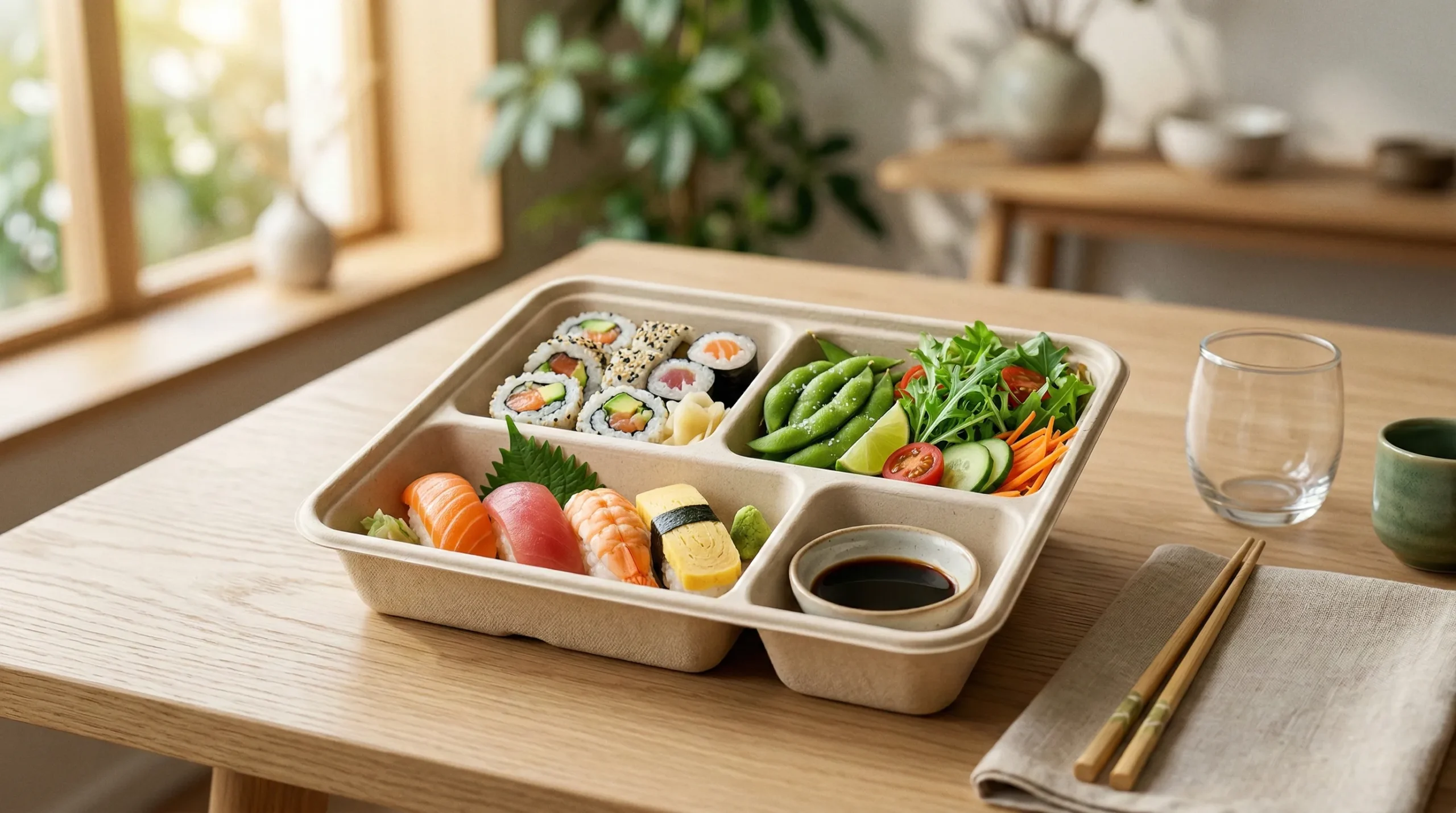
For takeaway meals, compare cajas bento against the actual menu and delivery conditions. Assess sauce cups separately from the main tray.
If customers will reheat the meal, require instructions for the exact container and lid. Do not infer microwave suitability from the PP resin code alone. Our guide to microwaving food in plastic containers explains the practical checks. For handling and lid selection, see our takeaway bento box guide.
Build a Product-Specific Compliance File
A supplier’s general certificate is a starting point, not a substitute for evidence covering the product you order. Ask for:
- A complete specification: SKU, dimensions, polymer grades, lid material, coatings, inks, adhesives, and intended use.
- U.S. compliance information: the regulatory basis and any restrictions relevant to each food-contact component.
- EU food-contact documents: an applicable Declaration of Compliance under the plastics rules and supporting migration evidence for the intended use.
- PPWR evidence: technical documentation and the applicable EU Declaration of Conformity addressing the requirements currently in force.
- PCR and PFAS records: supporting information for the exact claims made, not just a logo or marketing statement.
- Traceability and change control: batch identification and written notice before a material, additive, process, or supplier changes.
The plastics food-contact Declaration of Compliance and the PPWR Declaration of Conformity address different requirements. Check both where applicable. The plastics framework is set out in Regulation (EU) No 10/2011.
Also establish who acts as manufacturer, importer, and producer for each destination. EPR registration, reporting, fees, and representative requirements depend on the business’s role and the relevant market. Put these responsibilities in writing rather than assuming the factory or freight forwarder handles them.
A Practical 90-Day Supplier Review
Use this plan for new supplier qualification or to close gaps in an existing portfolio. It is a work plan, not a grace period. If a product fails a requirement already in force, address that problem before placing it on the affected market.
Days 1–30: Map Products and Documents
- List active SKUs, destination markets, food types, and contact conditions.
- Collect specifications, compliance declarations, test reports, and recycled-content records.
- Identify missing evidence and higher-risk coatings, additives, or material changes.
- Assign import, EPR, and documentation responsibilities.
Days 31–60: Resolve Testing Gaps
- Ask a qualified laboratory which tests the intended use and applicable rules require.
- Check that reports identify the correct product, test conditions, methods, and detection limits.
- Review PFAS evidence against all applicable limits, not total fluorine alone.
- Test lid fit, leakage, stacking, and reheating performance under realistic operating conditions.
Days 61–90: Approve Changes and Set Controls
- Replace or reformulate unsuitable products and verify the revised samples.
- Update specifications and affected declarations after relevant changes.
- Complete applicable registrations and agree ongoing reporting arrangements.
- Set incoming inspection checks and require supplier notification before future changes.
Preguntas frecuentes
Can the same container be sold in the U.S. and EU?
Possibly, but compliance in one market does not establish compliance in the other. Check the formulation, intended use, and documentation against both frameworks.
Does a food-contact test report prove microwave suitability?
Only if its scope and the supplier’s instructions support that use. A report for cold storage does not establish suitability for microwave reheating. Check the lid as well as the base.
When should a supplier update its documents?
When relevant changes to materials, production, intended use, or legislation affect the supporting information or compliance conclusion. Ask the supplier to identify what changed and which products it affects.
Should buyers choose mono-material packaging?
Consider it where it meets food protection and handling needs. Compare the full design and the destination recycling system. Mono-material construction alone does not prove food-contact safety, PFAS compliance, or recyclability.
Discuss Your Packaging Requirements with Manluen
Send Manluen your food type, filling temperature, storage conditions, reheating needs, destination market, and order quantity. Request a quote and ask which current specifications and supporting reports cover the proposed SKU.
You can review our certifications page y factory information as part of supplier qualification. For sourcing context, read our disposable bento box market article. Confirm product-specific claims before approving an order.

References
European Union. Regulation (EU) 2025/40 on Packaging and Packaging Waste.
Used for PFAS and heavy-metal limits, recycled-content targets, recyclability schedules, and packaging documentation requirements.
EUR-Lex
European Commission. Packaging Waste.
Used for the PPWR’s general application date and links to implementation guidance.
European Commission
U.S. Food and Drug Administration. Determining the Regulatory Status of Components of a Food Contact Material.
Used for U.S. food-contact regulatory bases and the scope of Food Contact Notifications.
U.S. Food and Drug Administration
U.S. Food and Drug Administration. Market Phase-Out of Grease-Proofing Substances Containing PFAS.
Used for the U.S. paper and paperboard phase-out and the 35 FCNs that became ineffective in 2025.
U.S. Food and Drug Administration
U.S. Food and Drug Administration. Recycled Plastics in Food Packaging.
Used for recycling-process reviews and the need to assess intended food-contact uses.
U.S. Food and Drug Administration
CalRecycle. Plastic Minimum Content Standards and Reporting (AB 793).
Used to distinguish California’s covered beverage-container requirements from general food-container sourcing.
CalRecycle
European Union. Regulations (EU) No 10/2011 and (EU) 2022/1616.
Used for the separate EU rules on plastic food-contact materials and recycled plastic food-contact materials.
Plastic food-contact materials
Recycled plastic food-contact materials

ManLuen Plastic Packaging Company, especializada en la producción de embalaje de alimentos de plástico durante más de 20 años. Nuestros productos están hechos de PP virgen y libre de BPA, cumpliendo con las normas de la FDA y europeas.
 ES
ES  EN
EN  ZH
ZH  FR
FR  PT
PT  KO
KO  JA
JA