
はじめに
A high-quality sushi container can improve product presentation, reduce damage, support faster packing, and make inventory easier to manage. Those operational gains can protect profit, but the package must match the food, sales channel, and handling conditions.
The goal is not to buy the most expensive tray. It is to choose a container that keeps sushi arranged and visible without adding unnecessary material, freight, storage, or labor costs.
This guide explains how restaurants, sushi shops, supermarkets, delivery businesses, and distributors can compare sushi containers and trays. It focuses on the factors that directly affect cost and performance: size, material, lid fit, stackability, carton efficiency, compliance, and supplier consistency.

How Sushi Containers Affect Operating Costs
Packaging cost is more than the price of one base and lid. A tray that cracks, opens, or lets food move can create remakes, refunds, wasted ingredients, and customer complaints. An oversized tray can increase material use, carton volume, storage demand, and freight.
The total cost includes:
- Container and lid purchase price
- Freight and import cost
- Warehouse and back-of-house storage
- Staff packing time
- Damage, leakage, and remakes
- Labels and tamper-evident seals
- Product waste caused by poor fit or weak protection
- Compliance testing and documentation
Use this simple comparison:
Total packaging cost = purchase cost + logistics cost + labor cost + expected failure cost + compliance cost.
This approach makes it easier to compare two trays with different unit prices. A slightly higher-priced container may cost less overall if it packs faster, stacks better, or reduces damaged orders.

Choose the Right Size Before Comparing Prices
The correct tray size depends on piece count, sushi type, arrangement, side items, and lid clearance. Measure the intended layout with the real food. Include ginger, wasabi, garnish, sauce containers, and labels.
An oversized tray may make a portion look sparse and allow pieces to move. A tray that is too small can compress toppings or make the package difficult to close. The sushi tray size and capacity guide explains how to match containers to 6-, 12-, 20-, 40-, and 100-piece assortments.
For medium portions, the WL-05 format provides a base measuring approximately 184×128×20 mm with a fitted lid around 188×132×31 mm. Manluen offers both a WL-05 Black Sakura sushi container and a WL-05 gold sushi tray for different display styles.
Do not approve the size from external dimensions alone. Ask for the usable internal area and test the actual arrangement.
Material Choice Must Follow the Application
Sushi containers may use PS, PP, PET, OPS, bagasse, kraft paper, or mixed constructions. These materials differ in clarity, rigidity, impact resistance, temperature limits, and end-of-life options.
The food packaging materials guide compares the main options in more detail. For sushi packaging, buyers should focus on chilled performance, lid visibility, base stiffness, closure, and local regulations.
| 素材 | Common Use in Sushi Packaging | What to Verify |
|---|---|---|
| PET | Clear lids and chilled display containers | Clarity, recycled-content basis, and temperature limits |
| OPS | Clear lids and display packaging | Cold impact strength, cracking, and destination-market restrictions |
| PS | Lightweight tray bases | Brittleness, heat limits, and local rules |
| PP | Tough bases and some prepared-food containers | Rigidity, clarity, and product-specific conditions of use |
| サバージェス | Molded-fiber tray bases | Grease resistance, PFAS status, lid fit, and composting access |
Do not call the entire sushi tray range microwave-safe. The base and lid may use different materials, and many clear lids are intended only for chilled display. Microwave suitability requires documentation for the exact finished package.

Use Packaging to Improve Presentation
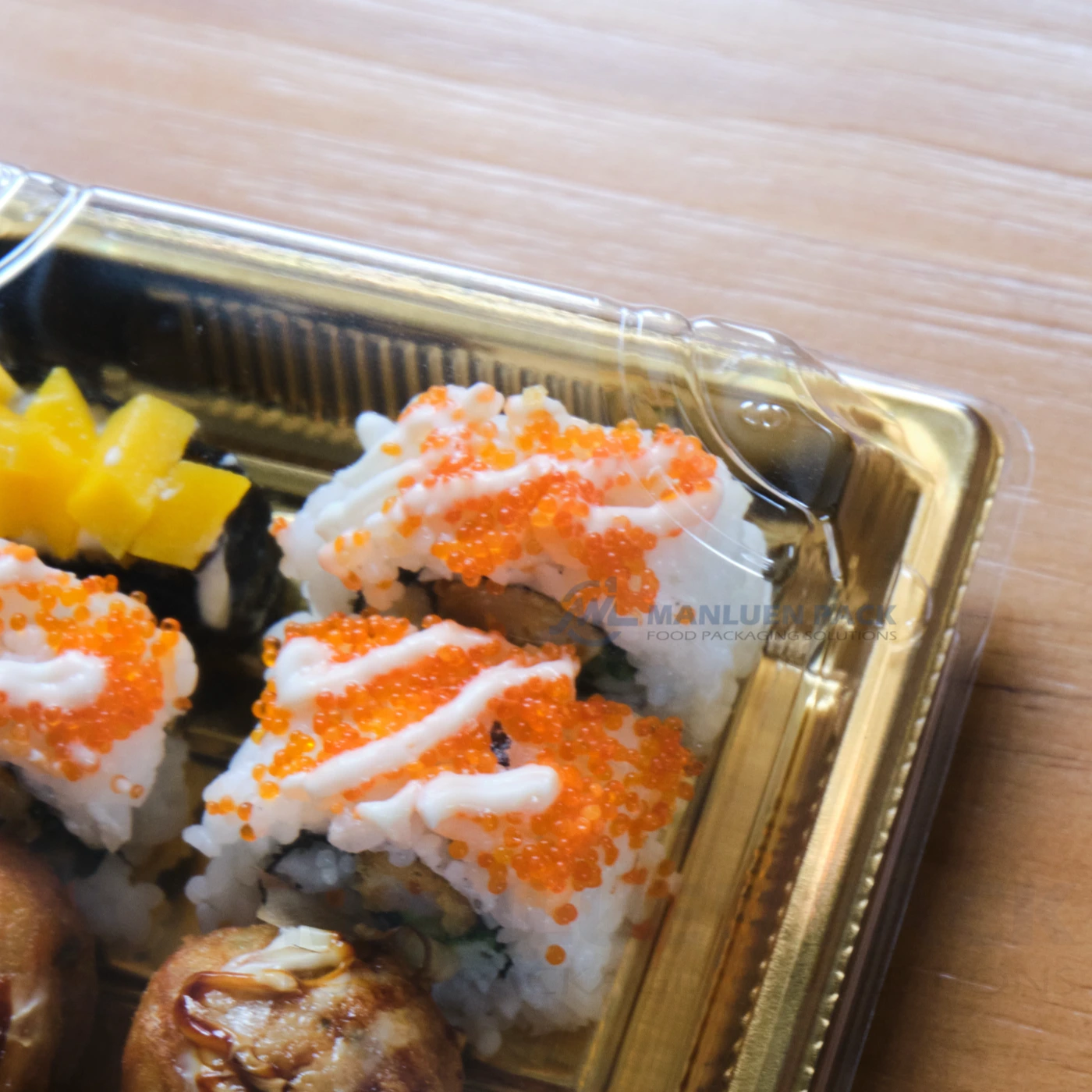
Sushi is a visual product. The tray color, lid clarity, base pattern, and arrangement affect how customers judge the assortment.
Use packaging to create a consistent presentation:
- Choose a base color that provides contrast with the food.
- Keep enough space between pieces to show the arrangement clearly.
- Use a clear lid that does not distort the product.
- Place labels where they do not cover the main display area.
- Use the same tray family across related portion sizes.
Decorative designs can help distinguish premium assortments, but they should not distract from the food. Test the filled package under the store’s actual lighting and after refrigeration.
The guide on improving supermarket food packaging with sushi trays provides more detail on retail presentation and prepared-food displays.
Match the Container to the Sales Channel
Restaurant takeaway
Restaurant takeaway packaging should close quickly, remain secure in a bag, and be easy for customers to open. Test the tray with sauce containers, chopsticks, napkins, and other order components.
If staff apply a security label, make sure it provides visible evidence of opening without weakening the lid. The guide to tamper-evident packaging explains the main options.
Delivery
Delivery adds vibration, tilting, stacking, and time inside an insulated bag. Test the container after the normal delivery period. Check whether pieces move, the lid loosens, condensation builds up, or labels peel away.
Pack several containers in the actual delivery bag. A strong individual tray can still fail if different package sizes stack poorly.
Supermarket and deli display
Retail containers need clear visibility, a stable shelf footprint, efficient stacking, and space for compliant labels. Test lid fogging and product movement after the complete display period.
The package should help staff rotate stock and identify sizes quickly. Similar tray dimensions with clear model codes can reduce picking errors and simplify reordering.
Catering and event trays
Large assortments require stronger bases and lids. Check lifting, stacking, and transport with the full food weight. The tray must remain stable when customers remove pieces from one side.

Test Before You Buy in Volume
Use the real food and workflow. An empty tray cannot show condensation, food movement, lid pressure, or label performance.
Run these checks:
- Measure the intended arrangement and fill weight.
- Pack the food at the normal preparation temperature.
- Close the lid using the normal staff procedure.
- Apply labels and seals.
- Refrigerate for the expected holding time.
- Stack and transport the package.
- Inspect fogging, cracking, lid fit, and food movement.
- Record staff time and any packaging failures.
Compare at least two sizes or constructions under the same conditions. This produces more useful purchasing evidence than a visual comparison of empty samples.
Manage Wholesale Purchasing and Inventory
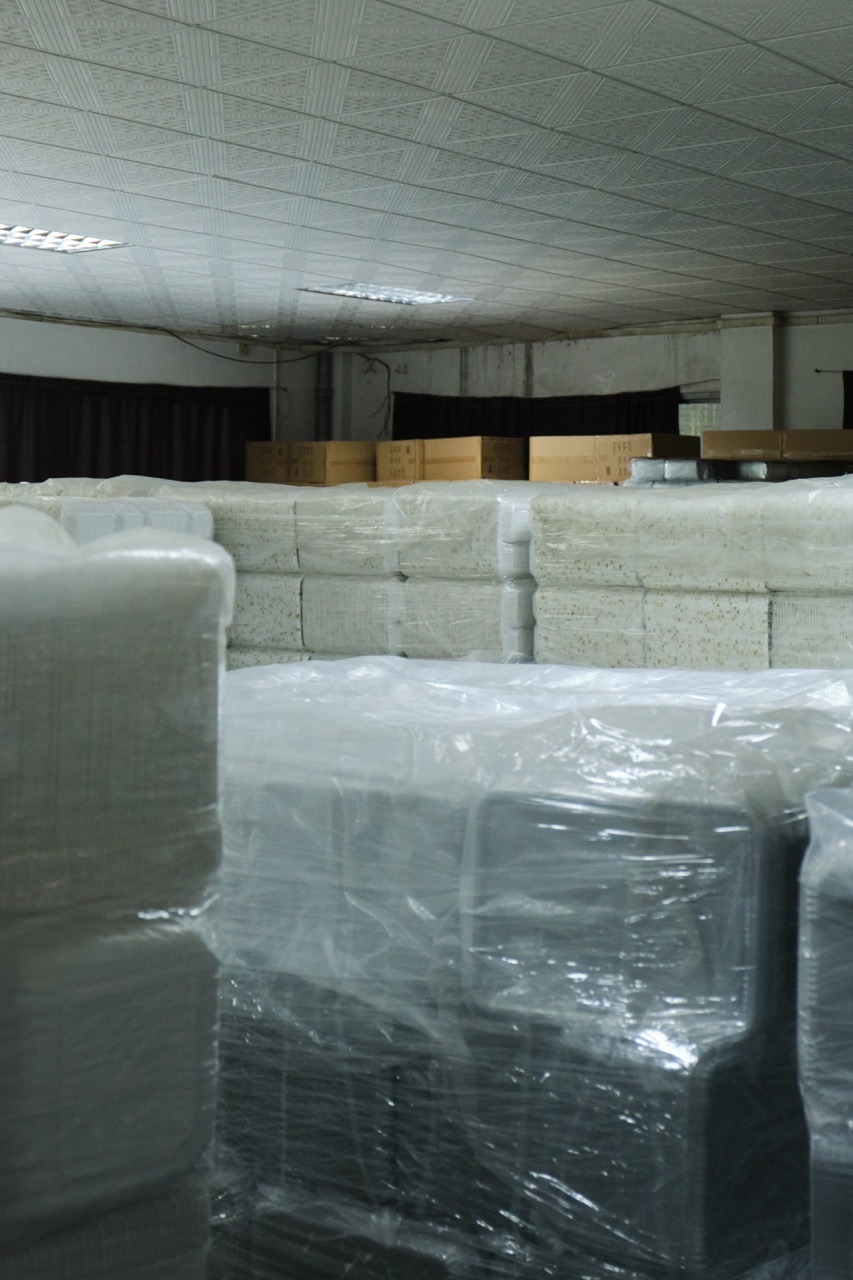
Bulk purchasing can reduce unit cost, but a large order also ties up storage space and cash. Before ordering, confirm:
- Units per carton
- Carton dimensions and volume
- Minimum order quantity
- Production and shipping lead time
- Monthly usage by tray size
- Safety stock requirement
- Custom-color or printing commitments
- Material and tooling change notification
Use sales data to set reorder points. Separate individual, medium, and family-size formats so slow-moving trays do not create excess inventory.
Customization can help brand recognition, but standard colors and sizes usually allow more flexibility. Confirm tooling, print setup, approval samples, and repeat-order conditions in writing.
Verify Food-Contact Compliance
A color, model number, or resin code does not prove that a finished package suits every use. The base and lid may use different materials. Inks, pigments, recycled content, and labels can add further considerations.
The FDA regulates food-contact substances according to their identity and intended conditions of use. Ask the supplier for documentation that identifies the exact product and material construction. Manluen’s guide to food-grade packaging explains the documents buyers should request.
For US and EU projects, the food packaging compliance guide covers regulatory basis, migration testing, PFAS, recycled content, and supplier declarations.
A basic file may include:
- A product-specific compliance statement
- Base and lid material specifications
- Applicable CFR, FCN, or other regulatory basis
- Migration testing where relevant
- PFAS, heavy-metal, and recycled-content statements when applicable
- Lot traceability and change-control records
Consider Sustainability Without Reducing Food Protection
Material reduction, recycled content, recyclable designs, and fiber-based trays can all play a role. The best option depends on the food, local waste system, and complete package.
The WL-05 bagasse sushi tray offers a molded-fiber base for buyers comparing alternatives to conventional plastic bases. It still requires evaluation of the lid, grease performance, PFAS status, certification, and local composting access.
Do not treat “plant-based,” “recyclable,” or “compostable” as a complete environmental assessment. The guide to sustainable food packaging trends explains how to compare material claims, food protection, and local infrastructure.

よくある質問
Can a better sushi container improve profit?
It can protect profit by reducing damage, remakes, packing delays, and poor presentation. The result depends on the actual failure rate, labor, sales channel, and price difference. Track these costs during a controlled trial rather than assuming a fixed percentage improvement.
Are WL-05 sushi containers microwave-safe?
Do not assume the entire WL-05 range is microwave-safe. Material options can vary between the base and lid. Use a container in a microwave only when the supplier documents that exact construction for the intended heating conditions.
How many sushi container sizes should a business stock?
Stock enough sizes to cover the main portion groups without creating slow-moving inventory. Many businesses can organize the range around individual, medium combination, and large sharing portions, then add a specialty size only when sales justify it.
Should I choose plastic or bagasse sushi trays?
Plastic may provide stronger clarity, low weight, and familiar chilled-display performance. Bagasse offers a fiber-based appearance and may suit certain sustainability goals. Compare the complete base-and-lid package, food protection, certifications, local collection, and cost.
What information should I send when requesting a quote?
Provide the model or required dimensions, sushi piece count, base and lid material, color, monthly or annual quantity, destination market, customization needs, and required compliance documents. Submit these details through Manluen’s request-a-quote form.
結論
A high-quality sushi container can protect food, improve display, support faster packing, and reduce avoidable failures. Profit improves when the complete packaging system costs less to operate—not simply when the unit price is lowest.
Choose the tray by testing the real food, portion, lid, label, refrigeration, stacking, and delivery conditions. Compare total cost, verify food-contact documents, and confirm wholesale terms before committing to a large order.
References
U.S. Food and Drug Administration (FDA). Packaging & Food Contact Substances.
Used for the US regulatory framework covering substances that contact food and their intended conditions of use.
U.S. Food and Drug Administration
U.S. Environmental Protection Agency (EPA). Recycling Basics and Benefits.
Used for the role of local collection and processing systems when evaluating packaging recovery.
U.S. Environmental Protection Agency

マンルエンプラスチック包装有限公司は、20年以上にわたりプラスチック食品包装の製造を専門としています。当社の製品は、100%のバージン素材とBPAフリーのPP、PS、OPSを使用し、FDAおよびヨーロッパ基準に準拠しています。
 JA
 EN
 ZH
 FR
 PT
 ES
 KO